The government’s recent removal of taxes on packaging materials, coupled with the VAT exemption on value-added tea, is already revitalizing Kenya’s tea industry — boosting competitiveness, lowering production costs, and encouraging more factories to package and brand tea locally.
The reforms are part of a broader strategy by the Ministry of Agriculture and Livestock Development to enhance value addition and strengthen Kenya’s position in the global tea market.
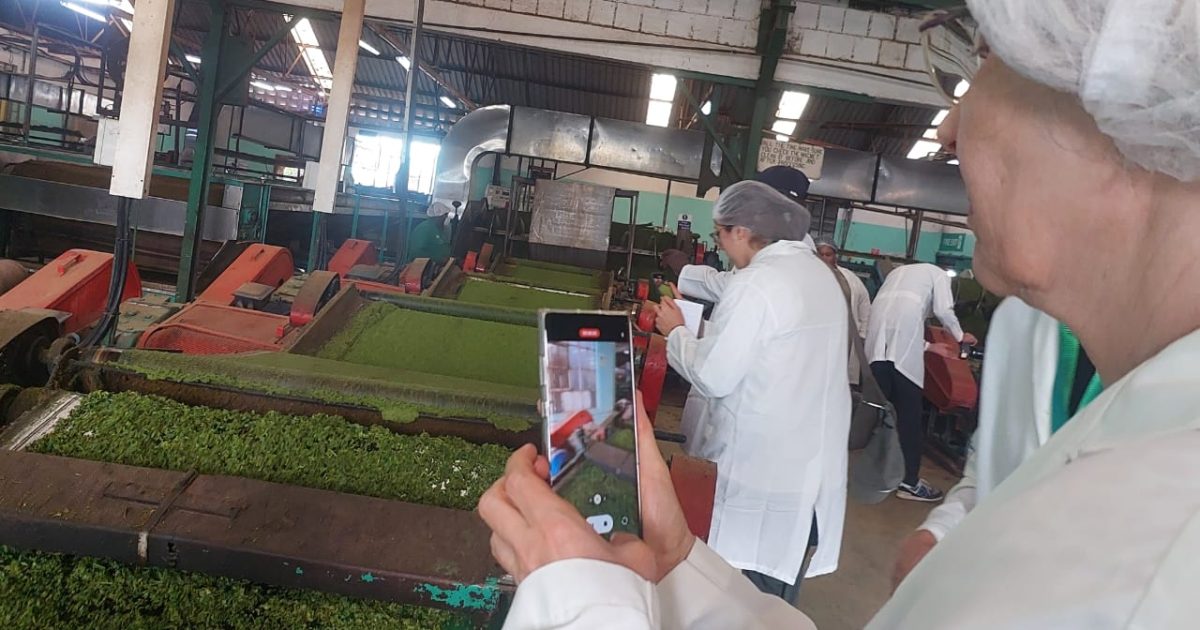
Among the first to experience the benefits is Ngorongo Tea Factory in Kiambu County, a leading processor producing Cut, Tear and Curl (CTC) teas under the Kenfresh brand for both local and export markets.
Speaking during a visit by delegates attending the 2025 International Federation of Agricultural Journalists (IFAJ) World Congress, held from October 15 to 18, Ngorongo’s Business Analyst Moses Oresia said the reforms will make value addition more viable for local processors.
“We produce about 18,860 kilograms of tea daily — roughly 3.7 million kilograms annually,” said Oresia. “Previously, most of it was exported in bulk, but with the new reforms, we can now package more tea in smaller retail units. This will expand our market and help both smallholder and large-scale farmers secure better prices.”
Established in 1965, Ngorongo Tea Factory works with farmers owning between five and fifty hectares and employs over 200 workers.
Oresia said the new tax policy and VAT exemption will enable more factories to deliver direct-to-shelf, traceable products that meet global standards.
“Packaging at source allows us to deliver fresher, traceable tea to global shelves while empowering smallholder farmers,” he added.
In September 2025, Agriculture and Livestock Development Cabinet Secretary Mutahi Kagwe announced the tax reforms during the North America Tea Conference in South Carolina.
“By packaging at origin, we eliminate unnecessary costs, improve competitiveness, and strengthen Kenya’s position in the global tea market,” said Kagwe adding: “These reforms will make it easier and more profitable for Kenyan producers to meet international packaging standards.”
The new policy removed a 25 percent excise duty on kraft paper and other packaging materials that had significantly raised production costs under the 2025 Finance Act. Industry data shows packaging accounts for up to 40 percent of the retail cost of tea, making the reforms a major relief for exporters and processors.
Beyond traditional teas, Ngorongo is now diversifying by collaborating with local producers of rosemary, stinging nettle, and other indigenous herbs to develop herbal infusions that target the growing health-conscious market.
“This diversification opens up new income opportunities for farmers and strengthens rural value chains,” said Godfrey Kihiu, the factory’s Assistant Production Manager.
Shift in-charge Alice Wanjiku added that value addition goes beyond profitability. “We want every cup of Kenfresh tea to tell a Kenyan story — of the farmer, the land, and the care that goes into each leaf,” she said.
The visit to Ngorongo Tea Factory was part of a series of 13 field tours organized across Nairobi, Kiambu, Murang’a, Nakuru, and Kajiado counties, where more than 250 agricultural journalists from 40 countries explored Kenya’s innovation, sustainability, and value-chain excellence. The congress was hosted by the Media for Environment, Science, Health and Agriculture (MESHA).
“It’s incredible how clean and well-organized the process is,” said one delegate from Germany. “From plucking to packaging, the precision reflects Kenya’s commitment to quality.”Kenya remains the world’s leading exporter of black tea, producing nearly 600 million kilograms annually, with more than 90 percent destined for international markets.
In 2024, tea exports earned the country Sh181 billion, with key destinations including Pakistan, Egypt, and the United Kingdom. The sector supports an estimated 6.5 million Kenyans directly and indirectly, contributing about two percent to the national GDP.
With the new packaging reforms now in effect, the benefits are already visible, from reduced production costs to greater investment in local branding and innovation. As factories like Ngorongo continue to embrace value addition, Kenya’s tea industry is entering a new era of competitiveness, sustainability, and farmer-centered growth.
By Violet Otindo