Regional peace and security have been termed as a key driver of integration and trade for the Common Market for Eastern and Southern Africa (COMESA).
The bloc has stood as a beacon of regional integration and economic cooperation in Africa since its inception 30 years ago.
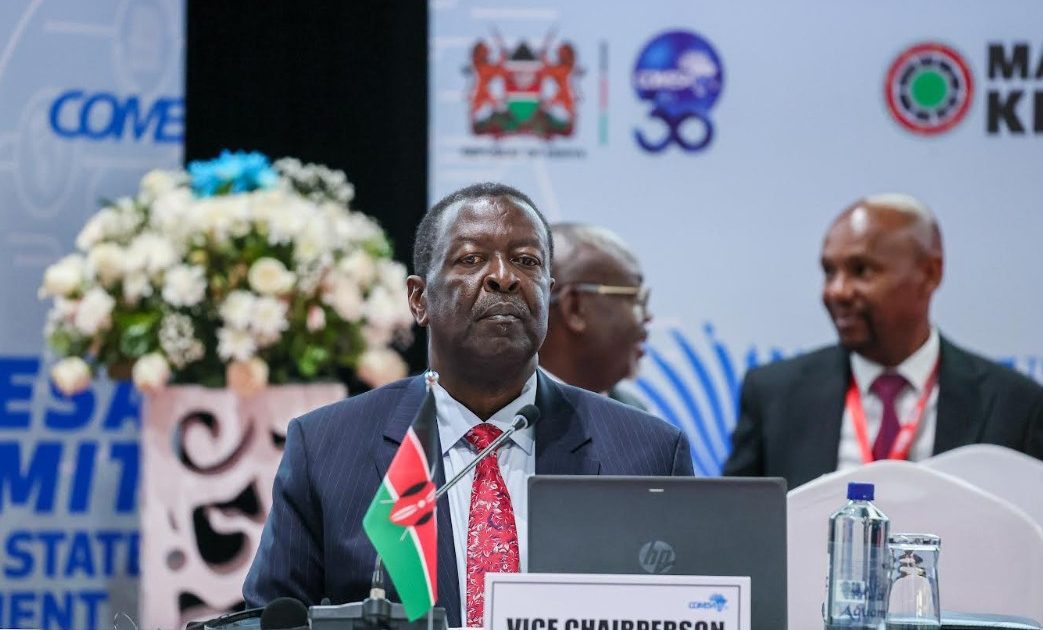
Prime Cabinet Secretary (PCS) and Cabinet Secretary for Foreign and Diaspora Affairs, Musalia Mudavadi, said that the regional bloc has established itself as one of Africa’s most ambitious and successful models of regional cooperation.
Mudavadi said that by promoting free trade, harmonising policies, and strengthening connectivity, COMESA has not only advanced economic integration but also demonstrated the power of collective action in building resilience.
He explained that Kenya, in 2024, exported to the COMESA region goods worth over USD$ 2.2 billion, underscoring the growing importance of regional trade to economic development.
“Yet, economic prosperity cannot be sustained without peace, stability and secure borders. The promise of integration faces pressing realities: persistent conflicts, political instability, terrorism, organised crime, cyber threats, climate-related insecurity, fragile governance systems, humanitarian crises, and other emerging threats that strain our collective capacity and ambition,” said Mudavadi.
Speaking in Nairobi on Wednesday, during the 20th Ministerial Meeting of COMESA Ministers of Foreign Affairs, Mudavadi said borders that should unite people as gateways for trade have instead become flashpoints of insecurity, with trade corridors being disrupted, infrastructure destroyed, mobility restricted and markets rendered inaccessible.
He explained that the Meeting of COMESA Ministers of Foreign Affairs takes place at a defining moment for the region and continent, when the imperatives of solidarity, innovation, and collective action have never been greater.
Mudavadi regretted that the results of the conflicts have been billions lost in trade opportunities, diminished investor confidence, and a devastating loss of lives and livelihoods.
“Armed conflicts in Africa are estimated to cost the continent at least USD$ 18 billion annually, with the African Union placing the figure closer to USD $50 billion, once indirect costs such as health crises, education setbacks and capital flight are included,” said Mudavadi.
He added that the African Development Bank further underscores that annual economic growth in conflict-affected countries was, on average, 2.5 percentage points lower than in relatively stable counterparts, compounding into massive long-term losses in income, investment and human development.
Mudavadi said that the human toll, coupled with mounting debt and disruptions to trade and investment, undermines continental aspirations for stability and prosperity.
“These realities underscore the urgency of enhancing COMESA’s role, not only as a driver of integration but also as a platform for dialogue, preventive diplomacy, and coordinated action in addressing the root causes of insecurity,” he stressed.
Mudavadi said that the meeting is taking place against the backdrop of profound shifts in the global order, where uncertainty and fragmentation increasingly shape international relations.
He said that as Foreign Ministers, they bear the responsibility of charting pathways that strengthen the bonds of unity within COMESA, while positioning the region as a dynamic and competitive actor in the global arena.
“Those of us who followed the recent deliberations during the High-Level Session of the 80th United Nations General Assembly can attest that regionalism has re-emerged as a critical pillar for resilience, offering Africa and COMESA in particular a platform to safeguard our shared interests, amplify our collective voice, and drive sustainable development and peace in an era of global volatility,” he said.
He highlighted that at a time when global supply chains are under pressure and protectionism is on the rise, COMESA offers the region a unique opportunity to deepen intra-African trade, foster innovation, and accelerate industrial transformation in line with the African Union Agenda 2063 and the African Continental Free Trade Area (AfCFTA).
“Africa must also position itself as a decisive geopolitical and geo-economic actor, capable of shaping its own development path. The Continent faces an annual financing gap estimated at between USD130 and USD170 billion for infrastructure, energy and industrialisation while continuing to bear the burden of disproportionately high borrowing costs on international debt markets,” explained Mudavadi.
He explained that this reality demands a bold shift in Africa’s financial architecture, with the proposed establishment of an African Credit Rating Agency, the operationalisation of the African Monetary Fund, advocacy for enhanced allocation of Special Drawing Rights (SDRs) to Africa, and the development of innovative capital-raising mechanisms being essential steps toward reshaping Africa’s financial architecture.
According to Mudavadi, unlocking the estimated USD 2.1 trillion of assets under the management of African pension funds, insurance companies and sovereign wealth funds will be critical to mobilising resources for the continent’s transformation and sustainable development.
He highlighted the need for advancing a new industrialisation paradigm that prioritises value addition, energy sovereignty and intra-African supply chains.
Mudavadi said that Africa must move beyond its historical role as a supplier of raw commodities by investing in strategic hubs for refining and processing critical minerals, such as lithium, cobalt, and rare earths.
The PCS said that industrialisation cannot occur without energy, making expanded investment in renewable and natural gas resources indispensable.
Mudavadi said that for Kenya, hosting this gathering is both a privilege and a reaffirmation of the country’s unwavering commitment to COMESA’s objectives, adding that Kenya believes that true integration must go beyond policy frameworks to deliver real impact for people through the free movement of goods, services, capital and persons, and through stronger coordination in peace, security and diplomacy.
“Our decision as Kenya to embrace a visa-free policy for all Africans reflects the conviction that the dismantling of barriers and the expansion of opportunities will unleash the full potential of our region. It is through such practical, people-centred measures that COMESA can deepen trust, expand markets and build a resilient community of nations, bound by shared prosperity and solidarity,” said Mudavadi.
The PCS challenged the regional bloc to go beyond declarations to actionable commitments that enhance trade facilitation, promote regional peace and security, and accelerate the free movement of people and goods across our borders.
“By setting clear priorities, aligning our efforts and holding ourselves accountable, this Ministerial Meeting can mark a decisive step in reaffirming COMESA’s leadership in advancing Africa’s integration and development agenda,” said Mudavadi.
“Kenya reaffirms its unwavering commitment to work with all Member States and the COMESA Secretariat to unlock our region’s immense potential for prosperity, resilience and shared progress built by Africans for Africans. We hold the power to transform COMESA into Africa’s unbreakable shield of peace and engine of prosperity,” Mudavadi said.
By Joseph Ng’ang’a