Agriculture and Livestock Development Cabinet Secretary, Mutahi Kagwe, has today issued a raft of measures intended to safeguard the benefits of Kenya’s macadamia sector.
According to the Macadamia Association of Kenya (MACNUT) Chair, Jane Maigua, harmful pesticides and aggressive pest attacks are destroying up to 40 percent of the national macadamia production, an economic blow valued at Sh2.88 billion each year.
Flanked by Pyrethrum Processing Company of Kenya (PPCK) Acting CEO, Njoroge Wachira, and the CEO of Pest Control Products Board (PCPB), Fredrick Muchiri, Maigua told the CS today that farmers are suffering unprecedented crop losses as destructive pests, now more widespread due to climate change, attack flowering nuts, bore into kernels causing severe leaf damage, and trigger widespread premature nut drop.
During a high-level meeting at the Agriculture CS office, Kagwe directed AFA, KEPHIS, PCPB, and county governments to intensify farmer sensitization through radio programs and field extension services.
The CS also advocated for promote integrated pest management practices, reduce
reliance on imported synthetic pesticides, and adopt safer, residue-compliant solutions that protect Kenya’s premium export markets.
“There is a need to rebuild the country’s pyrethrum value chain so that local farmers and processors such as PPCK can offer reliable, affordable pest control alternatives that protect both yields and market standards,” he reiterated.
He further issued strict instructions on protecting the intellectual property of the PPCK, noting that any private company using their scientific formulation data must pay for access or have their letters of access withdrawn immediately.
Kagwe emphasized that PPCK’s scientific data is a valuable national asset and a potential revenue stream that must be safeguarded as the country strengthens its domestic pesticide solutions.
MACNUTs Chair, Maigua explained that Kenya produces 45,000 metric tons of macadamia annually, with 44,100 MT being marketable, yet 17,640 MT are lost to insect damage, including 2,222.64 MT of high-value exportable kernels, translating into billions in lost revenue.
She noted that the industry also spends heavily on electricity and labor at processing facilities as workers sort out insect-bitten nuts, further compounding the economic burden.
According to KEPHIS, stink bugs are the most destructive threat, followed closely by nut borers, lace bugs, moths, rats, and thrips, confirming that climate change has intensified these attacks, making existing chemical pesticides both ineffective and risky due to the danger of surpassing international residue limits.
The PCPB CEO Fredrick Muchiri outlined a legal emergency provision that allows the swift authorisation of organic and pyrethrum-based pest control products.
He confirmed that once PPCK and KEPHIS identify the specific pest pressure, the Board can immediately approve emergency-use options, conduct local efficacy trials, determine scientific application rates, and work with county teams to sensitise farmers on proper use to avoid export-threatening residue violations.
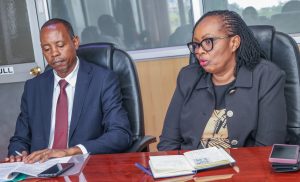
Muchiri assured the CS that pyrethrum-based products would be fast-tracked as long as they meet efficacy and safety requirements, underscoring the importance of shifting away from over-dependence on imported chemical pesticides, now exceeding 20 million kilograms annually.
This discussion comes after, three days ago on Tuesday, the CS met with the senate to deliberate on the leasing of the Pyrethrum Processing Company of Kenya (PPCK), where the CS revealed that the PPCK’s current financial performance was unsustainable, as the organisation is generating only Sh35 million annually, its best being Sh60 million.
“The agency not only lacks adequate resources to run its operations but has also received no allocation for research, a critical component for reviving the pyrethrum value chain. There is simply not enough money to sustain the organization itself,” Kagwe told Senators, emphasising that the current structure cannot deliver the sector’s revival.
Kagwe had further disclosed that farmers are owed Sh10 million for deliveries made in August, September, and October, funds that the government has committed to settle immediately.
However, he underscored that PPCK’s main obstacle is a staggering debt portfolio of Sh 3.5 billion, owed to suppliers and in staff pension arrears.
With the leasing model now on the table, Kagwe explained that the government, however, must first clean up PPCK’s balance sheet, undertake a fresh valuation of its assets, and ensure due diligence before a private operator can take over.
He stressed that the Cabinet’s approval will unlock a long-term, sustainable structure that mirrors successful models in competitive private industries.
During his broader submission to the Senate, Kagwe detailed the Ministry’s ongoing interventions across the pyrethrum value chain, including distribution of clean planting materials, expansion of extension services, and alignment of production standards with international regulatory requirements to secure export markets.
By Wangari Ndirangu