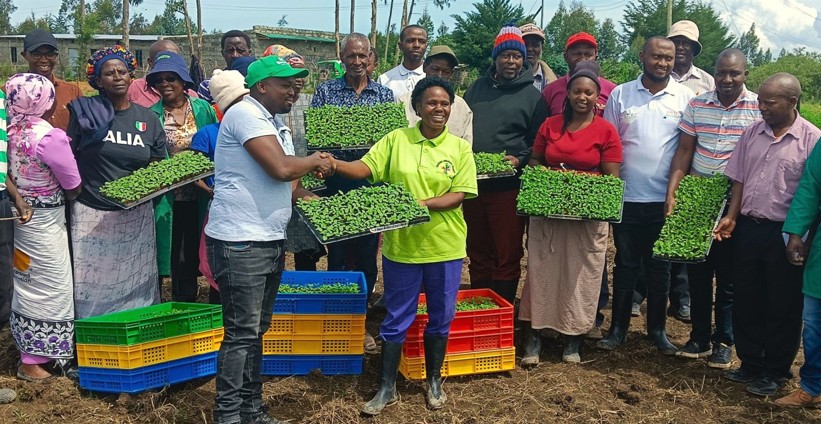
Over 100,000 potato farmers and stakeholders from Nakuru and Nyandarua counties are benefiting from the new potato Roots Apical Cutting (RAC) technology, courtesy of a joint initiative by government agencies and a consortium of research institutions that have been developing and distributing high-quality and affordable potato apical tissue seed.
The programme, being implemented by the Association for Strengthening Agricultural Research in Eastern and Central Africa (ASARECA) in partnership with the Kenya Agricultural and Livestock Research Organisation (KALRO) and Egerton University, has also incorporated farmers from Marishioni ward within Molo constituency and the Murungaru area in Nyandarua county, the leading potato-producing areas.
The targeted beneficiaries within Nakuru and Nyandarua counties are said to be members of cooperative societies and will include farmers, agro-input dealers, ward agricultural officers, seed multipliers and village-based agents, who have been working with KALRO and Egerton University under the technology Transfer through Innovation Systems dubbed, Enhancing Smallholder farmers’ capacity for profitable and sustainable potato production” project.
The Programme Officer for Agricultural Technology and Innovation at ASARECA Dr. Joshua Sikhu-Okonya, who spoke ahead of a potato seed distribution exercise in Nakuru, said the apical cuttings were more desirable as a source of disease-free seed and had no degeneration of genes, which assured the quality of tubers.
“Genetically, these cuttings produce high-quality crops with a high survival rate,” he assured.
The Programme Officer said they were supporting the targeted farmers and other stakeholders to establish demonstration plots using Roots Apical Cutting (RAC) technology to help multiply the market-demand-driven potato varieties to members of potato cooperatives and innovation platforms in Nakuru and Nyandarua counties.
Dr. Okonya, who is also coordinating the regional initiative, said the programme was meant to scale up the production of quality seed and eventual uptake of the new technology on an industrial scale.
He announced that they had organised a farmer field day on August 12 this year that will also involve dissemination of Potato Rooted Apical Cuttings Technology to be held at Marishioni Trading Centre in Nakuru County.
He stated that under the programme, some 26,000 farmers received their preferred potato seed varieties, including ‘Shangi’, ‘Unica’ and ‘Wanjiku’, in May this year, adding that 200 bags of fertiliser and assorted pesticides were also distributed to farmers and stakeholders in the two counties.
Other partners involved in the implementation of the initiative include the Strengthening Agricultural Knowledge and the Innovation Ecosystem for Inclusive Rural Transformation and Livelihoods in Eastern Africa (AIRTEA) project, the National Potato Council of Kenya (NPCK), Comprehensive Africa Agriculture Development Programme ex-Pillar 4 (CAADP XP4 Project), the European Union, International Fund for Agricultural Development (IFAD) and Farm Input Promotions Africa (FiPS-Africa).
Dr. Okonya said the project was also rooting for climate-smart agriculture to boost potato production in Kenya and to help potato farmers reduce production costs and boost their incomes.
According to the Program Officer, the RAC technology, also known as tissue culture, involves taking cuttings from healthy potato plantlets grown in controlled environments like screenhouses or greenhouses, where the cut plant tissues or organs are subsequently cultivated in a lab and thereafter the resulting plantlets or mini-tubers are transplanted into fields.
He further explained that the technology allows for the production of disease-free and high-yielding potato planting material and that the tissue cuttings were similar to nursery-grown seedlings, except that they are produced through vegetative means and do not originate from a seed.
“The cuttings are produced from tissue culture plants in the greenhouse, rather than tubers and after they produce the roots, they can be planted in the field,” he elaborated.
Dr. Okonya said that each cutting produces seven to 15 tubers, which are further multiplied for one or two seasons then distributed as seeds to farmers.
The cuttings, he added, multiplies rapidly and potatoes produced per plant are also more compared to tuber seedlings, which increases yield significantly compared to traditional seed potatoes.
At the same time, Dr. Okonya explained that the initiative was aligned with climate-smart innovations and technologies that are geared towards cushioning farmers against climate change challenges like drought, floods, diseases and pests.
“Our objective is to promote sustainable potato production through the adoption of climate-smart potato farming practices, Good Agricultural Practices (GAP), the use of certified seeds and the promotion of climate-smart agriculture technologies and innovations,” he said.
According to Biometrician Scientist at KALRO Dr. Elias Kamau, one of the main challenges that farmers were facing in Kenya was access to quality potato seed.
He said that while saying that poor seed leads to poor harvest, on the contrary, quality seeds had the potential of increasing yield by 50 percent.
Dr. Kamau assured that as a consortium they were providing high-quality seed certified by the relevant authorities to help improve yields.
The Biometrician Scientist indicated that they were also setting up demonstration plots to showcase the RAC technology’s effectiveness in addition to encouraging use of climate-smart agricultural practices, including development and use of drought- and heat-tolerant potato varieties, finding use for waste products from potatoes, training on the costs and benefits of crop insurance, reduction of post-harvest losses through support of agricultural machinery and adoption of biological pesticides.
ASARECA Programme Officer for Policy Julian Barungi noted that by working with researchers and development agencies, the farmers in Nakuru and Nyandarua were refining and embracing the technologies and contributing to national and global development goals through agricultural innovation.
Ms. Barungi said the consortium partners were also providing farmers and value chain stakeholders training on the benefits of RAC for seed production and on good agronomic practices for seed potato production.
This is in addition to practical demonstration sessions and actual establishment of potato plots of identified varieties using RAC in farmers’ fields.
“Our ultimate goal is to translate the information, knowledge and new technologies into increased incomes for smallholder farmers and alleviate poverty,” she added.
The potato sub-sector supports 3.8 million people directly and indirectly, with The National Potato Council of Kenya putting its worth at over Sh50 billion.
The Alliance for a Green Revolution (AGRA) reports that, on average, only about 20 per cent of farmers in Africa use seeds of improved varieties, while statistics from the Kenya Plant Health Inspectorate Service (KEPHIS) show that over 800,000 Kenyans are directly engaged in potato production.
Another 2.5 million people are in the potato value chain, with an annual potato production of 2.06 tonnes worth Sh10 billion at the farm gate and Sh28.2 billion at the consumer level.
The National Potato Council of Kenya states that an estimated 160,000 hectares (395,368 acres) are under potato farming, with 83 per cent of this being grown by smallholder farmers.
There are 13 major potato-producing counties in Kenya including Nyandarua, Meru, Nyeri, Kiambu, Taita Taveta, Nakuru, Narok, Bomet, Elgeyo Marakwet, Trans Nzoia, Bungoma, Uasin Gishu and West Pokot.
Other potato-producing counties include Kisii, Nyamira, Kirinyaga, Murang’a, Baringo, Nandi, Laikipia and Kericho.
The upcoming potential potato-producing counties include Machakos, Makueni, Embu, Kajiado, Tharaka Nithi, Samburu, Kwale and Nairobi.
Meanwhile, the leading production counties are Nyandarua at 29.8 per cent, as well as Nakuru and Elgeyo Marakwet at 18.9 and 16.2 per cent, respectively,” according to KEPHIS.
By Esther Mwangi