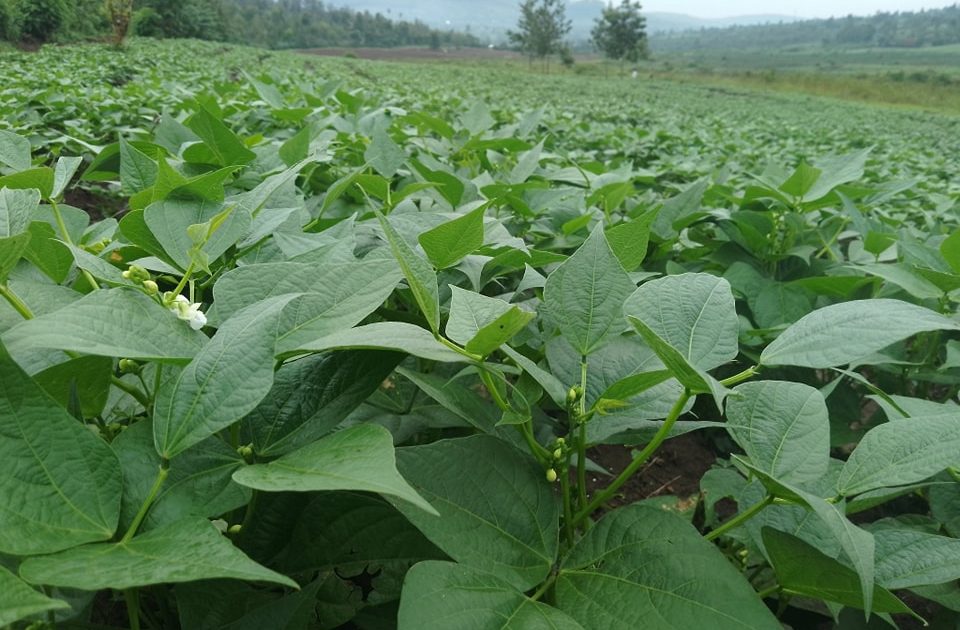
In the heart of Kipsimatia Village, Marakwet West Sub-County, 27-year-old Monica Jerono is redefining rural livelihoods through commercial horticulture.
Standing between meticulously cultivated rows of French beans, she represents a new generation of young farmers treating agriculture not as subsistence, but as an enterprise.
Jerono’s agricultural journey began against a backdrop of limited employment opportunities. For years, she relied on irregular casual work in town, an unstable income source that left her unable to meet basic family obligations. Farming, in her mind, was synonymous with survival rather than prosperity.
Her perspective shifted after attending a training facilitated by agricultural extension officers, borrowing heavily from Farm Africa’s agribusiness model.
The sessions introduced her to market-driven production systems, emphasising crop diversification, adherence to export standards, and the potential of horticulture as a reliable source of income.
“I realised that farming could be structured like a business,” she recalls, adding, “Through training, I learned how to manage crop cycles, control pests, and handle post-harvest produce in line with buyer requirements.”
Jerono mobilized limited capital through a women’s savings group to acquire certified seed, fertilizer and pesticides.
She prepared a quarter-acre plot using recommended agronomic practices, ensuring proper spacing, soil fertility management, and integrated pest control.
Within weeks of planting, the field exhibited vigorous growth, and her first harvest was channeled through a local cooperative linked to export markets.
The returns were transformative and Jerono was able to pay her brother’s school fees and reinvest in small livestock, signaling her transition from subsistence to agribusiness.
“For the first time, I felt independent. I had something of my own that I could grow and control,” she says with conviction.
Today, Jerono operates as part of a structured producer group, where farmers pool resources for inputs and irrigation.
This collective model reduces production costs, enhances bargaining power, and ensures compliance with stringent market standards.
Beyond financial gains, the cooperative framework has exposed her to climate-smart technologies such as drip irrigation, which she plans to adopt to mitigate rainfall variability.
Her role has also evolved into that of a peer mentor. Other young women in Kipsimatia regularly visit her farm for practical demonstrations on land preparation, crop husbandry, and post-harvest handling.
“French beans demand precision and consistency,” she explains, adding, But when managed well, they can provide sustainable livelihoods for youth.”
However, challenges persist including market price fluctuations, limited access to affordable credit and unpredictable weather patterns continue to affect smallholder horticulture.
However, Jerono remains optimistic, framing these not as deterrents, but as drivers for innovation and adaptation.
She envisions scaling up to two acres, adopting advanced irrigation systems and eventually venturing into direct export.
According to Raymond Cheboi, an agricultural extension officer, Jerono’s story underscores the shift toward agribusiness among rural youth.
“She demonstrates that farming, when integrated into structured value chains, can generate meaningful employment and income. This is the direction agriculture must take,” he affirms.
As dusk settles over the fertile fields of Kipsimatia, Jerono inspects her crop one last time, ensuring that pods meet market specifications.
For her, each harvest is not only a source of income but also proof that the transition from casual labour to agribusiness is achievable.
Her journey reflects a broader transformation in Marakwet West, where young people are beginning to recognise that agriculture, anchored in technical knowledge and market linkages, can deliver dignity, sustainability and a future worth cultivating.
By Rennish Okong’o