Africa has taken a bold leap towards achieving its education transformation goals with the official launch of RESPECT, a new Digital Public Infrastructure (DPI) for Education.
The platform was unveiled during the STEMtastic Adventures! Africa 2025 Symposium at the Centre for Mathematics, Science and Technology Education in Africa (CEMASTEA) in Karen, Nairobi.
Developed by the Spix Foundation, RESPECT is designed to make it easier for African Ministries of Education and EdTech stakeholders to align with AUDA-NEPAD’s Africa EdTech 2030 Vision and Plan, which calls for every African student to have access to high-quality, interactive digital courseware developed in Africa by Africans.
Speaking during the launch, John Kimotho, EdTech Consultant, Spix Foundation, and Head of the RESPECT Africa Office, said the platform solves long-standing structural problems in EdTech development.
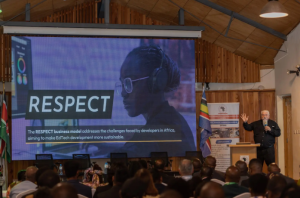
The EdTech expert emphasised the importance of RESPECT’s app integration, noting, “Much of EdTech is pilot-driven and disconnected from education systems, leaving developers without clear growth pathways and teachers with tools that don’t last.” adding that “RESPECT makes it easier for policymakers, educators, and developers to build solutions that align with real classroom needs and can grow and last.”
Kimotho assured the delegates that with the release of RESPECT Version 1, Africa is now taking the lead in the global conversation on educational digital public infrastructure (DPI).
“Every African student should have access to the world’s best interactive digital courseware, developed in Africa by Africans, on smartphones already in their pockets, homes, or schools,” proposes the AUDA-NEPAD Vision.
While institutions such as the United Nations have only recently begun discussing the need for such infrastructure, Africa has already implemented one, positioning the continent to fast-track inclusive, scalable digital learning models.
The launch comes as AUDA-NEPAD released new data showing that only 40 per cent of African primary schools have internet access, 30 million children of primary-school age remain out of school, and the continent will require an additional 17 million teachers by 2030 to maintain universal access.
The experts argued that, despite billions invested in EdTech, most solutions remain unsustainable, fragmented, and limited to short-term pilot projects.
Kimotho noted that RESPECT aims to turn that around by offering an interoperable, policy-aligned system that rewards scale and relevance.
Africa has a unique opportunity to simultaneously drive access to free localised EdTech solutions that can reach all parts of the education ecosystem, even those offline, while making it profitable and sustainable to develop the world’s best interactive digital courseware right here in Africa, added Kimotho.
He said the system has been failing the innovators, not the other way around, but assured delegates that RESPECT will make it easier for developers to deliver the solutions Africa’s children truly need.
The analysis by the mEducation Alliance shows the scale of the fragmentation problem, as developers have to navigate different rules, requirements, and procurement protocols in nearly every African country, resulting in what researchers ’term “small-batch deployment”.
The experts argue that whilst Africa has produced world-class educational technology, from Kenya’s classroom management systems to Senegal’s Wolof-language XamXam platform, serving 1.2 million users, these innovations remain largely isolated within their countries of origin.
Teachers are experiencing ‘tool fatigue’ from juggling multiple siloed applications with no central access or data integration, the Alliance noted in its 2024 report. This discourages adoption, even when individual apps are excellent.
To solve the problem, AUDA-NEPAD’s Vision and Plan identifies two root causes: Lack of real-time data on what works for which learners and systemic barriers to scale.
According to the Vision and Plan, “AUDA-NEPAD observes that if Africa solves these two problems by making it easy for courseware to generate real-time data for ranking and research and by lowering policy, technical, and commercial barriers, then market forces will do the rest.”
And that all RESPECT Compatible apps transmit anonymised data on learner-app interactions to the relevant education authority, enabling data-driven teaching techniques such as Structured Pedagogy and Teaching at the Right Level.
The expert said this real-time data, aggregated at a continental level, supports ranking, research, and future development.
In addition, RESPECT implements AUDA-NEPAD’s newly released draft Policy Framework for Standards-Based, Vendor-Neutral EdTech, which is aimed at lowering policy barriers and improving collaboration between public education systems and private developers.
On the technical front, RESPECT offers built-in support for offline and low-connectivity environments through on-device caching, mesh networking, proxy servers, and data compression, making it possible for developers to create one app that works everywhere.
It also enforces international interoperability standards like xAPI, OneRoster, and OAuth and supports early-stage features for text localisation and curriculum alignment.
Significantly, RESPECT lowers commercial barriers by allowing all RESPECT Compatible™ apps to be accessed for free by students and educators, while developers and localisers are compensated based on usage and eventually educational impact.
The platform’s sponsor-funded model has been described as a hybrid of “YouTube meets PBS Kids” for EdTech, providing reach and sustainability without compromising public access.
Kimotho emphasised the urgency of seizing this moment. “The opportunity is historic, but time is short. We need to stop lamenting the barriers and start dismantling them systematically.”
By Ian Chepkuto