Kenya Secondary School Heads Association (KESSHA) officials have raised alarm over the recent admission by the Treasury Cabinet Secretary, John Mbadi, that the government was unable to continue supporting free primary and secondary education.
In this regard, the school heads called on the Ministry of Education to issue an official circular to all schools as a commitment to the recent changes in education funding, insisting that formal communication is urgently needed to guide schools on how to manage the funding shortfall and help them plan more realistically.
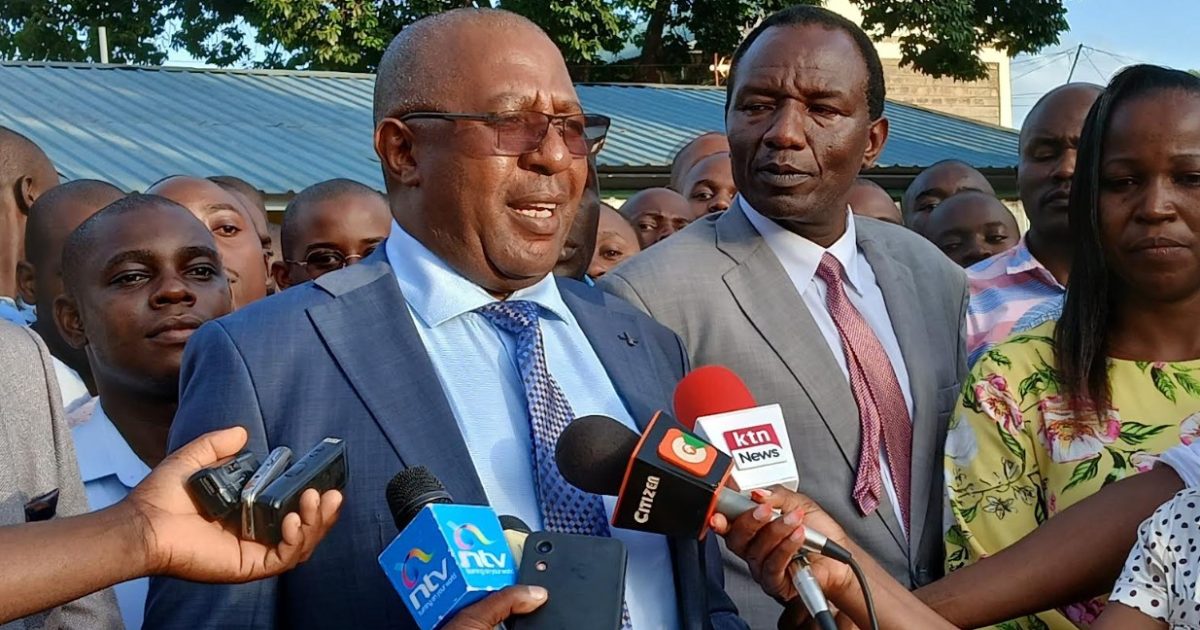
Speaking in Murang’a, KESSHA National Chairperson Willy Kuria and KESSHA Murang’a County Chairperson Esther Wambugu noted that schools are already grappling with severe underfunding.
She asserted that this scenario led to operational challenges and asked the government to allow schools to introduce practical, legal mechanisms to raise the additional funds to facilitate smooth learning.
“We are pleased that the cabinet secretary has finally admitted that secondary schools have not been receiving the full capitation of Sh22,244 per learner as had been the government’s stated policy. Instead, schools have only been receiving Sh16,900, which is a significant shortfall of Sh5,344 per learner,” she said.
“The admission is a step in the right direction and confirms what we have consistently highlighted: that our schools are grappling with chronic underfunding leading to strained resources and growing debt burdens.”
Kuria noted that it is imperative that the government provide a clear pronouncement allowing cost sharing with parents in view of the significantly reduced capitation disbursement.
“school heads are in a dilemma, as they are expected to run institutions without adequate resources while being restricted from engaging parents meaningfully in bridging the shortfall and this is unsustainable,” he argued.
The school heads have further raised concerns over the recurring delays in the disbursement of capitation, saying it has strained relationships between school heads and parents.
Moreover, it has disrupted learning programmes, and lowered the quality of education, further arguing that the government needs to clearly inform parents that they will now be expected to contribute more toward their children’s education, especially at a time when the cost of living continues to rise.
“even when the capitation stood at Sh 22,244 it was still insufficient, having been set over eight years ago and not adjusted for inflation and increased operational costs,” he further said.
The chairperson noted that the real value of this amount has been severely eroded, making it increasingly difficult for schools to provide quality education under the current circumstances.
On her part, Ms. Wambugu confirmed that many schools have already closed for the August holiday earlier than scheduled, citing lack of funds to run daily operations.
She warned that unless urgent steps are taken, more institutions could follow suit in the next term, putting thousands of learners at risk and destabilising the academic calendar.
“We are heading to the third term of the school calendar, which is very crucial for our learners especially the candidates and we are worried that if the issue is not addressed the quality of education will be affected severely, yet secondary school education is compulsory for all,” she observed.
She further noted that they have been disheartened by the revelation that some ghost schools were receiving capitation of up to 50M yet the most deserving schools are not receiving enough funding.
“I appeal to parents to cooperate with the board and school heads when called upon to cover the deficit so that education will go on uninterrupted and to avoid dropouts and allow for thorough preparation of the candidates for national examinations,” she said.
The government on Wednesday cited unsustainable financial pressure on the state to continue funding free primary and secondary education.
The Treasury Cabinet Secretary revealed that the capitation per student in secondary schools has been slashed from Sh22,000 to Sh16,600.
By Florence Kinyua