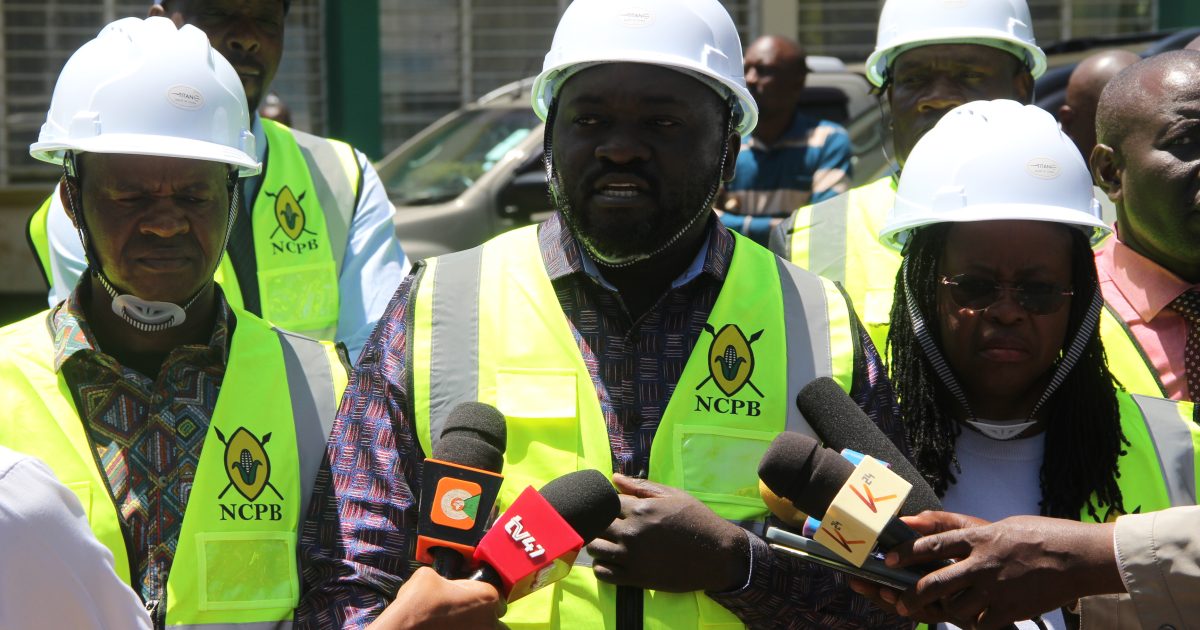
The Senate Standing Committee on Agriculture, Livestock, and The Blue Economy was in Uasin Gishu County and held discussions with county executive led by the Governor Jonathan Chelilim Bii, to have a view and oversee the status of Agriculture in the County.
The committee led by its Chairperson Senator David Wakoli Wafula together with other members including Senators Alexander Mundigi (Vice Chairperson) and Catherine Muma further held a meeting with the National Cereals and Produce Board (NCPB) North Rift Regional Silo led by Regional Manager Gilbert Rotich.
Speaking during a press interview at the NCPB Regional Office North rift, The Standing Committee Chairperson pointed out that the tour was to gauge the board’s level of preparedness as a strategic grain reserve center, to see how they are prepared to deal with food security in the country.
“We have discussed on how NCPB can have mutual agreement and working relations with the county government of Uasin Gishu and the neighboring county governments to ensure that the last mile fertilizer issuance is equally and properly implemented,” noted Senator Wakoli.
The committee also deliberated on how the NCPB can tap into the devolved units to ensure that farmers get fertilizer, quality seed on time and they are able to manage the post-harvest processes properly so that the farmers in the region benefit from the resources and expertise from NCPB.
The Senate Standing Committee chairperson raised concerns on the underutilization of the equipment procured especially the Dryers to help farmers dry their cereals and manage post-harvest losses due to aflatoxins.
“And through this consultative session, that government procured dryers to counties in this region. The dryers in the custody of NCPB are working but 98 percent of the dryers that are at county level, are not working,” he said.
He attributed the problem to lack of good working relation between the purchasers, the suppliers and the recipients of the dryers, the county to guide and empower county governments to be able to facilitate farmers to dry their maize using those dryers.
He affirmed the committee’s bold step to move with speed to demand an explanation and swift action from the national government that procured these dryers to ensure that they no longer become idle investments, but they must be turned into proper equipment to serve the farmer.
Furthermore, Senator Wakoli expressed concern on the human resource establishment in NCPB which he said has only 24 staff at Eldoret regional office and about 130 in the entire region. He cited several reasons for staff shortage like resignation and emphasized the need of recruiting more staff to bolster the service delivery.
“So we will be calling upon the national government to ensure that they facilitate the quick recruitment of people in this particular sector,” added Wakoli.
The committee discovered that the national government has equally not footed part of their bills to NCPB despite giving directives to take fertilizer deep down into the villages noting that this equally hinders the boards capacity to carry out its mandate.
“The National government and county governments have not equally paid their dues to NCPB up to Sh 10 billion and therefore crippling the capacity of NCPB to roll out proper services to Kenyans. So in due course, the committee will be discussing the specific counties and why they are not paying, and also the national government, why it is not paying NCPB to enable it to do what it ought to do,” he exclaimed.
The Senate Standing Committee on Agriculture and the Blue Economy asserted that NCPB will only work well if there is proper cooperation between the Ministry of Agriculture, between Treasury, between county governments, and among leaders to ensure that it serves the purposes for which it was established.
By Ekuwam Sylvester