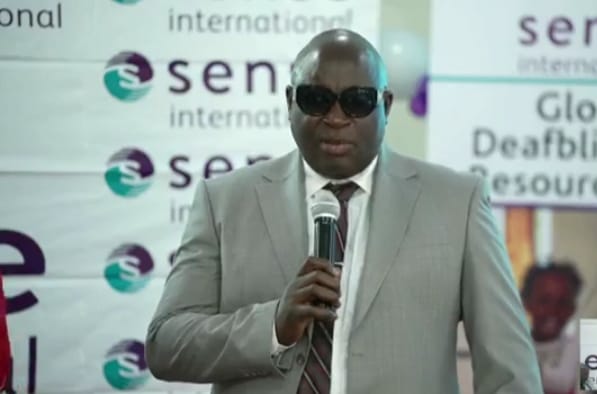
Sense International has launched the Global Deafblindness Resource Hub, an innovative digital platform designed to provide accessible information and learning materials for persons with deafblindness and multisensory impairments.
The hub, developed by Sense International in partnership with the Ministry of Education and other stakeholders, is part of a global initiative aimed at bridging the digital divide for persons with disabilities.
Speaking during the launch, Frederick Haga, Director at the Ministry of Education’s Directorate of Special Needs Education, affirmed that the government remained committed to ensuring that every child with disability had access to education.
“Learners with special needs have always been included in the digital learning programme since 2013. Today, through this hub, critical resources such as policies, legislation and learning materials can be deposited, accessed and used to support persons with disabilities. Every stakeholder has a role to play,” assured Haga.
The Director noted that the Ministry allocates a budget annually for specialised learning resources and assistive devices, channeled through the Kenya Institute of Special Education (KISE).
“Not every child has received the devices yet, but a majority in our schools have, and we continue to expand coverage,” he clarified.
Making his remarks, Daniel Musango, Country Representative for Sense International Kenya, explained that the hub builds on the organisation’s life-cycle approach, supporting people with deafblindness from early childhood through education, vocational training and livelihoods.
“We innovate, we inform, and we influence,” Musango said, outlining the organisation’s three core values. “Our work ensures that people with deafblindness are included in health, education and economic systems; that information is available to them; and that their rights are recognised in policies and budgets,”Musango said.
Founded globally over 40 years ago, Sense International has been active in Kenya since 2005, operating in 14 counties with interventions such as eye screening, audiological services, inclusive education, and livelihood support.
Musango cited the establishment of the first complete audiological unit at Samburu County Referral Hospital, where children can now receive hearing tests, diagnosis, and fitting for hearing aids.
“These are model projects embedded in government institutions to ensure sustainability,” he added.
Notably, the Global Deafblindness Resource Hub was officially launched in February 2025 at Google’s Accessibility Discovery Centre in London. It aggregates resources from eight countries across four continents and is accessible in seven languages, including English and Kiswahili.
Christopher Patnoe of Google, who supported the platform’s development, described it as a milestone for digital accessibility.
“Digital learning is critical, yet much of the online world remains inaccessible. The Hub champions inclusion for all,” he said.
The hub currently hosts over 150 resources ranging from guides to toolkits, available in downloadable formats with features that comply with international web accessibility standards. Future plans include adding video content and expanding regional resources.
Similarly, Julius Ogayo, a board member of Sense International Kenya, underscored the importance of digital inclusion for persons with deafblindness.
“Nearly one million Kenyans live with some form of deafblindness, with over 100,000 cases severe. For them, digital tools are not optional; they are a lifeline. Digital inclusion is about dignity, opportunity, and justice,” he highlighted.
Further, Ogayo called for joint investment to expand the hub’s reach urging stakeholders to prioritise accessibility in digital infrastructure and public services.
“Let us strengthen collaborations so that the voices of persons with deafblindness are heard,” he rallied.
Ogayo added that Kenya could not achieve Vision 2030 or the Sustainable Development Goals if people with disabilities were digitally excluded.
“Digital inclusion is not charity, it is smart development, good economics, and the right thing to do,” he asserted.
Likewise, Barack Odhiambo, a teacher at Maseno School for the Deaf, emphasised the role of digital literacy in education.
“Learners who are deafblind must be fully included in society. Through digital platforms, they can communicate, access information, and interact with their peers. Digital literacy gives them independence and improves their learning outcomes,” he explained.
Odhiambo added that for severely deafblind learners, the hub provides guidance for parents and teachers by offering best practices and resources to support learners both at school and at home.
Meanwhile, the initiative has also been hailed as supporting the upcoming Persons with Disabilities Act 2025, which mandates accessible digital platforms and designs.
Also, the hub is accessible via smartphones, laptops and tablets, and will continue to grow through contributions from government, civil society and development partners.
Ultimately, participants were reminded that digital inclusion is central to realising equality with Musango describing the hub as not just a platform but a statement that inclusion is possible, that technology can bridge divides, and that no one should be left behind in the digital era.
by Darlene Wambui & Samuel Kivuva