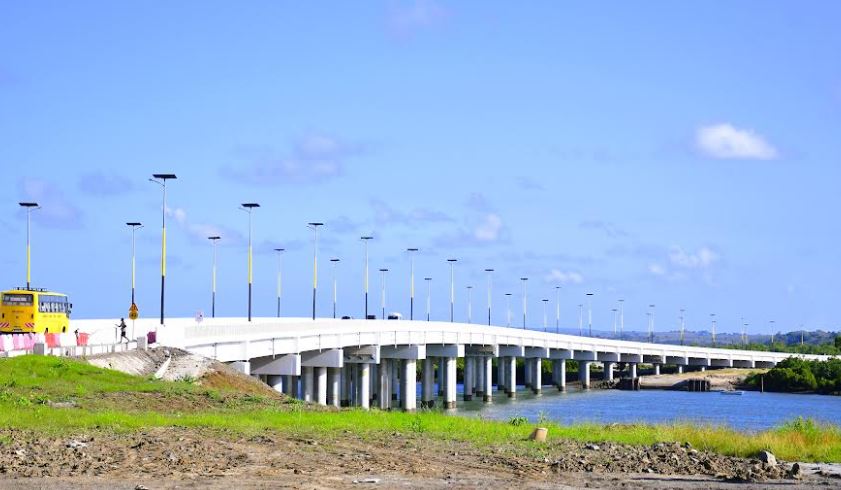
The Sh45 billion Dongo Kundu bypass in the coastal city of Mombasa has been billed as a game changer that is set to redefine the coastal region’s socio-economic landscape.
Dongo Kundu bypass is an 18-kilometre highway designed to connect Miritini on the mainland west to Ng’ombeni on the south coast, bypassing the congested Likoni Ferry crossing.
Providing a direct route that improves connectivity and economic activity in the coastal region, the bypass is 98 per cent complete. It is currently being used by motorists pending official commissioning.
The highway is slowly boosting socio-economic activities by facilitating the seamless movement of goods, services, and people.
Stakeholders say the road would enhance security and connectivity across the coastal counties of Mombasa, Kwale and Kilifi, enabling safer and faster travel.
The project, also known as the Mombasa Southern Bypass Highway, uses three bridges, including the longest over-water bridge in East Africa, and aims to significantly reduce travel time to Diani and the south coast, boost regional trade, facilitate tourism, and spur the envisioned development of the Dongo Kundu Special Economic Zone.
Dongo Kundu bypass is an important transport corridor for traffic destined to the interior of Kenya and beyond, besides promoting trade facilitation and improving socio economic development.
The bypass project straddles Kwale and Mombasa counties, starting at Mteza Bridge, and terminating at Kibundani along the Mombasa-Lungalunga highway.
It is also providing connection from the Moi International Airport and the SGR terminus hence improving tourism and hospitality industry in the coastal region.
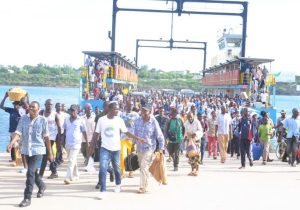
The completion of the bypass has drastically reduced dependence on Likoni Ferry channel, which is estimated to serve 300,000 people and 6,000 vehicles on a daily basis using MV Jambo, MV Kwale, MV Likoni, MV Kilindini, MV Nyayo and MV Harambee.
Ferry services, whose operations are situated on the gateway to the Port of Mombasa, started way back in 1937 and have remained the only link to the South Coast before the advent of Dongo Kundu bypass.
Ferries provide crucial services but at the same time are also a “nightmare” for passengers and motorists due to chronic issues like mechanical challenges, delays, vehicle congestion and safety concerns for both locals and tourists alike.
Deputy Chief of Staff in the Executive Office of the President, Eliud Owalo says the Dongo Kundu bypass is an important transport corridor for traffic destined to the interior of Kenya and beyond besides promoting trade facilitation and improving socio economic development.
Owalo says the critical bypass links to major transport corridors, including the Mombasa-Nairobi highway, enhancing overall transport efficiency.
He said the project is enhancing infrastructure, creating employment opportunities, and facilitating easier movement of services, thereby boosting economic growth in the coastal region.
“It will also provide connection from the Moi International Airport and SGR terminus hence improving tourism and hospitality in Kwale,” he said during an inspection tour of the infrastructural projects in the coastal region.
The Deputy Chief of Staff stated that the Special Economic Zone Development project at Dongo Kundu is one of the Vision 2030 flagship projects.
The Dongo Kundu project also encompasses the Dongo Kundu Special Economic Zone (SEZ) that is approximately 3,000 acres large, adjacent to the Mombasa Port in Likoni Sub County of Mombasa County.
Built at a cost of Sh30 billion, the special economic zone is located in a strategic location with a high potential for development and high competitiveness in terms of logistics and facilities.
It is in close proximity to the Mombasa Port, Mombasa Southern Bypass, Standard Gauge Railway (SGR), and Moi International Airport.
The master plan of this ambitious project was created by the Japan International Cooperation Agency (JICA) whose main objective is to boost economic activity in the coastal region and connect Kenya to international markets.
Dongo Kundu Special economic zone is developed and managed by Kenya Ports Authority (KPA) and is suited for a variety of industries, and its planning has zoned areas for industrial activity, enterprise and trade, tourism, and port services.
Mombasa has the largest concentration of Export Processing Zones (EPZ) in Kenya, home to a 3,277-acre SEZ that includes the Dongo Kundu EPZ and Mombasa Industrial Park EPZ, which will include shorefront sites and its own port.
The Dongo Kundu Bypass and the Dongo Kundu SEZ is expected to ensure the smooth implementation of the 24-hour economy initiative.
With a raft of tax and non-tax benefits, the government expects that not only will foreign investors be encouraged to invest in Kenya, but that the local industry will also be afforded an opportunity to competitively access international markets.
Mombasa Governor Abdulswamad Nassir says the project will address unemployment in the tourist resort town and other neighboring coastal counties.
Nassir said Mombasa was the most ideal location for an SEZ and once complete is expected to increase Foreign Direct Investments in the country by at least Sh100 billion according to stakeholders.
The Mombasa county boss says the SEZs need support from all the stakeholders both in public and private sectors, running from strategy to implementation stages.
He added “special economic zone seeks to stimulate investments and spur growth. SEZs have long been touted as an effective way to ramp up foreign direct investment (FDI), increase trade and provide jobs for developing and developed countries alike.’
Nassir said the completion of this mega project would place Kenya at par with countries like China, Singapore and Dubai that have leveraged special economic zones to foster prosperity.
By Mohamed Hassan