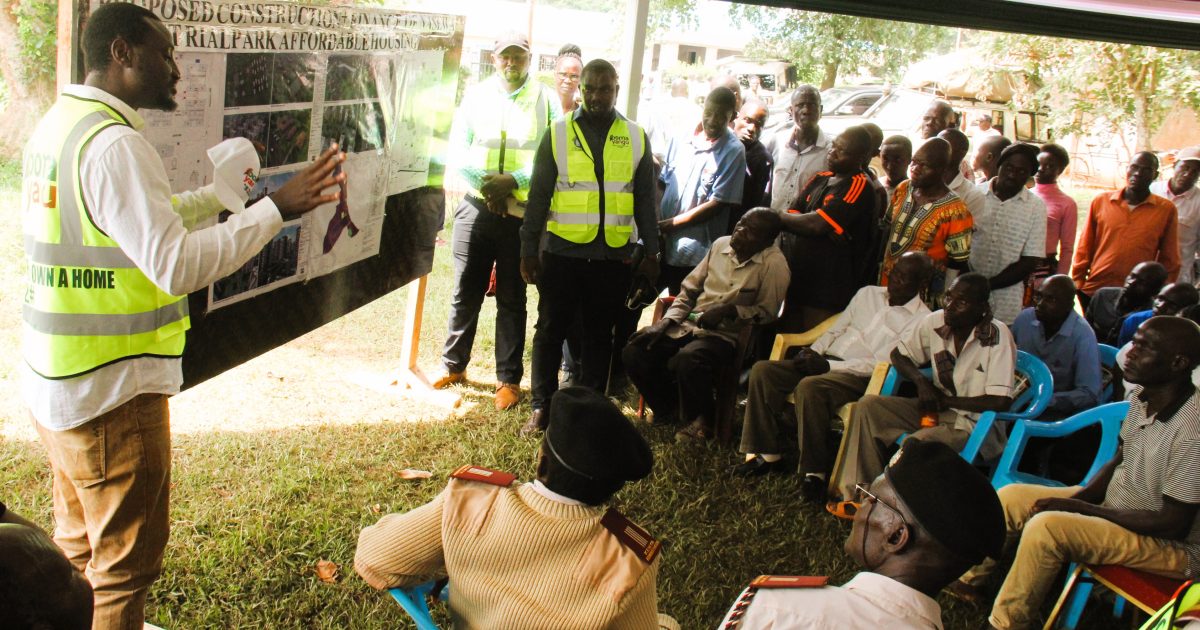
The State Department for Housing and Urban development today handed over the proposed Sh 5.5 billion Nasewa Industrial Park Affordable Housing Project site to the contractor, who is expected to start off the project immediately.
Speaking during the occasion, Cassius Kusienya, Secretary of the Integrated Project Delivery Unit for the affordable housing program, said the site will have 2000 house units together with associated infrastructure.
“We will have a level 3 hospital, ECD kindergarten, primary school, social hall, shopping Centre, a police post and chiefs’ office. The other amenities in the project will be 2 basketball pitches, a football pitch and a volleyball pitch,” he said.
Kusienya asked the contractor to ensure that the agreed delivery timeline for the project is achieved, adding that funds have been set aside to ensure the project is finished on time.
“The project will take 24 months and the contractor is starting the work immediately. Enough funds have been put in place and therefore there should be no issues in honouring the certificate of payments and therefore we expect the work to be ongoing and delivered by the contractor on time,” he said.
He stated that the project will provide an opportunity for those working on the site to get accreditation from the required government bodies if they meet requirements.
“This project is going to provide employment, as there is a clear directive that 70% of the jobs be given to the local community. We are also going to collaborate with the National Construction Authority, NITA and TVETS to do onsite assessments for those with skills to be accredited. This will enhance their skills and give them the opportunity to work at other places when certified,” he said.
The official urged the contractor to ensure there is proper consideration of occupational safety and health to avoid injuries and fatalities, adding that enforcement officers will be doing routine inspections at the site to ensure the workplace policy is observed and complied with.
“The houses we are going to construct will pull together a minimum of 5,000 people and with the accompanying infrastructure, this will change this area. There will also be employment opportunities for around 3,000 people when the project is done. There will also be jobs for those who will be working in other amenities like hospitals and schools,” he said.
“I want people from this area to start registering with Boma yangu so that when these houses are done, they will not be taken by people from other places. We should also benefit by getting and staying in those houses, something that is possible regardless of our economic status,” he said.
Busia County Director for Housing Jason Abuga called on the community to fully support the project due to its benefit.
“This is our project and we should now own it by ensuring we cooperate and work well with the contractor. When you get an opportunity to work at the site, ensure you follow all the set guidelines, including the safety measures and even time so that there is a smooth working relationship between you and the people in charge’ he said
Abuga added that the government is determined to ensure that many other projects are established in Nasewa to add on to the existing EPZA and the County Aggregated Industrial Park (CAIP) that will ensure the area has been fully transformed into an industrial area.
Busia Assistant County Commissioner Jackline Sabulei assured the team of the security during the progress of the work.
“This is a project that is going to change the lives of many people starting from today and therefore it needs much protection. We are going to ensure there is enough security for people who are working at the site and work closely with them so that the project can be successful.
Residents led by Simon Makokha welcomed the project, stating that it will change their lives through the employment and infrastructure.
“We’ve had youth engaging in criminal activities due to lack of employment but this has now put that to an end. We are happy because we are now safe, many people are getting jobs and our living standard is going to change. We are very appreciative to the national government for what it is doing in this area.
By Salome Alwanda and Rodgers Omondi