Nestled in the remote town of Gacami in Othaya sub-county, Rukira Vocational Training Institute (VTC) is no longer a pale shadow of its former self.
Two years ago, the 68-year-old institution like many other VTCs, was literally on its death bed as it struggled to cajole secondary school graduates to enrol in any of its 10 artisan courses.
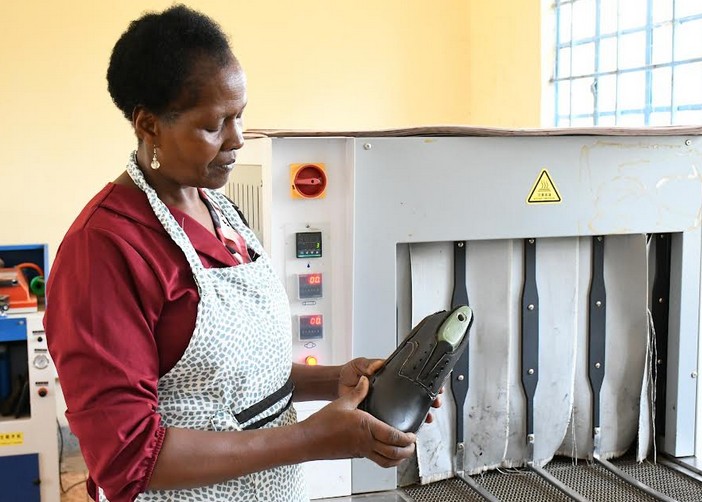
But that was before the County government of Nyeri came in and pumped some Sh13-million worth of equipment into the institution to facilitate the production of leather shoes.
Today the college is now home to the first cottage industry that specializes in production of leather products in the Nyeri County.
“We enrolled our first trainees in 2023 around May and so far, we have trained around 80 youth in these employable leather works,” says Lawrence Magashi, the institution’s manager.
Magashi says since the opening of the leather department, the center has been able to enroll a significant number of youths who would otherwise be idling in the village.
As an additional incentive, the institute has partnered with the residents of Gacami to encourage the locals to enrol in the trade and gain meaningful skills not just in shoe making but crafting other leather products as well.
“This department has given us some visibility because in the county, when one talks about shoe making, everyone associates it with this institution. The first trainees in this trade area were trained for free and they were youth from this locality, so by the end of the day, the young people who used to sit idle at shopping centers acquired some skills and are now able to sustain themselves and help the community in a way,” he says.
The county’s learning institutions are also reaping additional benefits from having a shoe making workshop that is in close proximity.
Some of the biggest beneficiaries of the craft are learners in the county’s Early Childhood Development and Education (ECDE) centers, primary and secondary schools that place orders for the learners.
The institution has the capacity to produce 300 shoes in a day. During our visit, the institute had just finished making more than 350 pairs of school shoes for an ECDE centre in Kieni Constituency.
The money which accrues from such sales goes towards supporting the institution.
“While a pair of leather shoes would cost you upwards of Sh2700 on average, purchasing the same pair of leather shoes at Rukira will cost you Sh1,000. We have realised that our customers appreciate both the quality and the pocket friendly prices that we have set for the shoes,” he says.
Magashi is however quick to clarify that their priority is imparting the skill to as many youth as possible, as opposed to earning income.
Currently there are about 30 trainees undertaking the leather technology course.
For Jeremiah Wanjiru, a student pursuing the course, the trade holds the key to a bright future as an entrepreneur.
The Grade III leather technology student said he decided to try his luck with leather making after a driver’s license and a certificate in electrical and electronics failed to secure him employment.
He tells us that his end goal is to set up his own business and be self-reliant.
“The more I progress with the training, the more I discover opportunities for self-employment and even employment in the leather industry. The beauty of it is that people will always wear shoes or they may want to have them repaired, so there are numerous opportunities of being meaningfully engaged,” he says.
He is not alone, his classmate Maureen Muthoni, is among the few young female students who have immersed themselves in a craft that is perceived to be a preserve of the male gender.
Her choice of the course was fueled by a passion for shoe fashions and design.
Like Jeremiah, she is banking on the skills she is acquiring now to set up her own business.
“We are not just learning about shoe making alone, we are also learning how to make other products such as handbags, belts. I intend to get a loan from one of the micro-finance institutions in the county to set up a business,” she says.
According to the Kenya Industrial Research and Development Institute, the Sh15 billion industry provides 17 million jobs annually.
The Ministry of Cooperatives, Micro, Small and Medium Enterprises Development projects that the value of the leather industry will hit the Sh100 billion by the year 2040 with production capacity expected to grow from 8 million shoes annually to 40 million annually.
By then, the Ministry projects that the industry will have the capacity to provide 100,000 jobs.
However, even with these rosy and promising projections, Magishi says that getting the youth to enrol for the course remains a herculean task.
“These days young people tend to shy away from these vocational trades because they feel like they are intensive yet they like to do simpler skills but we are still trying to encourage them to enrol for these vocational courses,” he says.
Mary Karaba, the Principal Education Officer in charge of Othaya sub-county tells us as a measure to remedy the apathy in taking up vocational training, the county government has been working with partners to popularize vocational training in the county.
They have also been holding sensitization forums to encourage youth who have attained the minimum entry grade for university to enrol into VTCs as they wait to join the university.
“For the students that do very well, we reward them with tools so that they can start their businesses. There are quite a number of youth who have benefited from these skills, we have teenage mothers who would otherwise have not been able to have a skill and they have benefited,” she says.
That notwithstanding Consolata Njai, a trainer in leather technology at the institute says that most of the alumni have successfully joined the juakali sector while others are engaged in leather industries in different parts of the country.
As a parting shot, Ms Njai encourages the youth to train in artisan courses which she notes are very marketable.
“I would encourage the youth to come and train in leather technology which is a very marketable course and they will enjoy being engaged in the leather sector which needs a lot of employees in this country,” she says.
by Wangari Mwangi & Samuel Maina