Various stakeholders have come up with an initiative to brand Kenyan tea based on its geographical identity with a target to hit a broader market.
The initiative, dubbed Geographical Indications (GIs) and spearheaded by the French Embassy, Equity Bank, and Murang’a County government will see tea be branded according to the area it was produced.
The GI links the product’s quality and reputation to its specific geographical origin, protecting its origin and enhancing the perceived value.
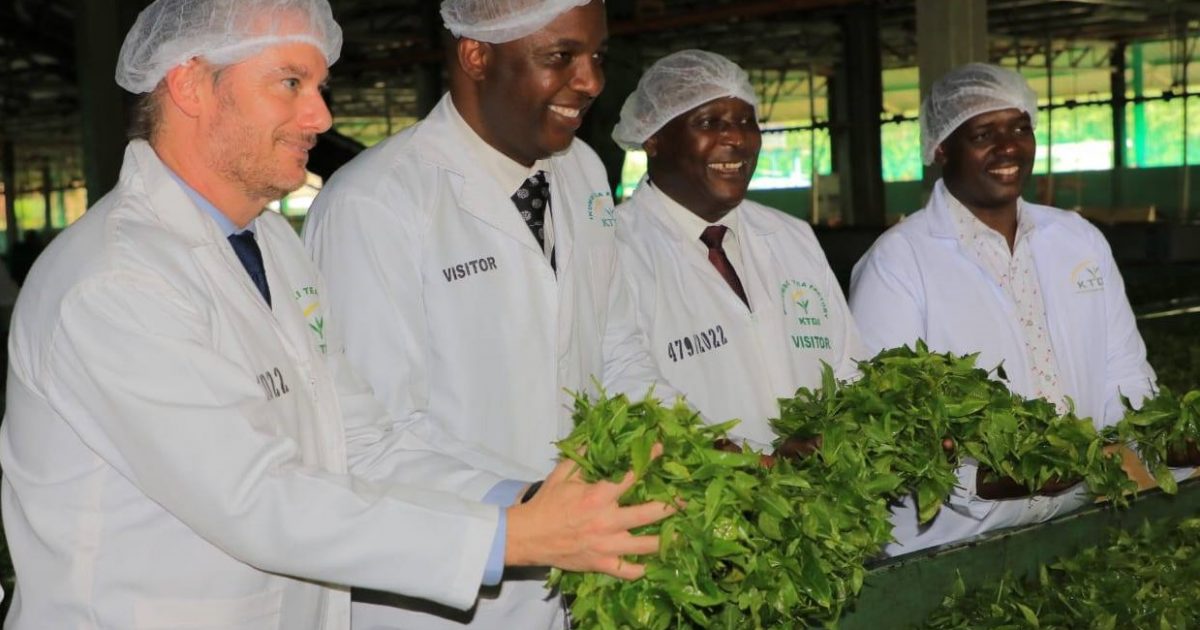
On Monday, a team from the French Embassy led by Ambassador Arnaud Suquet, officers from Equity Bank, and officials from the Murang’a County government visited the 10 tea factories in Murang’a County to assess and inspect the processing of tea in readiness to implement the GIs initiative.
Equity Bank CEO Dr. James Mwangi, who led the team, underscored GI’s way of branding tea saying consumers will be able to buy a variety of tea based on where it was produced.
He said GIs branding, if well implemented, Murang’a tea will attract more buyers considering its quality.
“We have agreed to start a GI initiative here in Murang’a, and that’s why we are visiting the 10 tea factories in the county to assess and inspect the processing of green leaf,” said Mwangi at the Kiru tea factory.
He said the type of branding will see farmers earn more than three times what they currently earn from their tea production.
Murang’a, the CEO observed, is richly endowed with good climatic conditions, high altitude, good soils, and cultural diversity, adding its economy and trade are largely based on agriculture.
Mwangi cited champagne wine as an example of a Geographical Indications saying it was done well in France, where it was produced in a certain locality called Champagne and acquired a global brand.
He noted that with proper measures put in place, Murang’a can produce high-quality tea that the world can be willing to pay a significant premium for.
He added that the farmers will be the custodians of quality because the quality will define the brand and the price the consumer will be willing to pay.
With GI, Mwangi said farmers will be able to own their tea through a brand that, when they go to a shelf abroad, they will be seeing their produce, as it gives them pride and esteem of ownership.
“Currently farmers lose their brand the moment they take their tea to the factory, and the factory loses its brand once the tea goes to auction in Mombasa. That is how Murang’a tea loses its name in the world.” He added.
He remarked that they want to give the farmers their assets, and consumers can trace back to Murang’a, to a factory, and to a farmer such that the consumer knows which tea they are consuming, thus a win to the consumer and the farmer.
The CEO said the project will focus on capacity building on GIs, including the implementation of a pilot GI in the Murang’a tea value chain.
“The journey has started and will be determined by how the stakeholders will walk together. Equity Group is fully committed to walk this journey together.” He added
After branding tea, Mwangi noted, the project will focus on other agricultural products like coffee, dairy, macadamia nuts, and others that have been identified.
He stated that the collaboration with the French embassy will help facilitate global marketing of agricultural products by leveraging its diplomatic ties and knowledge of the global market, as well as collaborating with Kenyan agricultural stakeholders.
“The collaboration will involve promoting Kenyan agricultural products abroad through events, trade missions, and by connecting Kenyan producers with French buyers and distributors.” Remarked the CEO.
On his part, The French Ambassador to Kenya reaffirmed the deepening partnership between Kenya and France, focusing on advancing food security, sustainable farming, and technology transfer by leveraging France’s global expertise in agriculture.
The ambassador emphasized the importance of inclusive collaboration to create an economically viable GIs by ensuring long-term added value noting that Kenya and France continue to elevate their bilateral ties in the agricultural sector.
Murang’a governor Irungu Kang’ata noted the initiative will help boost local development, prevent delocalization of production, and contribute to a better understanding of local products and their unique qualities.
Kang’ata hailed the GIs as protecting products and preventing others from using the same name or symbol on products, as they are protected under intellectual property rights.
“Products can gain GI status if they have a reputation and characteristics that are essentially attributable to the area of origin.
“The county is home to various agricultural products whose reputations are linked to geographical origin like coffee, tea, avocado, milk, among others,” observed the Governor.
He said effective protection of GIs requires elaboration of a legal framework but also knowledge and understanding of the GI by different stakeholders, including those who will implement the law.
Murang’a is home to 10 tea factories, which are distributed across various sub-counties and are managed by KTDA.
The factories include Kiru, Kanyenyaini, Gatunguru, Githambo, Nduti, Makomboki, Gacharage, Ikumbi, Ngere, and Njinu.
The tea factories play a crucial role in supporting the livelihoods of over 85,000 smallholder tea farmers in the county.
By Bernard Munyao and Purity Mugo