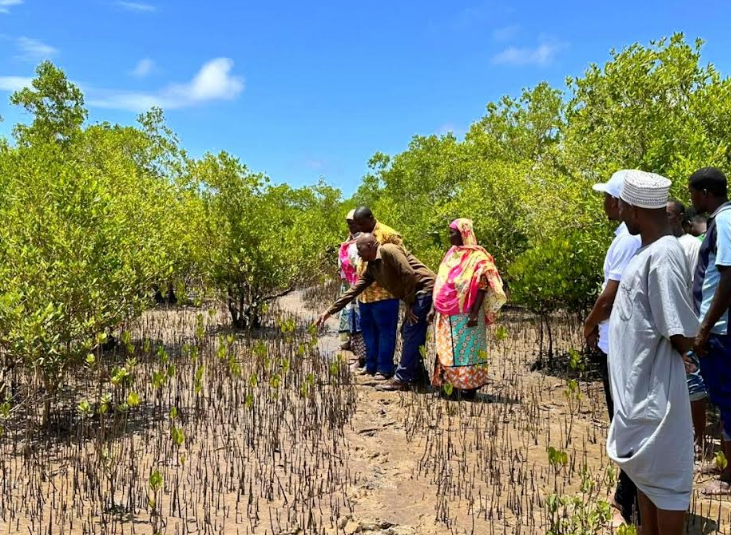
Environmental stakeholders in Kwale County joined hands with residents of the Mwazaro area in Pongwe–Kidimu Ward, Lungalunga Sub-County, to mark this year’s World Wetlands Day through a large-scale mangrove restoration exercise along the Mwazaro coastline.
The event, celebrated on the second day of February every year, was led by the National Environment Management Authority (NEMA), which oversaw the planting of 1.8 million mangrove seedlings, aimed at restoring degraded wetland ecosystems and strengthening climate change mitigation efforts in the coastal community.
Kwale County NEMA Director, Edith Kalo, said wetlands, including coastal zones and lakes, play a critical role in environmental conservation, food security and livelihoods, noting that their degradation continues to threaten communities that depend on them.
“Wetlands are not only important for biodiversity but also for agriculture, fishing and climate regulation. However, they are increasingly being affected by climate change and human activities. It is therefore important that all stakeholders come together to conserve and restore these fragile ecosystems,” said Kalo.
She added that mangrove restoration helps protect the shoreline from erosion, improves fish breeding grounds and enhances carbon sequestration, contributing to the fight against climate change.
Speaking at the same event, Kwale County Forest Service (KFS) Chief Conservator, Elvis Katana, said communities in Kwale are beginning to reap the benefits of environmental conservation through sustainable utilisation of forest resources.
“We are seeing communities benefit from conservation efforts through regulated harvesting of forest products such as charcoal, which is now being done in a sustainable manner.
This shows that conservation and livelihoods can go hand in hand when communities are empowered and involved,” said Katana.
He urged residents to continue embracing conservation initiatives, saying healthy wetlands and forests translate into improved livelihoods for coastal communities that depend on fishing, tourism and farming.
Pongwe–Kidimu Community Forest Association Chairman Mshemanga Matata said the local community has committed to restoring degraded mangrove areas to improve the environment and sustain economic activities, particularly fishing.
“Our mangroves were damaged over the years, and this affected fish breeding areas. As a community, we have taken responsibility to plant mangroves and protect them so that we can restore the ecosystem and improve our fishing activities,” said Matata.
He noted that mangrove conservation has also created opportunities for community members through nursery establishment and environmental stewardship programmes supported by partners.
The World Wetlands Day celebrations brought together the local community, the Kwale County Government, NEMA, the Kenya Forest Service (KFS), the We World NGO and other environmental stakeholders, who called for sustained collaboration in protecting wetlands as vital ecosystems that support livelihoods and resilience to climate change.
By Chari Suche