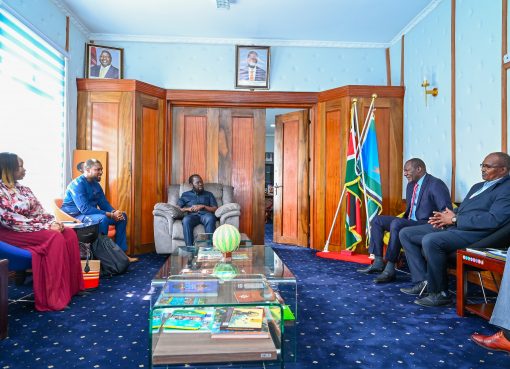
The Principal Secretary for Trade Regina Ombam has reaffirmed Kenya’s commitment to fully implementing the World Trade Organisation’s Trade Facilitation Agreement (WTO-TFA).
The agreement, which came into force on February 22, 2017, marks a major milestone in promoting efficient international trade by simplifying and harmonising cross-border procedures.
It is the first multilateral agreement concluded under the WTO since its inception and the first major achievement from the Doha Round negotiations.
The TFA aims to expedite the movement, release and clearance of goods across borders, thereby reducing bureaucratic delays and lowering global trade transaction costs.
It is anchored on three main pillars: freedom of transit that ensures landlocked countries have unrestricted access to the sea, disciplined fees, which require that charges related to importation, exportation, and transit remain reasonable and non-obstructive, and transparency that mandates the publication of customs and trade information to promote clarity and predictability.
Speaking in Mombasa during the opening of a five-day review of Category C measures under the WTO-TFA, PS Ombam urged the National Trade Facilitation Committee (NTFC) to present progress updates to policymakers, noting the strong influence of political dynamics on trade facilitation.
“We could do all the technical things right, but we can get a backlash politically that can actually make us not move this trade facilitation the way we want and be able to report to WTO that this is the progress we are making as a country,” she said.
She further emphasised that engagement with the political class has the wherewithal to unlock bottlenecks that may be identified
The PS also challenged the NTFC to ensure that trade costs are minimised in line with the WTO target of 14 per cent.
She noted that the country has made significant strides with noticeable improvements in trade volumes and a reduction in unnecessary delays since the ratification of the Trade Facilitation Agreement in 2015.
Kenya has established and operationalised the Kenya TradeNet System (Single Window system), the introduction of the Pre-Arrival Processing (PAP), which has streamlined customs processes and the functioning of One-Stop Border Posts (OSBPs) at key border points.
“We still have a lot to do, and that is why we really need to do a comprehensive review on the implementation status of these measures,” she stated, adding that the committee needs to devise a way of implementing all 28 measures.
Trade Mark Agreement Senior Programme Manager Mr. Job Wanjohi underscored the importance of the review, as the country has signed many trade agreements, and the meeting would ensure effective trade facilitation not only in Africa but globally.
“If you look at the statistics that we post as TMA in our strategy for 2023-2030, it shows that we are looking at the increment in the share of African exports as a percentage of global trade from 3 to 4 per cent and in terms of value of Sh500B to Sh600B,” he said.
“If it is intra-African trade compared to the European Union, which is at 69-70 per cent intra-EU trade, we are looking at how we can get to 20 per cent from where we are 16 per cent,” he added.
By Sadik Hassan