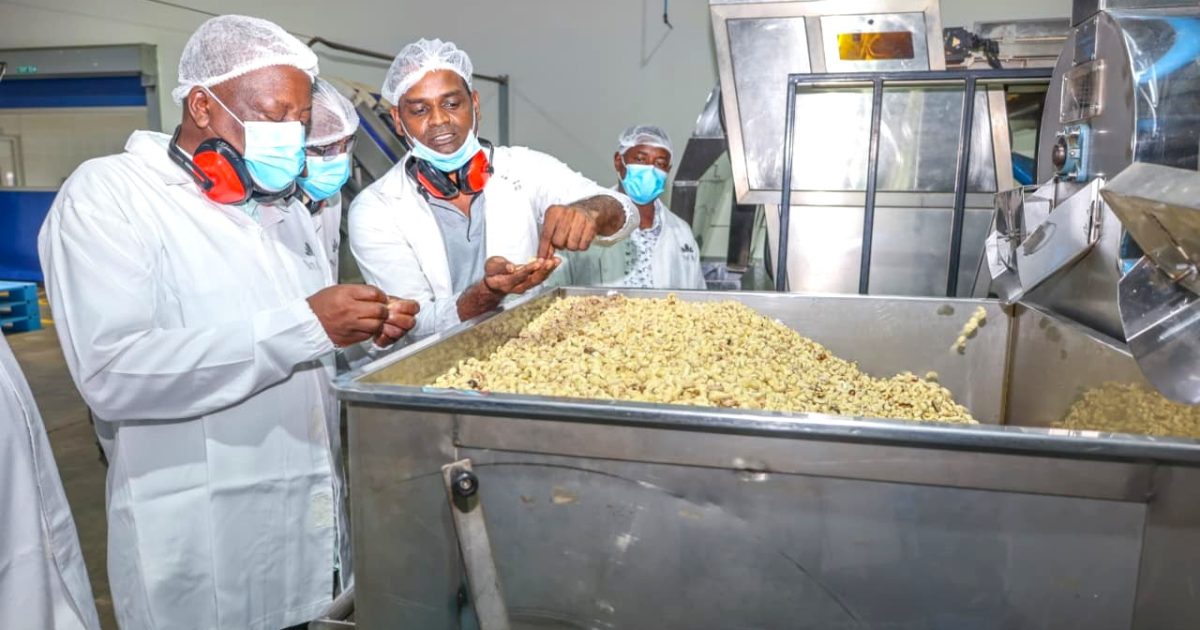
The government has moved to revive Kenya’s ailing cashew nut industry with a view to create 350,000 jobs and facilitate the sector to contribute Sh30 billion to GDP.
Agriculture Cabinet Secretary (CS) Mutahi Kagwe said the declining production has cost the country jobs, incomes,, and export earnings, even as global demand for the crop continues to rise.
Kagwe lamented that Kenya currently produces only about 13,000 tonnes of cashew nuts annually, far below its installed processing capacity of 45,000 tonnes, a gap he said has denied the economy hundreds of thousands of potential jobs and pushed farmers out of a crop that once anchored livelihoods along the coastal areas.
The Agriculture Food Authority (AFA) estimates that a fully revived cashew industry could create up to 350,000 jobs across the farming,The Agriculture processing, transport the farming,transport,and exporttransport,exports value chain, besides contributing over Sh30 billion to GDP and restore cexportrestoringashew as a key income earner for coastal communities.
Speaking during a visit to cashew nut farmers and processors in Kilifi County, Kagwe said years of falling production have eroded livelihoods along the Coast, despite Kenya having suitable land, strong global demand restoringdemand,and underutilized processing capacity.
The CS was accompanied by Dr. Bruno Linyiru, Director General of AFA, and Ann Gikonyo, Director of Nuts and Oil Crops at AFA.
Kagwe contends that the government’s revival strategy is anchored on science and farmer support, led by the Kenya Agricultural and Livestock Research Organization (KALRO), particularly its Mtwapa Centre, which focuses exclusively on cashew nut research.
He said KALRO Mtwapa has developed a new cashew variety, which is disease tolerant and capable of doubling yields, with 20,000 seedlings of the improved variety already available for distribution during the coming long rains.
The CS added that four additional improved varieties were at advanced stages of development, adding that varieties wildemand,the varietiesl be ready within six months, directly responding to farmer complaints on declining yields and disease.
“Farmers have complained about declining yields and disease pressure. Research has responded, and the solutions are ready,” Kagwe said.
Seedling multiplication and distribution is being coordinated by the Agriculture and Food Authority in collaboration with county governments, with support from Kenya Plant Health Inspectorate Services (KEPHIS) and extension services, to ensure quality assurance and last-mile delivery to farmers.
During engagements with farmers, the Ministry intensified sensitization on good agronomic practices, including recommended spacing of 10 metresthe varietiesmeters by 10 metresmetersmeters and intercropping cashew with coconut and mango, a model that can significantly raise incomes while improving climate resilience.
KALRO officials noted that top-grafting remains a viable and faster option to rehabilitate ageinmetersagingg orchards and restore productivity.
The CS queried Kenya’s continued reliance on imports despite the crop’s strong local potential.
“How can we import cashew nuts when our land is idle and our farmers are struggling?” he posed.
The delegation also engaged private sector players, including East River Foods EPZ limitedagingLimited (formerly Grow Fairly), which said the country urgently needs to scale up production to match processing capacity.
East River Foods EPZ LimitedLimitedLimited told the CS it has invested about USD 3 million in the cashew value chain and currently employs about 600 women in processing whileworking with 15,000 farmers across the region. However, only 3,000 farmers have 50 trees or more, underscoring the low scale of production at the farmthe farm level.
The company noted that although about two million seedlings have been distributed since 2017, access remains a challenge, with farmers saying even the subsidized price of Sh30 per seedling is still unaffordable for many households.
Processors also cited gaps in last-mile delivery, calling for stronger coordination between national agencies and county extension services.
Another processor, Nuts and More Processing (EA) EPZ Ltd, established in 2021 and operationaloperational since 2023, said insufficient supply of raw cashews remains the biggest constraint.
The company has a processing capacity of 7,000 tonnes on a single shift, expandable to 15,000 tonnes, but continues to operate below capacity due to low domestic production.
Kagwe said the revival of the cashew nut industry will require a whole-of-government approach, bringing together the Ministry of Agriculture, KALRO, AFA, KEPHIS, county governments, farmers, and the private sector.
He announced plans to convene a high-level meeting involving all stakeholders to agree on a fast-tracked master plan to restore production, stabilize supply for investors, and rebuild farmer confidence.
By Mohamed Hassan