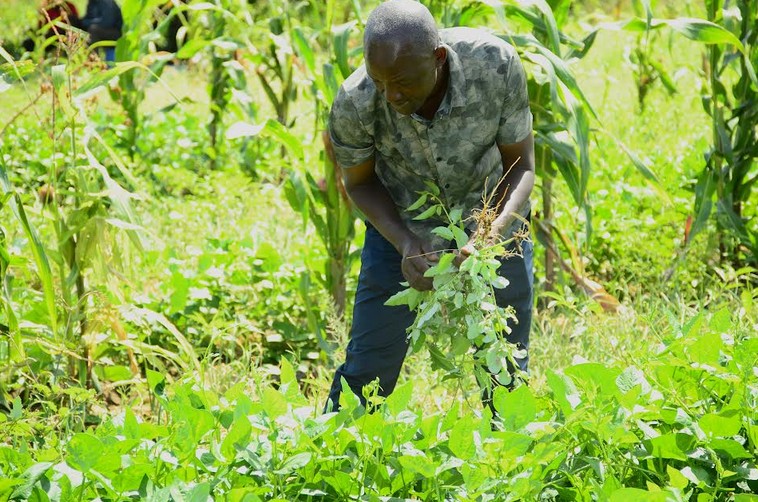
In the heart of Tharaka Nithi County, a quiet revolution in agriculture is changing lives, restoring land, and creating opportunities for thousands of farmers across Kenya’s semi-arid regions.
At the helm of this transformation is Peter Mutegi, Director of Tegemeo Cereals Enterprise Limited, a trailblazing organization committed to promoting conservation agriculture as a sustainable and profitable way of farming.
Founded in 2013 by a group of 25 agrovet operators, Tegemeo began as a grassroots initiative to train farmers on better agricultural practices.
The group focused on key principles of conservation agriculture, including minimum tillage, prevention of soil erosion, application of organic manure, digging of trenches for water conservation, and protecting farms from animal destruction.
Over time, this knowledge evolved into a full-fledged enterprise with a powerful mission of empowering farmers to produce more with less, despite the growing challenges of climate change.
“We started small, but we knew the potential of this model. Conservation agriculture has helped us triple our yields in some areas. Personally, I moved from harvesting two sacks of green grams per acre using conventional farming to 12 sacks using conservation methods,” Mutegi said.
While Tegemeo’s roots remain in Gatunga, Tharaka constituency, Tharaka Nithi county, its impact now spans across several semi-arid counties including Kitui, Meru, Makueni, Machakos, Taita Taveta, Elgeyo Marakwet, Homa Bay, and Busia.
Farmers from across Kenya travel to the model farm in Gatunga to learn first-hand about sustainable practices that work even with minimal rainfall.
“Tharaka Nithi has vast lands suitable for farming but the biggest challenge is water scarcity. That’s why we teach farmers to grow fast-maturing, drought-resistant crops, especially now that rains are unpredictable,” said Mutegi.
To ensure farmers have access to the right inputs, Tegemeo works closely with the Kenya Agricultural and Livestock Research Organization (KALRO) and distributes KEPHIS-certified seeds across all counties of operation.
These partnerships guarantee that farmers are not only trained on proper techniques, but also equipped with the best seeds to maximize their productivity. Beyond farming, Tegemeo is also addressing youth unemployment by turning agriculture into an attractive and viable career path.
The venture has employed several young people who now serve as trainers, extension officers, and agri-preneurs in their own ways.
“In 2013, we started with 30 young people. Today, 12 of them run their own agrovets and agribusinesses and have employed others in the process. Some are engaged in poultry farming, pig rearing, and livestock ventures,” said Mutegi.
In each County that Tegemeo operates, it has extension officers who provide continuous support and training to local farmers.
The organization offers guidance throughout the farming cycle ranging from land preparation and planting to pesticide application, post-harvest management, and marketing.
Despite their remarkable achievements, Tegemeo faces significant hurdles mainly resulting from the rising network of over 70,000 farmers as the demand for agricultural equipment far outweighs supply.
“For instance, we only have one cultivator in Tharaka Nithi, which is very little. If we had more equipment, we could serve more farmers efficiently, boost food production, and contribute significantly to fighting food insecurity in Kenya,” said Mutegi.
Tegemeo is also planning to establish a processing plant which would ensure that surplus produce does not go to waste and would allow the enterprise to package processed food for low-income consumers, creating yet another income stream for farmers.
What started as a simple idea among agrovets has become a beacon of hope for thousands. Through conservation agriculture, farmers are no longer afraid of dry spells, but instead they are confident that their hard work will pay off whether there is enough rain or not.
“Those who have walked this journey with us are no longer worried about the rains, since they know they’ll harvest anyway,” concluded Mutegi.
by Dickson Mwiti