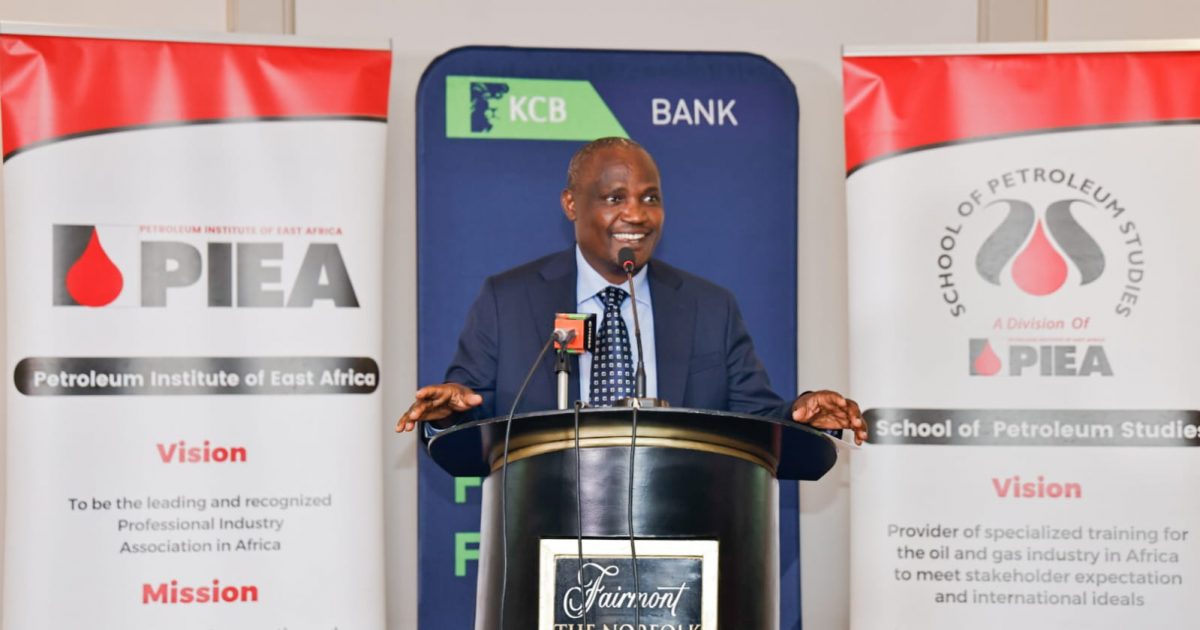
National Treasury and Economic Planning Cabinet Secretary John Mbadi has pledged robust government support for the petroleum sector while outlining broad fiscal and structural reforms to stabilise and grow the economy.
While addressing key stakeholders in the petroleum industry during the second quarter 2025 briefing organised by the Petroleum Institute of East Africa (PIEA), the CS applauded PIEA members for their role in creating jobs, contributing to tax revenues, and supporting infrastructure across the petroleum value chain.
“We appreciate the role of PIEA in economic development within Kenya and the East African Community,” expressed the CS, noting that the institute’s contributions have significantly shaped Kenya’s employment landscape, tax base, and regional capacity in oil and gas.
Mbadi stated that Kenya’s economy had demonstrated resilience, recording an average growth rate of 5.2 per cent between 2023 and 2024, outpacing both the global average of 3.3 per cent and Sub-Saharan Africa’s 3.8 per cent.
He attributed this performance to deliberate policy choices and a diversified economic base. However, he cautioned that three major risks threaten economic stability, including external shocks, fiscal constraints, and structural weaknesses in the real economy.
Further, the CS cited global conflicts and pandemics as triggers for rising inflation and supply shortages, which have driven up the cost of essential commodities such as fuel, edible oils, and fertilisers.
“Domestically, the country is grappling with a shrinking fiscal space as the public debt ratio reaches 69.7 percent of GDP (Gross Domestic Product),” observed Mbadi.
Additionally, he highlighted that interest payments had overtaken all other recurrent expenditures, including the national wage bill and county allocations, underlining the urgency to restore Kenya’s external creditworthiness.
“Public debt servicing now consumes 63 per cent of ordinary revenue. The interest cost has become the single largest recurrent expenditure item, exceedingly even salaries and county allocations,” added Mbadi.
The CS also acknowledged growing public frustration with the disconnect between reported economic growth and lived realities.
He explained that the bulk of recent growth has been driven by large infrastructure projects like the Standard Gauge Railway and Nairobi Expressway, which have limited trickle-down benefits.
According to the CS, sectors like agriculture have been underfunded, forcing the country to increasingly rely on food imports that have risen from 10 per cent to 17 per cent of all imports over the past decade.
“This paradox of impressive GDP growth and economic hardship is not a mystery. It’s a reflection of past investment choices that did not sufficiently benefit the productive economy,” he expounded.
In response, Mbadi revealed that the 2025/26 budget was crafted to stimulate recovery and strengthen macroeconomic stability citing a significant drop in inflation from a peak of 9.6 per cent in October 2022 to 3.8 per cent in May 2025, accompanied by a notable decline in prices of basic foodstuffs and energy.
“A 2-kilogram packet of sifted maize flour, for instance, now retails at Ksh 156.9, down from Ksh 177.7 in 2022,” he exemplified.
Meanwhile, the Central Bank of Kenya (CBK) has since responded to this improved macroeconomic environment by reducing the Central Bank Rate from 13 per cent in August 2024 to 9.75 per cent by June 2025, with lending rates from commercial banks falling accordingly.
The shilling has also strengthened, appreciating from Sh 159.7 to Sh 129.3 to the US dollar, while foreign reserves have reached USD 10.5 billion—equivalent to 4.7 months of import cover.
The CS highlighted several measures underway to further enhance resilience, including broadening the tax base through digitization at the Kenya Revenue Authority (KRA), settling verified pending bills to unlock liquidity, and improving fiscal transparency through a comprehensive audit of public debt initiated by the Auditor General.
“There is a perception of opacity in the management of public debt,” he pondered. “We have taken this concern seriously and initiated an independent audit from the Auditor General whose findings will be shared with the public.”
In order to curb unrealistic budget estimates, Mbadi disclosed that the Treasury had adopted zero-based budgeting and adjusted revenue projections to align with actual trends.
On reforming Government-Owned Enterprises (GOEs), the CS stated that the proposed GOE Bill, 2025, would restructure about 60 commercial state entities to operate under the Companies Act, enabling them to focus on profitability and efficiency. The objective is to shift project development in these institutions from state-driven to private sector-led models, freeing up fiscal resources for social spending.
“These entities were established to operate commercially and pay dividends, not to rely on exchequer support and therefore incorporating them under the Companies Act brings them in line with private sector standards,” stressed Mbadi.
He at the same time confirmed plans to list the Kenya Pipeline Company (KPC) on the Nairobi Securities Exchange through an Initial Public Offering (IPO), a move he maintained would reduce pressure on public finances and stimulate economic efficiency.
“Privatization through IPOs is not only about fiscal sustainability. It’s about creating alternative financing models that don’t rely on debt or taxes,” he told stakeholders.
Mbadi reaffirmed the government’s commitment to petroleum sector development and invited industry players to present ideas for collaboration.
“We welcome your proposals on how to partner in building this nation. Let us walk this journey together,” he urged.
By George Gerish and Victor Kiplagat