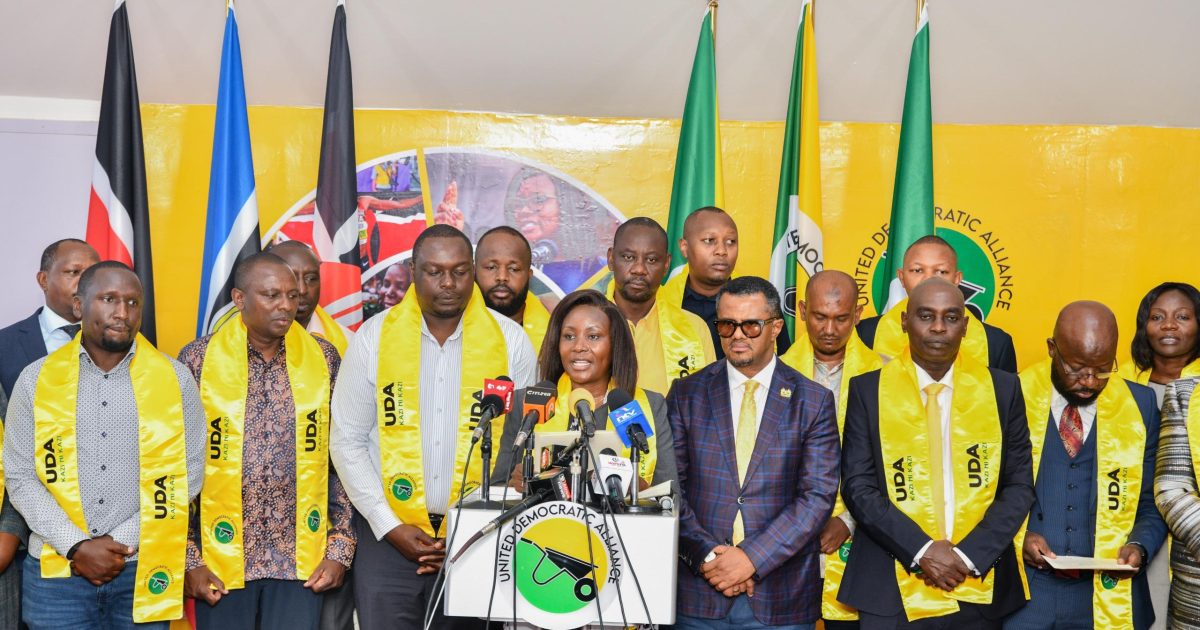
The United Democratic Alliance (UDA) has announced March dates for repeat grassroots elections in disputed polling centres and outlined a series of high-level political activities aimed at strengthening party structures ahead of the 2027 General Election.
The resolutions were made during a National Steering Committee (NSC) meeting held on Wednesday, chaired by the party leader, President William Ruto.
Addressing the media at the UDA headquarters, Embu Governor and UDA National Chairperson Cecily Mbarire, said the NSC reviewed reports from the National Elections Board (NEB) and the Electoral and Nomination Dispute Resolution Committee (ENDRC) concerning the recently concluded grassroots elections.
“The elections were conducted across 42 counties, with Phase Two held in June 2025 and Phase Three in January 2026. However, disputes were lodged in select polling centres,” Mbarire explained.
Following rulings by the ENDRC and decisions by the National Executive Committee (NEC), the party will hold repeat elections in the affected polling centres. Repeat elections for Phase Three will take place on March 7, 2026, while Phase Two repeats are scheduled for March 28, 2026. Mbarire emphasized that the move is aimed at ensuring fairness, transparency, and inclusivity in the party’s internal democratic processes.
“As a party, we are committed to inclusivity and fairness. We do not want any member to feel left behind, particularly those who raised concerns during the grassroots elections,” she said.
Mbarire also announced that registration for aspirants seeking various positions at the Polling Centre Congress has commenced on the party’s website, urging members to register within the stipulated timelines.
In light of the grassroots election resolutions, the party will convene a Special National Governing Council (NGC) meeting on Monday, January 26, 2026, at 8 a.m. at State House, Nairobi. President Ruto will chair the meeting, which will bring together all elected and nominated UDA leaders, including governors, deputy governors, senators, members of the National Assembly, women representatives, East Africa Legislative Assembly representatives, and Members of County Assembly.
The NGC will review a detailed scorecard on the implementation of the government manifesto, the Bottom-Up Economic Transformation Agenda (BETA), and a report from the National Elections Board on the party’s grassroots elections. The council will also ratify an NEC resolution mandating the party leader to commence structured negotiations with the Orange Democratic Movement (ODM) to strengthen cooperation within the broad-based government and in preparation for the 2027 polls.
“As these engagements proceed, our coalition remains intact and balanced. Our unity must be anchored on real issues that affect Kenyans, not just political convenience,” Mbarire said.
Leader of the Majority in the National Assembly and Kikuyu MP, Kimani Ichung’wah, described the NGC meeting as a key forum for briefing elected leaders on progress made in implementing the party manifesto. The meeting will also review the NEB report on grassroots elections and deliberate on the NEC decision mandating the party leader to engage ODM in structured negotiations.
Ichung’wah added that UDA’s approach is guided by inclusivity, noting that thousands of complaints were lodged by aspirants seeking positions, including MCA, parliamentary, gubernatorial, and presidential seats. He said the NSC had resolved to establish a UDA Aspirants Forum to accommodate the growing number of members interested in elective positions.
The party already has elected officials in at least 41 of Kenya’s 47 counties and is working to expand its national footprint ahead of the 2027 General Election. Mbarire highlighted that the upcoming NGC meeting will include leaders elected under parties that merged with UDA, alongside observers and other stakeholders, as the party seeks to consolidate national reach and strengthen grassroots mobilization.
She said the NSC resolutions underscore UDA’s commitment to internal democracy, unity, and effective preparation for the next electoral cycle.
By Naif Rashid