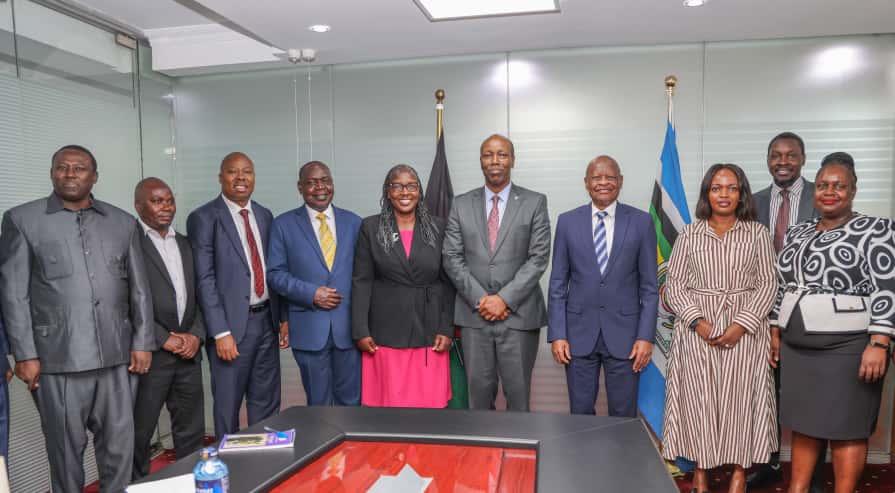
Kenya has welcomed a high-level trade mission from Uganda for a three-day benchmarking visit aimed at studying the country’s Special Economic Zones (SEZs) model and industrialisation framework, in a move expected to deepen regional cooperation and boost East Africa’s manufacturing competitiveness.
The delegation, led by Uganda’s Minister for Trade, Industry and Cooperatives, Gen. Wilson Mbadi, was received in Nairobi by the Cabinet Secretary (CS) for Investments, Trade and Industry, Lee Kinyanjui.
The mission will visit Kenya’s flagship SEZs, Konza Technopolis, the Kenya Export Promotion and Branding Agency (KEPROBA), the Export Processing Zones Authority (EPZA), the Kenya Bureau of Standards (KEBS), and other industrial nodes that have shaped the country’s investment landscape.
The Ugandan team comprises senior officials from the Uganda Free Zones Authority, the Uganda Export Promotion Board and the Uganda National Bureau of Standards (UNBS).
Their visit reflects growing interest within the region in Kenya’s SEZ policy as a blueprint for attracting investment, spurring industrial growth and expanding export capacity.
Speaking during the engagement, CS Kinyanjui maintained that the collaboration aligns with the aspirations of the East African Community (EAC) to strengthen joint industrialisation efforts.
“As members of the East African Community, we have much to learn from one another. Collaborating more closely is not only strategic but essential if we are to achieve our shared industrialization goals,” he advised.
Kinyanjui noted that Africa continues to face policy and regulatory bottlenecks that slow manufacturing growth, adding that SEZs offer a practical solution by creating investor-friendly environments through tax incentives, subsidised power, affordable land leases and modern infrastructure.
Further, the CS announced that Kenya has so far gazetted 37 Special Economic Zones, attracting more than USD 1.2 billion in investments and creating 12,000 direct and 30,000 indirect jobs.
“These zones have become pivotal nodes in advancing Kenya’s industrial ambitions while strengthening regional value chains under the EAC, AfCFTA and COMESA frameworks,” highlighted the CS.
Kinyanjui also underscored the need for mutual recognition of standards across the region to reduce regulatory duplication and ease the movement of goods.
On his part, Gen. Mbadi lauded Kenya’s openness in sharing its experiences and commended the country’s progress in strengthening its SEZ ecosystem.
As well, he asserted that Uganda aims to apply the lessons learned to accelerate the rollout of its free zones.
“We are keen to learn from the Kenya experience to do things better. SEZs and free zones are key to stimulating industrialisation. Once basic infrastructure is in place, it reduces the cost of doing business and creates opportunities for jobs, wealth creation and government revenue,” affirmed Gen. Mbadi.
Uganda currently has 15 free zones under development, and the Minister noted that insights from Kenya will guide the country’s regulatory and operational frameworks as it scales up its industrial hubs.
During the visit, the Ugandan officials will tour Konza Technopolis, the smart city at the heart of Kenya’s digital economy strategy alongside major industrial corridors managed by SEZA, KEPROBA, EPZA and private sector-led developments such as Tatu City.
Similarly, the delegation is also expected to hold technical meetings with Kenyan agencies to review governance models, incentive structures, public–private partnership arrangements and export promotion strategies.
Meanwhile, Kenya’s SEZ framework has in recent years been recognized as one of the most progressive in the region, credited with improving investor confidence and enabling the establishment of manufacturing parks, logistics centres, agro-processing plants and technology hubs that feed into both domestic and international markets.
The visit also comes at a time when East Africa continues to position itself as a competitive manufacturing destination, with both Kenya and Uganda prioritising industrial parks, export zones and innovation districts as key drivers of economic transformation.
by Naif Rashid