Resilient as the film seemed to be, the time had come for the filming fraternity to acknowledge, even albeit inadvertently, that its term was over. It had lost the filming war. It couldn’t cope with the avalanche of shots fired at it by a myriad of camcorders. Some ‘filming’ expressions such as ‘shooting’, among others, though, were to cross over to the new imaging landscape.
Instead of the filmstrip, magnetic tape was taking over the reins of filming at a rate similar to a pandemic. If you can’t beat them, join them. This is the attitude that Bwoka was forced to embrace.
A film cameraman was expected to be artistically keen. He was to avoid under and overexposing shots. His images had to be in crispy focus. He thought and did more to capture appealing shots.
A video cameraman wasn’t necessarily subjected to similar stringent handling that film cameramen had to observe. The tapes were not light-sensitive. Put aside were darkrooms and loading bags. Processing of latent images to render them visible ceased.
With the infiltration of video-based recording systems, Bwoka didn’t necessarily have to be retrained so as to operate every new camcorder that came onto the stage. “It’s like driving a vehicle. Once you learn how to do it with one, you can figure out how to drive another,” he says.
The key to successfully mastering any video camera is to understand the basic principles of motion picture photography. Many camcorders have automatic exposure control and built-in light meters that hint at the correct exposure settings. If a camcorder operator is oscillating between indoors and outdoors, the Auto Tracing White (ATW) balancing may take over especially if the action is fast-paced. Bwoka’s days had no such luxury.
As camcorders are produced, an ever-changing variety of media keeps rolling out—after tapes, discs, cards, solid state drives (SSDs) and others came. Bwoka has tried his hands at most of these.
(Photo: Benedict Wasiche/KNA)
As a seasoned filmmaker, Bwoka would take time to visualize how the final image would be.
He exerted himself to produce pictures worth being glued to the silver screen. The cameras he operated caused him to preserve valuable memories.
His wife Jennifer, a teacher, is proud of what Bwoka did for this nation. She says, “I used to watch the movies he produced and brought home. We would go to Nairobi and Kenya Cinemas. Kenya Newsreel used to be the first thing.”
The couple got married in 1990 when Jennifer was still a student at Kenyatta University. They have two daughters, Tracy and Brenda, 28 and 27-year-olds respectively, who live abroad.
IMAGING HARDWARE
Observing Bwoka working with filming hardware elicits some empathy from her. “Carrying those cameras was not easy,” she says. “I used to cry because they were too heavy.”
Brenda says of her father, “He used to travel all over the world showcasing his talent as a cameraman.” She reveals Bwoka would tell his family that when he was growing up he wanted to be a cameraman. “His dream came true,” she says. “The house is full of his memorabilia.”
Bwoka has kept some older versions of the film still cameras and accessories manufactured by Minolta and Zenit. Brenda says that he used to teach her and her sister how to take pictures and how to use microphones when they were kids.
“Anybody would feel proud travelling with the president and other high-ranking personalities in the same plane,” says Jennifer.
When the Betacam series shot to the fore, the majority of newsmakers, particularly politicians, some of whom doubled as cabinet ministers loved it. If a function was scheduled and only print journalists were present, the function would not start.
Immediately a cameraman wound his way through the multitude gathered, the occupants of the dais would become boisterous because “the journalist has come.” Speeches that would ordinarily take a minute or two were extrapolated. Woe to the cameraman if for whatever reason that item never went on air.
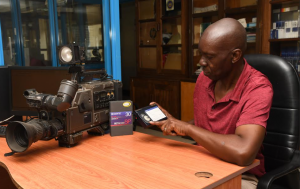
(Photo: Benedict Wasiche/KNA)
During part of the time that the Ministry of Information and Broadcasting was housed at Jogoo House ‘A’, Albert Ekirapa was the Assistant Minister. He shared a lift with a cameraman who was returning from covering an event.
Ekirapa asked to hold the camera. He said, “It’s too heavy. They should reduce its size.” That time was coming. The DVCAM series which had camcorders such as the DSR 300 and 370 arrived and even smaller ones such as the PD 150, and 170, among others.
Several newsmakers sneered at the new babies on the block. “Hii itatoa kweli?” (will this one record?), some would ask. With time, the smaller camcorders proved that they could do the job. Confidence in them increased.
In the gathering and dissemination of television news, sometimes comical issues arose. For instance, consider this flashback. A cameraman receives a call from the editor asking him to be on standby to cover an event. The cameraman inserts the battery and the tape into the camcorder. He waits to be picked. The editor calls him stating that the event is cancelled.
VIDEO EDITING
The cameraman ejects the tape from the camcorder and returns it to a cabinet. There’s another turn. The editor calls yet again saying the event is on. The cameraman is picked. On arrival at the event, alas! He has no tape. In his mind, the tape was still in the camcorder.
In some media houses, it was the responsibility of the reporter to carry the tapes. But once in a while, a reporter would assume that the cameraman had done so and vice versa. It was common to see colleagues from different media houses coming to the rescue of the distraught crew.
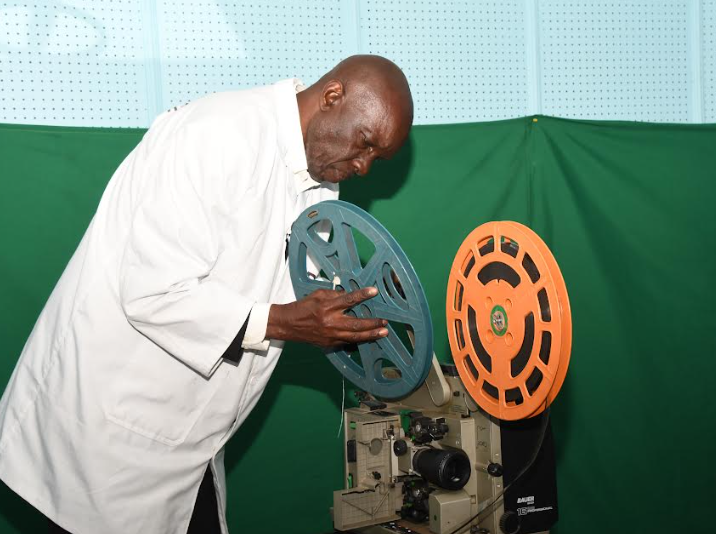
Editing material has undergone a complete metamorphosis. The film used to be cut physically using a splicing tool. This was to be precisely done. Otherwise, if just one frame were to be lost, the pictures would go out of sync. One part of the cut film would be joined to another using a liquid cement applied by a tiny brush. The process was known as linear. It was tedious.
When video came in, analogue video editing machines came in. It was just a matter of shuffling knobs and keying in and out at desired points. Digital editing software is what’s taken over; a non-linear system.
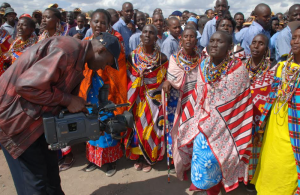
(Photo: Benedict Wasiche/KNA)
Just like sound techniques lecturer John Wambulwa, Bwoka too has moved from film production to farm production. He keeps some sheep, ducks and chicken. He also farms a few crops for subsistence.
After Bwoka retired though, he taught for some time camera operations at KIMC and the Kenya Film School located at Kasarani Sports Centre. He still loves teaching.
He’s a co-director alongside Jennifer, at ORRECC School for Orphans which has primary and junior wings. Brenda says, “As a father, at school, he’s the father to many, but at home, he’s a father to two—my older sister and me.”
At the school, Bwoka’s passion for teaching exhibits itself. He teaches mathematics and, of course, photography to groups of curious children. He hopes that the tips he gives the learners may inspire some of them to take up journalism.
By William Inganga