The Government has reaffirmed its commitment to unlocking the potential of Kenya’s arid and semi-arid lands (ASALs) through large-scale irrigation and feedlot projects aimed at boosting food security, building climate resilience, and transforming pastoral livelihoods.
The ongoing Griftu Irrigation and Feedlot Project in Wajir County stands out as a flagship initiative under the Bottom-Up Economic Transformation Agenda (BETA), showcasing how integrated water and livestock systems can uplift ASAL communities.
Now nearing completion, the 5,000-acre project promotes irrigated agriculture and livestock commercialisation, directly benefiting 250 households and indirectly supporting more than 700 others. Once operational, the feedlot will accommodate 2,000 cattle, supporting cross-breeding, fattening, and value addition to improve market value, household income, and food security.

Anchored in President William Ruto’s directive to establish feedlots and water storage projects across ASAL regions, the initiative aims to transform dryland counties into hubs of sustainable livestock and crop production. It also forms part of the Government’s broader plan to establish 450 feedlot projects countrywide to strengthen value chains and enhance drought resilience.
Key infrastructure under implementation includes diversion works, a 6.5-kilometre open water channel, road crossings, and four water pans with a combined capacity of 750,000 cubic metres. The project also features solar power installations and perimeter fencing to safeguard the investment.
Upon completion, the Griftu Project is expected to inject approximately KSh 288 million annually into the local economy through improved agricultural productivity and livestock commercialisation. It will also contribute significantly to red meat production by ensuring reliable water access for feedlots, livestock, and pasture development.
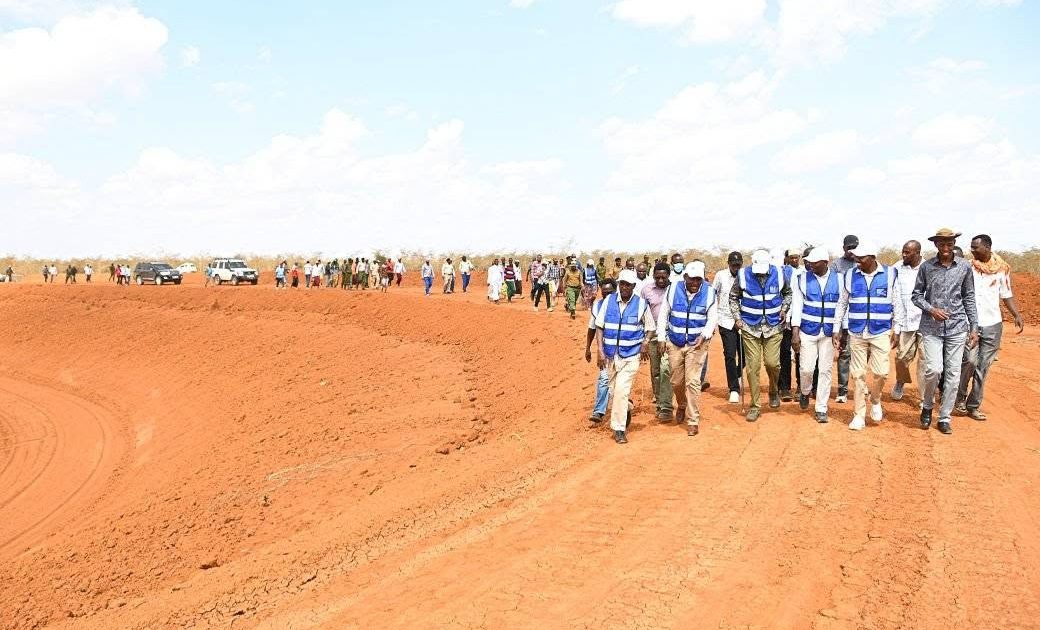
During an inspection tour of the project, Principal Secretary for Irrigation, CPA Ephantus Kimotho, said the project exemplifies the Government’s integrated approach to improving water access, enhancing livestock value chains, and building climate resilience in ASAL regions.
“This project is a game-changer for Wajir County and beyond. It will create jobs, improve nutrition, and support the shift from subsistence to commercial agriculture,” he said.
Principal Secretary for ASALs and Regional Development, Kello Harsama, observed that the project reflects the Government’s dedication to practical, community-driven solutions tailored to the unique needs of pastoral communities.
“The Griftu Feedlot Project is a model of how collaboration between national and county governments can deliver sustainable solutions to drought and food insecurity in ASALs,” said Harsama.
“We are building a future where livestock losses due to drought become a thing of the past. By investing in resilience projects like this, we are securing livelihoods and restoring dignity for communities that have borne the brunt of climate shocks for decades,” he added.
Wajir Governor and Chair of the Council of Governors, Ahmed Abdullahi lauded the project’s progress, saying it would transform pastoral livelihoods and strengthen the local economy.
“This project is a lifeline for our people. It will empower pastoral communities to embrace commercial agriculture and secure their livelihoods against recurrent droughts,” said the Governor.
The Griftu Feedlot Project was conceptualised following the devastating 2020/2021 drought, which led to the loss of over 2.5 million livestock across ASAL counties. It now stands as a model for sustainable livestock production, drought resilience, and economic transformation in Kenya’s dryland regions.
Also present during the inspection were senior officials from both the National and County Governments, including Joel Tanui, Irrigation Secretary (Land Reclamation and Climate Resilience); Yatich Kipkemei, MBS, Director for Regional development, Wanjiku Manyatta, Secretary for Administration; Karuku Ngumo, Wajir County Commissioner; Daniel Odero, Director for Irrigation Water Management; and Thandi Githae, Director for Climate Resilience.
By Charles Matacho and Hamdi Buthul