During the 2025 West Kenya Agricultural Society of Kenya Show (ASK), various exhibitors came up with technologies that shows how to use non-decomposed wastes to promote climate-smart agriculture.
In this year’s show held at the Lichota ASK showground, all exhibitions aligned to the theme; promoting climate smart Agriculture and Trade initiatives for sustainable economic growth.
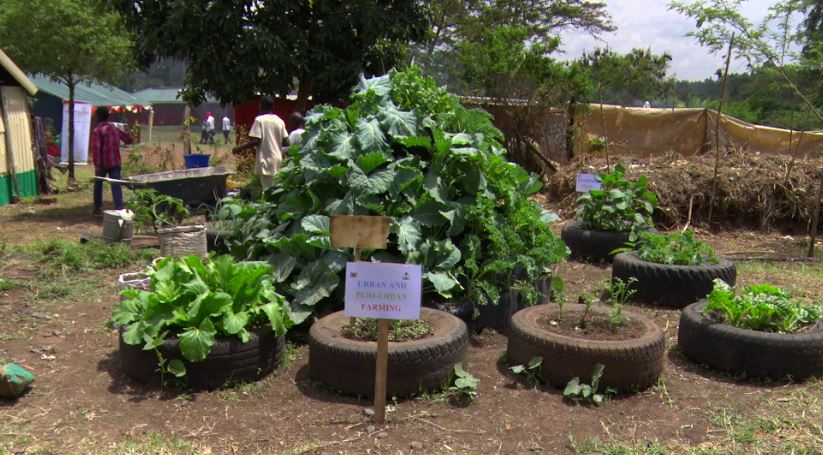
Among the exhibitions was the Urban and Peri-urban Agriculture (UPA), exhibited by the department of agriculture Migori county government.
This Agricultural technology refers to the comprehensive system of growing crops, raising livestock, and related activities such as processing, distributing, marketing, and resource recycling that take place both within the boundaries of a city and in the surrounding metropolitan region.
These diverse practices utilize various spaces, from community gardens and vacant lots (urban) to semi-commercial farms on the city’s fringe (peri-urban), primarily serving to improve local food security, increase access to fresh produce, create livelihoods, and enhance the environmental resilience of the urban area.
According to Mr Tonny Kidiga an agricultural expert from the county government of Migori in-charge of the exhibition plot, they promote Urban and Peri-urban farming to utilise small spaces in towns.
As an agripreneuer Mr Kidiga express his conviction that food security in Kenya will only be achieved if people utilize the spaces around them. “Food can be grown anywhere, if people learn to creatively use the resources and waste materials around them, containers, and household refuse into productive farming tools,” he explained.
One of his main exhibitions was the use of recycled tires as crop planters. Painted in bright colours, the tires were stacked and arranged into neat gardens, each one sprouting with vegetables.
Kidiga explained that this method allows people with little land, especially in towns, to maximize the little spaces they have. “These gardens are ideal for flats and rental houses in towns where space is limited,” Kidiga said adding: “It is not just farming, it is also a form of recycling that reduces waste in our environment.”
Another technology was the hanging garden technology, where crops grow in vertical rows using recycled containers. This method he says saves space and water while offering a creative way to grow vegetables like spinach, Sukuma wiki, and even herbs.
“Many urban households think farming is impossible because they don’t own big farms. But with simple innovations like these, every balcony, backyard, or roadside plot can produce food for the family,” he said.
The demonstrations also tackled the broader challenge of waste management in towns and villages by turning discarded materials into farming tools.
Kidiga noted that urban households often spend heavily on buying vegetables from markets, yet most of this food can be produced at home. “We want to change the culture of relying fully on market produce. Families can save money, eat healthier, and even sell the surplus to neighbours,” he added.
The initiative also supports the national agenda of achieving food security.
As Mr Kidiga showed, when individuals produce more than they consume, the only logical step is to share or sell the surplus to neighbours. “This creates micro-economies in our communities,” he said adding; “When my neighbour buys vegetables from me, she saves on transport to the market, and I earn a little income. Over time, we build stronger, self-reliant neighbourhoods,” he said.
This idea resonated with many attendees, who were eager to learn how they could replicate the models at home.
For long, urban residents have associated farming with rural life, often considering it dirty or backward.
Kidiga and his team want to change that narrative and by showcasing colourful, creative gardens made from recycled materials, they present farming as both modern and fashionable.
“You don’t need hectares of land to be a farmer, you just need creativity, passion, and the willingness to make use of what you already have,” Kidiga elaborated.
The 2025 West Kenya ASK show also featured discussions on the role of youth in agriculture and climate-smart farming practices.
By Awuor Andy clay and George Agimba