For decades, the Maasai community has solely relied on livestock keeping as their source of income.
This, however, has been greatly affected by climate change which has brought about frequent and severe droughts leading to severe water scarcity and lack of pasture consequently resulting in loss of numerous livestock.
Severe loss of livestock especially in the ravaging drought witnessed in the year 2022 led to not only economic drain but also social disruption in the community that solely depend on livestock keeping.
But there is hope that is beckoning. The community is now shifting to other income generating activities which have proven to be more reliable and sustainable than livestock keeping.
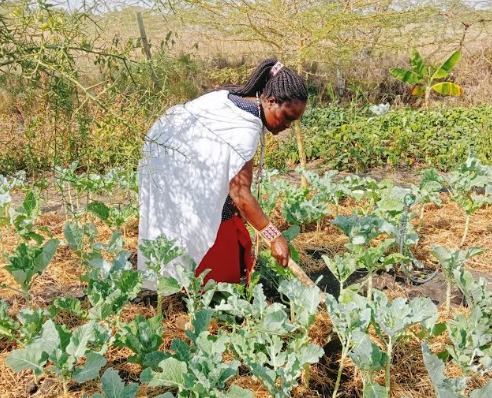
Jane Koileken, a resident of Oloosidan in Kajiado East Constituency has embraced farming after all her livestock were decimated by the ravaging drought of 2022.
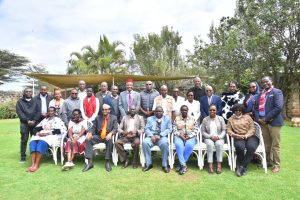
Koileken, a mother of five, says that life became very hard when all their livestock died due to drought with school going children whose education fully depended on livestock sale.
“By the time the ravaging drought came, three of my children were at the secondary school level. Life became hard and my children were sent home due to school fee arrears which affected their performance at school,” she narrates.
Luckily for her, the area chief invited her for a workshop on climate change which was organized by The Saving Lives and Livelihoods Initiative, a program funded by Mastercard Foundation and implemented by Africa Centre for Disease Control and Prevention (ACDC) and its partners including Amref Health Kenya, UNICEF, Kenya Red Cross and Akros.
Through the Participatory Climate Scenario Planning Workshops, both livestock and crop farmers are trained on scenario development, scenario planning and given advisories based on the rainy or drought seasons.
“During the week-long workshop, we were taken through other income generating activities like bee keeping, aquaculture, organic farming and hay harvesting. I decided to practice organic farming and my family has really benefitted from it,” said Jane.
The workshops also have a component of food safety where crop farmers are taught how to grow crops organically without the use of synthetic fertilizers and pesticides.
She revealed that through organic farming, they are now able to educate their children from the sale of vegetables as she sells the vegetables to her neighbours.
“Since we were taught how to make our own organic pesticides, I do not have much expenses in maintaining the garden,” she added.
Stephen Tipanko, Oloosidan location Chief stated that the residents predominantly depended on livestock keeping for their source of income but they are now embracing alternative sources of income to build resilience.
“About 100 farmers from the area have already been trained on different alternative sources of income including bee keeping, hay harvesting and organic farming ensuring that they are not only food secure but also able to fend for themselves through other means apart from livestock,” said chief Tipanko.
“Since all their livestock were decimated by the ravaging drought in the year 2022, I saw that Jane was a perfect fit for the training on resilience and I am glad that she is putting what she learnt into practice. Her family and neighbors have really benefitted from the farming venture and she is currently also training others to venture into farming,” he added.
He lauded the county government agricultural extension officers who have been offering extension services to the residents saying that their guidance has brought much success to the new farmers.
Michael Semera, The County Executive Committee Member for Water, Environment, Natural Resources and Climate change says that there is an increase in agricultural produce in the county as a result of people heeding to meteorological advisories.
“The Participatory Scenario Planning workshops are critical as residents get advisories on early warnings of drought enabling them to adequately prepare and diversify in terms of crop production or livestock keeping,” he said.
Mary Mathenge, Amref Health Africa personnel and the team lead for Africa CDC in Kenya says that The Savings Lives and Livelihoods supports Participatory Scenario planning workshops as part of their one health initiative.
The one health approach brings together the meteorological, livestock, agriculture and health departments to address issues of health holistically in relation to environment, animals and public health.
“PSP brings on board the meteorological department, livestock and agriculture, and health to look at the intersection between climate and health with a view of the scenarios that are happening recently in terms of the weather,” said Mathenge.
Participatory Scenario Planning is key in projecting what will happen in the future and try to address mitigation measures that we can put in place in order to have a resilient community that is able to adapt to the changing climatic conditions.
By Diana Meneto