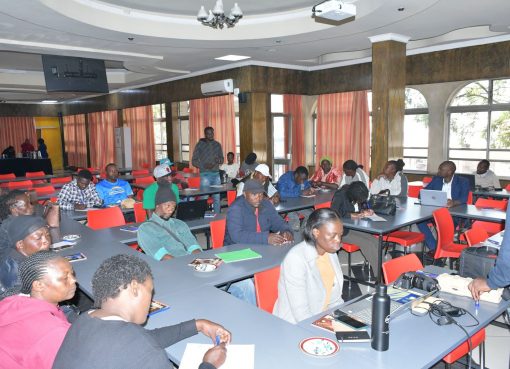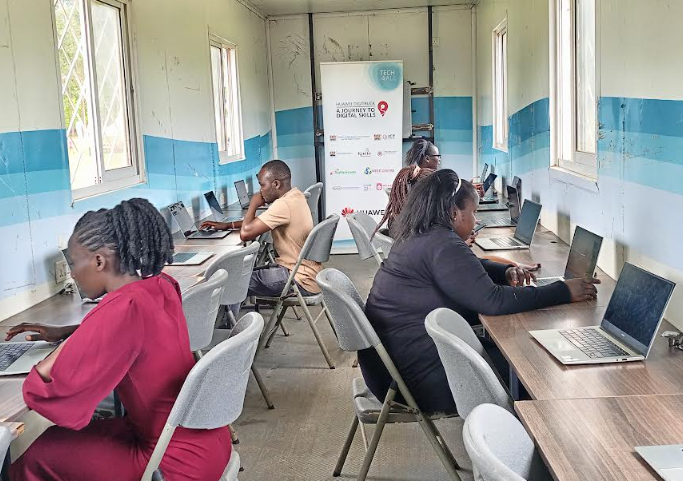
At least 150 people in Kisii County have successfully completed a four-week digital skills training under a mobile, solar-powered digital classroom initiative that has seen 9000 students benefit from 36 counties since 2019.
The programme aims at equipping participants with essential digital competencies including basic computer use, internet navigation, digital marketing, online safety, and entrepreneurship among others.
Speaking during the graduation ceremony at Mokubo in Magenche ward, Bomachoge Borabu Constituency in Kisii County, Education Ministry TVET’s Secretary Joseph Njau applauded the programme saying it conformed to the government’s Bottom-up Economic Transformation Agenda especially the digital skills’ superhighway component, aimed at ensuring the populace has digital knowledge.
Njau who was representing the ministry CS Julius Ogamba, said the ministry had collaborated with the Huawei, computer for schools’ organisation and other players to ensure the program reached out to Kenyans in the most remote places of the country to empower them with relevant digital skills and certificates for the global market.
Njau noted that the programme went a long way to ensure the country was not left behind in the global economic growth especially in the e-commerce, research, innovation, global jobs, and development of the artificial intelligence.
He said the success of the programme, dubbed DigiTruck programme, was a testimony to how well public-private partnerships align projects and programmes with community needs.
“The DigiTruck programme is a powerful example of what can be achieved when the national government, county governments, the private sector, and community organisations work together to drive digital and ICT literacy in rural areas and empower our youth for the future,” he said.
Nominated MP Irene Mayaka emphasised the long-term impact of the programme, stating that the digital skills, like online safety and digital marketing, were not just tools for employment but gateways to global opportunities and financial independence.
She noted that the skills acquired would unlock opportunities for the agricultural activities in the area and urged the students to utilise them to assist in all sectors including farming.
She reiterated President William Ruto’s assertion that the country was working with Ministries of Labour and Foreign and Diaspora Affairs to get ‘Kazi majuu’ or jobs outside the country some going for up to 6 months and beyond, for the skilled labour force.
Huawei Kenya’s Director for Public Affairs Mr Yuta Leng congratulated the graduates and reaffirmed the company’s commitment to digital inclusion saying that with the right tools and training, the youth could be powerful innovators and would bring economic empowerment to communities.
“Huawei remains committed to expanding digital inclusion and supporting the next generation of Kenyan leaders,” he said
He said DigiTruck initiative was part of Huawei’s global Tech4All programme and is implemented in collaboration with the Ministry of Information, Communications and The Digital Economy, the Ministry of Education, ICT Authority, Computers for Schools Kenya (CFSK), and other stakeholders.
The Kisii graduation follows recent DigiTruck programmes held in Baringo, Migori, and Homa Bay Counties, bringing the total number of youth trained in 2025 to over 900.
In May 2025, 180 youth graduated from Kabimoi Vocational Training Centre in Baringo County. In Migori, 210 youth (95 women, 115 men) completed training at Uriri Vocational Training Centre, while Homa Bay recorded 290 graduates (143 women, 147 men) at Oriwo Boys High School.
Huawei Media and Government Relations Director Hadita Mohammed urged the students to utilize their skills.
She cited a case of Likoni where the first student was awarded a tablet which he used to earn some income after opening a mobile cyber cafe to help people in villages pay taxes, register for e-citizen and get relevant permits.
An area retired Senior Chief Samuel Omambia explained how the mobile truck helped the needy students from very poor background in the area.
Kisii National Polytechnic Chief Principal John Agola explained that the TVETs had learnt from the programme how to reach out to youths in their remote environments with mobile training, including welding and fabrication, and carpentry at the village level.
“The ujuzi mtaani concept is good initiative because it can help the children who can’t pursue further education due to various reasons,” he said.
A cross section of the students gave their account of their success and benefits to the community.
Ateya Paul, a teacher and a resident, described the training as informative adding that the skills would help the community on how to keep their data and get market for their goods.
He said that with the knowledge, he would be able to store data for his students safely and make money through on-line marketing.
By Jane Naitore