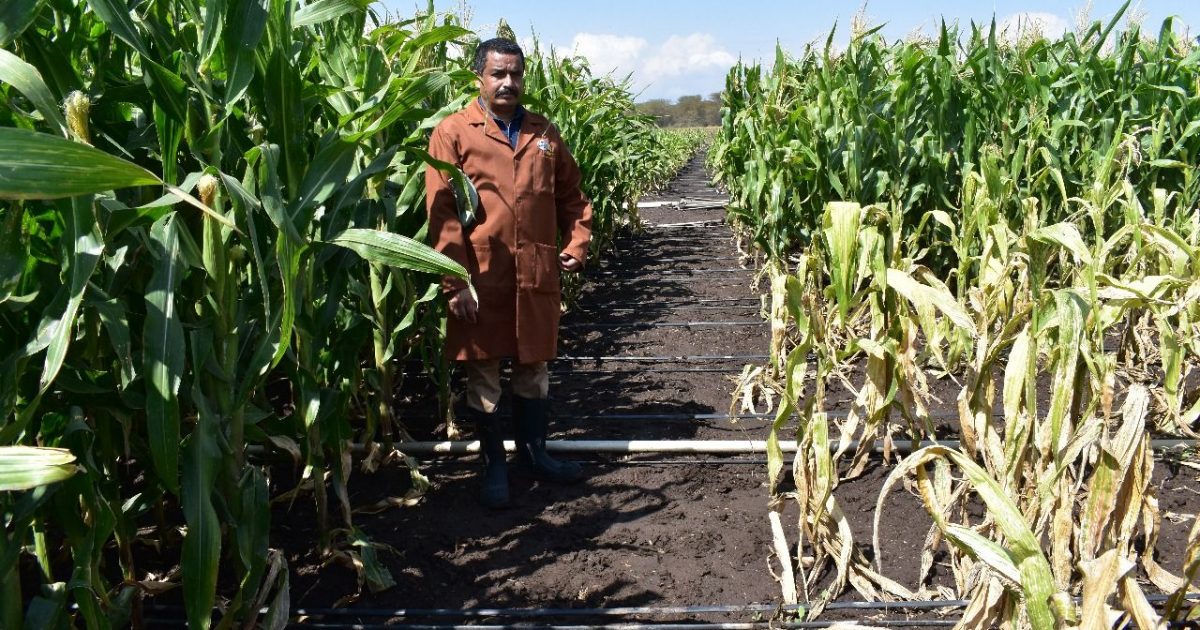
Kenya and Zimbabwe have established robust testing and quarantine systems which have registered huge success in the fight against Maize Lethal Necrosis (MLN).
The initiative being undertaken by the International Maize and Wheat Improvement Center, known by its Spanish acronym CIMMYT has seen the training of over 4,000 stakeholders including seed producers to inspectors on MLN-free seed production.
CIMMYT Maize Pathology Lead – Sub Saharan Africa Dr. Lingadahalli Mahabaleswara Suresh said that Maize Lethal Necrosis was first detected in Kenya in 2011, and it quickly spread to more than six countries in the region.
Speaking on Wednesday during a Webinar on Smart Surveillance and Integrated Response to MLN in Eastern and Southern Africa, Dr. Suresh said that the disease is caused by the co-infection of two viruses which are Maize Chlorotic Mottle Virus and Sugarcane Mosaic Virus.
“In severely affected areas, farmers have experienced up to 100% yield loss and a complete crop failure. The implications go beyond fields as this disease jeopardizes food security, disrupts seed trade, and shatters rural livelihoods,” said Dr Suresh.
“Maize is not just a staple food; it is a lifeline for over 300 million people in Sub-Saharan Africa. But since 2011, this lifeline has come under threat from the devastating viral disease MLN.”
Dr. Suresh said that their Mine Countermeasures Vessel (MCMV) seed treatment prototype has sanitized more than 8,000 germplasm lines.
To track this process digitally, Dr Suresh said that they have developed the Maize Clean Seed Production Tracker linking seed companies, National Plant Protection Organization (NPPOs) and researchers.
“Recognizing the threat caused by the disease, CIMMYT and its partners developed a holistic response combining resistant varieties, rigorous monitoring, advanced diagnostics, clean seed production, and targeted outreach,” said Dr Suresh.
He added that their strategy began with building smart surveillance systems in collaboration with National Plant Protection Organizations.
“Through these partnerships, we have successfully contained Mine Countermeasures Vessel (MCMV) within Eastern Africa and most importantly, there has been no spread of MLN to new countries since 2016,” he said.
Dr Suresh disclosed that they have optimized their diagnostic protocols and integrated real-time field data collection using mobile tools.
He disclosed that countries like Rwanda have achieved full national coverage and southern Africa stands as a model of regional exclusion.
“Smart surveillance gives us time to act and in disease control, time is everything,” said Dr Suresh.
He explained that the most concerning aspect of MLN is that MCMV is seed-borne which means seed trade becomes a vector for the disease.
“To prevent this, we have enforced stringent phytosanitary protocols for safe germplasm exchange. However, we have also uncovered weaknesses like limited quarantine infrastructure, weak cross-border coordination, and inconsistent policies,” he said.
According to Dr Suresh, there is a pressing need for regional surveillance cooperation to sustain a biosecure maize seed system.
“One of our greatest strengths is people and our strategy invests heavily in capacity building. We have cultivated a strong MLN Community of Practice across Eastern and Southern Africa anchored in diagnostics, surveillance, phenotyping, and agronomic management,” said Dr Suresh.
He explained that through regular training, field demonstrations, and communication outreach, they have reached more than 4,000 stakeholders, diagnosed over 18,000 samples, published technical guides, and supported over 20 students in research.
“Our MLN screening facility in Naivasha, Kenya, developed with Kenya Agriculture and Livestock Research Organization (KALRO), is now a global benchmark for public-private collaboration,” he said.
Dr Suresh said that over 241,000 maize entries have been evaluated at the facility using robust, high-heritability phenotyping protocols.
“We have harnessed molecular markers, gene editing, and traditional breeding to create over 350 MLN-resistant lines. More than 20 resistant hybrids have been released and are now available for farmers,” he explained.
By Joseph Ng’ang’a