In the heart of Narok County, where culture and tradition often dictate silence on matters of menstruation, a quiet revolution is beginning to take shape — one that could transform the lives of thousands of school-going girls.
Despite the presence of several NGOs working to empower the girl child, access to menstrual hygiene products remains a significant barrier for many girls in Narok’s remote areas.
It is estimated that nearly 65 percent of school-going girls in these regions miss classes each month due to a lack of sanitary products, perpetuating a cycle of stigma, absenteeism, and, in severe cases, school dropout.
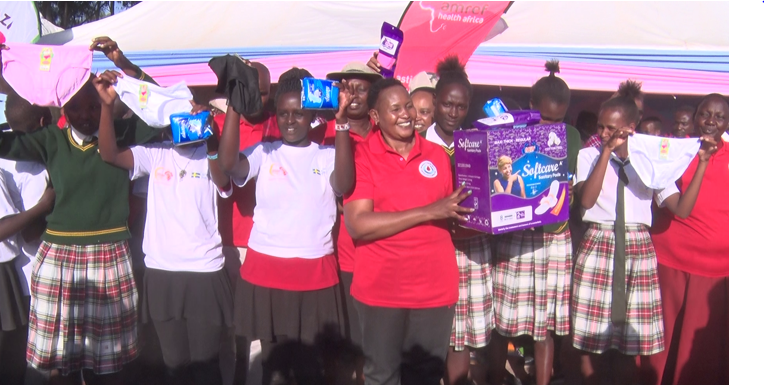
“Menstruation should not be a reason a girl cannot achieve her dreams,” said Agness Ntutu, spouse of the Narok County Governor Patrick Ntutu, as she addressed hundreds gathered at Maji Moto in Narok South during this year’s World Menstrual Hygiene Day.
In her heartfelt address, Mrs. Ntutu called on parents, local leaders, government agencies, and development partners to make menstrual health a collective priority.
“Many girls miss class every month. That is 65 percent in rural areas, missing classes due to a lack of sanitary pads. This has led to stigma, absenteeism, and in some cases, dropping out of school entirely,” she emphasized.
Her remarks struck a chord in a community where menstruation is still shrouded in shame and myths, and where discussions around it are often avoided entirely.
For girls like 17-year-old Naisula (not her real name), a Form Three student in a day school near Ololulunga, periods are not just a biological occurrence — they are a source of monthly anxiety.
“There are days I’ve had to stay at home because I didn’t have pads,” she says quietly. “Sometimes I use cloth or paper, but it’s uncomfortable and I’m always worried about leaking.”
Stories like Naisula’s are all too common in Narok. In many pastoralist communities, cultural taboos have created an environment where even mothers feel embarrassed to discuss menstruation with their daughters. As a result, girls are left unprepared, misinformed, and unsupported.
Mrs Ntutu acknowledged the invaluable role NGOs have played in bridging this gap. “Your support has restored dignity, confidence, and hope to our young girls,” she said, applauding organizations that have distributed menstrual products and conducted awareness campaigns in hard-to-reach areas.
A good number of these Non-Governmental Organizations have been running menstrual hygiene workshops and providing reusable sanitary kits in schools across Narok.
Most of their programs are not just about pads — they are also about empowerment. They teach girls about their bodies, hygiene, and self-worth. They also talk to boys and male teachers to break down the stigma.
But the need remains urgent. A recent survey by a local NGO focusing on education indicated that menstrual-related absenteeism is one of the top five factors affecting girl-child education in Narok’s rural zones.
The lack of sanitation facilities in schools, long distances to reach shops, and high poverty levels all compound the challenge.
Mrs Ntutu urged county and national government actors to prioritize menstrual health as a policy issue. “We cannot talk about empowering the girl child without addressing this very basic need. If we want our girls to excel, they need to be in school every day of the month.”
Her call to action included a plea to parents: “Let us not wait for donors or NGOs. As parents, it is our duty to make sure our daughters are safe, confident, and supported through every stage of their lives.”
As the event came to a close, schoolgirls received menstrual kits donated by local partners, their shy smiles belying the quiet relief that came with knowing someone cared.
In a county often labelled as marginalized and remote, moments like these signal hope. The journey toward menstrual dignity in Narok may be long, but for girls like Naisula, each day with dignity and confidence is a step closer to a brighter future.
By Lamech Willy.A