The national government plans to establish a pharmaceutical manufacturing plant in Murang’a county and the first of its kind in the country on a 500-acre piece of land, part of the 1300 acres ceded by Delmonte Kenya to the Murang’a County government.
The move is aimed at reducing the cost of importation of pharmaceutical commodities, which costs the country up to Sh150 billion annually.
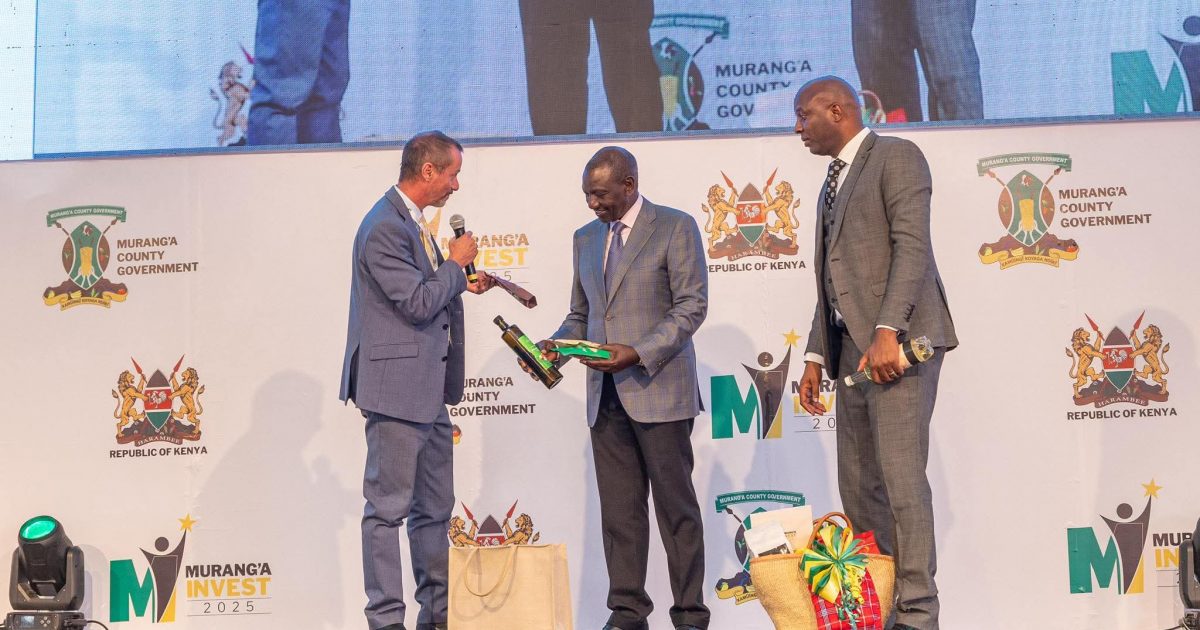
Speaking at the Inaugural Murang’a County Investment Conference in Murang’a, Friday, President William Ruto revealed that they had identified and marked Murang’a special Economic Zone as the country’s pharmaceuticals manufacturing hub.
“The ministry of health is providing relevant expertise to ensure that the Sh150 billion worth of pharmaceutical commodities supply that is currently being imported is manufactured right here in the country,” he said.
The president, while lauding the county government of Murang’a’s efforts to make the county an industrial hub, noted that the investment conference came at a pivotal time when the country was integrating county-level investment promotion into its broader foreign engagement strategy.
“Kenya’s real strength lies at the grassroots as it is our counties that comparative advantages in agricultural, manufacturing, energy, ICT, infrastructure and tourism become visible and that is why we must develop competitive value chains, and move beyond primary production,” he said.
The president observed that a key milestone in this effort is the signing of the EU-Kenya Economic Partnership Agreement (EPA) which grants the exporters duty-free, quota-free access to the European Union, as this will present significant opportunities for counties like Murang’a in agro processing, manufacturing and value chain addition.
“I urge all business people and farmers from our agriculture-rich regions to take advantage of these negotiations, which will play a huge role in expanding the market for our goods and services,” he added
The president reiterated that robust collaboration between the County and national government is instrumental as it would strengthen partnership for development through harmonized regulations, frameworks and coordinated investment promotion efforts.
He urged county governments to create a conducive environment for doing business by streamlining regulations, improving infrastructure and ensuring investor friendly policies while fostering innovation and lowering the cost of doing business.
President Ruto emphasized the importance of public–private partnerships, efficient service delivery and security as key enablers of economic growth at the grassroots level.
He noted that an end-to-end value chain ecosystem will help raise local incomes, create employment for the youth, improve food security and position counties as globally competitive exporters.
Meanwhile, the president revealed that the first phase of the affordable housing units in the county will be commissioned in August, noting that the housing project had significantly reduced land fragmentation.
“Currently, Murang’a is the country’s number one producer of avocados, tea and coffee and that is why we chose to construct affordable housing here to avoid excessive land fragmentation and use the land for agricultural productivity instead to build a food secure nation” he said
The president reaffirmed the national government’s commitment to supporting infrastructure development across the counties, noting that improved roads, power supply and connectivity are essential for attracting investment and driving economic growth.
The investment conference brought together hundreds of investors and delegates to explore key investment opportunities which include Murang’a Industrial Park which will hold an Export Processing Zone (EPZ)with an allocation of 500 acres and a Special Economic Zone (SEZ) with an allocation of 800 acres.
Other areas for investment are the County Aggregation and Industrial Park (CAIP), the Gikono Landfill, the Murang’a County Creameries Cooperative Union(MCCU), Small and medium Enterprises Parks (SMEs), Mukurwe wa Nyagathanga Cultural site and the Mariira Farm Kenyatta Agricultural Training Centre.
By Florence Kinyua