Air quality experts and communities of practice from across Africa and globally are calling on collective efforts in advancing collaborations and multi-regional partnerships for clean air actions in African cities.
The Championing Liveable Urban Environments through African Networks for Air (clean-air) Forum is helping African cities build on that shared language and vision in this year’s Clean Air Forum 2025 being held in a Nairobi hotel, Nairobi from 15th to 17th July.
The Forum held under the theme “Partnerships for clean air solutions,” seeks to strengthen cross-border transdisciplinary partnerships, evidence generation and capacity for advancing clean air solutions in Africa.
The forum has brought together over 300 participants representing national and local governments, academic institutions, startups, funding organizations, development partners, and grassroots groups from across Africa to discuss the pressing issues of air pollution on the continent.
Organized by AirQo, a Pan-African air quality research initiative at Makerere University, and hosted in collaboration with Nairobi City County Government, World Resources Institute (WRI) Africa, and the Health Effects Institute, the Forum builds on the success of previous editions held in Kampala 2023 and Lagos 2024
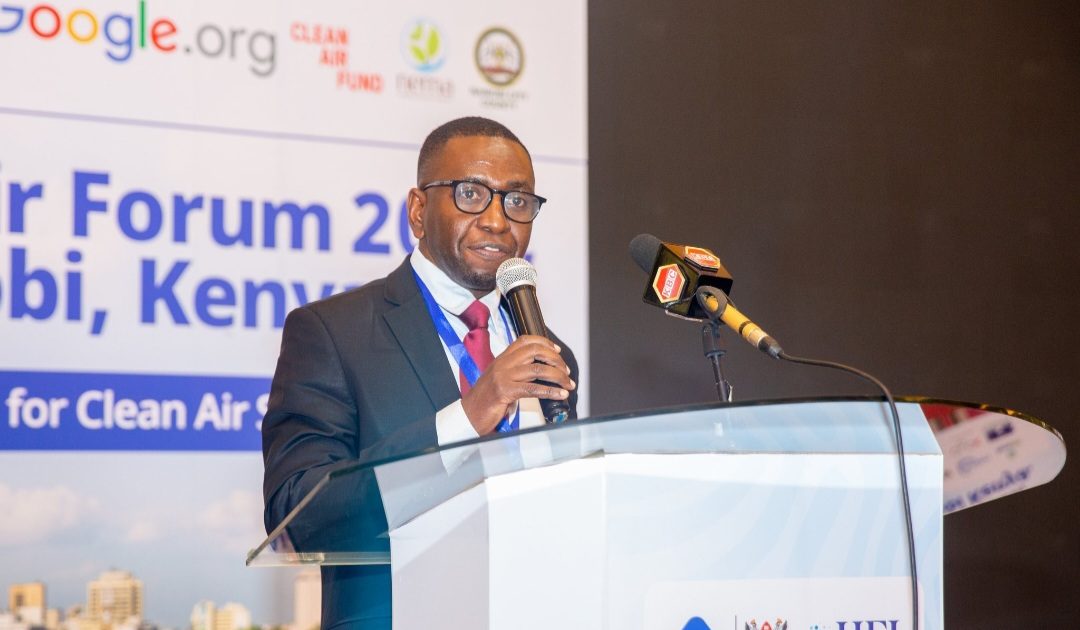
Speaking during the event, Country Director for World Resources Institute in Kenya Dr. George Mwaniki said that this year’s theme features a dynamic program designed to foster collaboration and inspire action noting that air pollution remains one of the most serious and underreported public health challenges across African cities.
He said that the Forum has become Africa’s leading platform for driving evidence, innovation, and equity in air quality and serves as a platform for knowledge sharing, collaborations, multi-regional partnerships, and networks to tackle air pollution in African cities.
“The theme, partnerships for clean air solutions, is a timely reminder: no one city, country, or community can solve this crisis alone. We have to work together,” he said.
Mwaniki said that air pollution is important in this part of the continent noting that if you look at most reports that look at air pollution in Africa, very few countries are doing anything about it.
“In 2019 when we did the first report, I think only two or three countries actually had air quality regulations in Africa. But by 2025, I think that number has increased to around 15,” he said, adding that participants engaged in policy dialogues that focus on advancing evidence-informed regulations across African cities.
Mwaniki also heads the air quality WRI across Africa and said that air quality is not a stand-alone issue. It is deeply connected to land use, waste management, housing, transport, and even digital governance.
He said the forum showcases emerging technologies, including low-cost air quality sensors and the use of artificial intelligence for pollution forecasting tools that are transforming how cities monitor and respond to air quality challenges.
According to a recent Health Effects Institute Scoping Review titled “Health Effects of Air Pollution in East Africa”, air pollution led to approximately 294,000 deaths in 2021 across the region, making it the second-largest contributor to mortality, surpassed only by malnutrition.
The review also shows that biomass fuel use and vehicle emissions are among the dominant sources of pollution, with limited air quality monitoring coverage across the region.
Director AirQo Prof. Engineer Bainomugisha said We need to bring together different stakeholders and we all must act knowing that clean air is not a single discipline; it’s not a single stakeholder matter.
“This forum is a platform to enable us to see how we can collaborate together. When we clean up the air, it is not a single country cleaning up the air, because that is not sufficient,” he said, adding that we cannot have a boundary of clean air.
He noted that a country or city might be polluted, but actually it might not be the source of the pollution, because pollution is influenced by other factors, meteorological factors, like wind and so on.
“Clean air is not like water. You can go and buy a bottle of clean water, but you cannot go out and buy a bottle of clean air,” he said, adding that the forum is important so that we see that there is a need to collaborate.
CECM Mobility and Works Nairobi City County Ibrahim Nyongesa said that the air we breathe is shaping our public health, our economic resilience, and the future of urban sustainability and that addressing air pollution challenges begins with robust, transparent, and actionable data noting that no government can manage what it cannot measure.
“Data is needed to inform effective, evidence-based action in real-time, location-specific, publicly accessible air quality data that remains limited, inconsistent, or altogether absent in many contexts,” he said.
He said that emerging technologies including low-cost sensors, artificial intelligence, machine learning, satellite-based remote sensing, and community-driven platforms are redefining how we measure, understand, and respond to air pollution.
“But technology alone is not enough. The real breakthrough lies in partnerships. Between cities and researchers. Between governments and civil society. Between local innovators and global platforms” he said.
He said that Nairobi City County is working with development partners to develop a city-owned air quality data ecosystem, one that is decentralized, transparent, and accessible to the public, with regulations anchored in the Nairobi City County Air Quality Act, 2022.
“I urge us to move forward and to collaborate boldly, recognising that no single actor can deliver clean air alone,” he said, adding nations need to prioritize local data ownership and scalable innovation and to act urgently, because the cost of inaction is measured in lives, livelihoods, and lost potential.
By Anita Omwenga