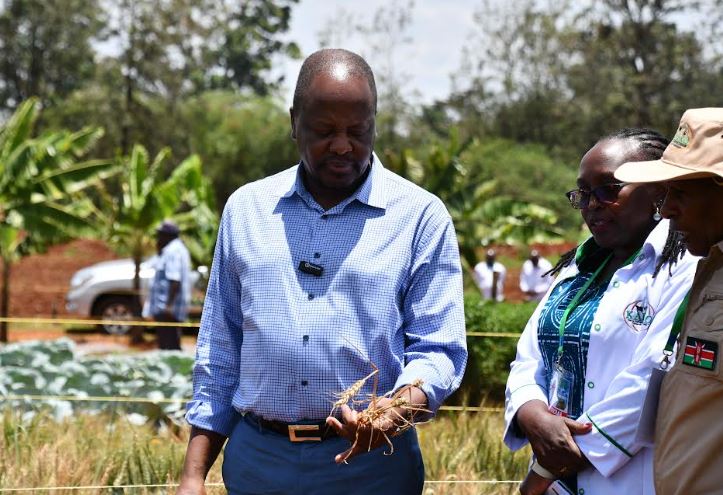
Cabinet Secretary for Agriculture and Livestock Development Mutahi Kagwe has issued a stern warning to individuals involved in the sale of counterfeit seeds and fertilizers, describing the illegal trade as a serious threat to national food security.
Kagwe said the government is considering introducing tougher penalties, including possible treason charges, against those found selling fake agricultural inputs to farmers.
Speaking during the opening of the two-day Kilimo Biashara Expo organized by Kenya Agricultural and Livestock Research Organization (KALRO), the Cabinet Secretary described the sale of fake seeds as economic sabotage that could undermine the country’s ability to feed itself.
According to Kagwe, unscrupulous traders have been importing and distributing counterfeit seeds, fertilizers and chemicals, putting farmers at risk of crop failure and financial losses.
“There are individuals bringing counterfeit seeds into the country and selling them to our farmers. As far as I am concerned, anyone selling fake seeds to farmers is committing an economic crime that threatens the survival of the nation,” he said.
The CS emphasized that agriculture is the backbone of the country’s food security and should therefore be protected from criminal activities that could destabilize production.
He warned that the proliferation of fake farm inputs could cripple the agricultural sector if urgent measures are not taken.
“They are ensuring that the country cannot feed itself. The quickest way to weaken a nation is by destroying its food production systems through fake seeds, fake fertilizers and fake chemicals,” Kagwe noted.
He added that the government is already engaging members of Parliament with the aim of strengthening laws governing the agricultural sector and imposing stiffer penalties for offenders.
Kagwe acknowledged that the current legal framework has not been strong enough to deter criminals who exploit farmers by selling substandard inputs.
“We have spoken to our colleagues in Parliament and we will be proposing much stronger penalties for those engaging in criminal activities in the agricultural sector,” he said.
Apart from counterfeit farm inputs, the Cabinet Secretary also highlighted soil degradation as another major challenge affecting agricultural productivity.
He said that despite ongoing soil testing programmes led by KALRO, many farmers still lack access to accurate information about soil fertility and the appropriate fertilizer to use.
Kagwe proposed that soil testing services should be provided free of charge to farmers to encourage wider adoption and improve agricultural productivity.
“Science is what we are going to rely on. Soil testing should be made accessible to all farmers so that they can know exactly what their land requires and apply the right fertilizers,” he said.
The CS revealed that the government is currently undertaking a nationwide digital soil mapping exercise aimed at providing farmers with detailed information on soil conditions.
The initiative is being implemented across 45 counties and seeks to transform agriculture through science and technology-driven solutions.
The digital soil mapping project aims to identify specific nutrient deficiencies in different regions and provide farmers with data-driven recommendations on fertilizer application.
By using advanced technologies such as artificial intelligence, drones and remote sensing, the programme will generate ward-level soil data to guide farmers on the most suitable soil management practices.
The initiative also seeks to improve crop yields, reduce fertilizer wastage and reverse land degradation by at least 30 percent by the year 2034.
In addition, the programme has engaged more than 40 young professionals and agri-preneurs to participate in soil sampling and mapping activities across the country.
Kagwe said the exercise will help farmers make informed decisions that will ultimately improve productivity and strengthen national food security.
The Kilimo Biashara Expo, organized by KALRO, is being held under the theme “Advancing Agribusiness through Improved Technologies, Partnerships and Market Linkages.”
The two-day event brings together farmers, researchers, agribusiness investors and other stakeholders in the agricultural value chain to share knowledge and explore innovative technologies that can transform farming.
By Wangari Ndirangu