When 15-year-old Laura Adhiambo sat her Kenya Primary School Education Assessment (KPSEA) exams at a small informal school in Nyalenda slums, her future hung in the balance.
Her mother, a casual labourer, could not afford senior secondary school fees.
For weeks, Laura remained at home, uncertain whether her education would end there.
Her breakthrough came through a well-wisher—part of an Asian community support network that secured her a place at Lions Secondary School. Today, Laura is among a fortunate few.
For thousands of other learners emerging from Alternative Provision of Basic Education and Training (APBET) schools across Kisumu County, that opportunity never comes.
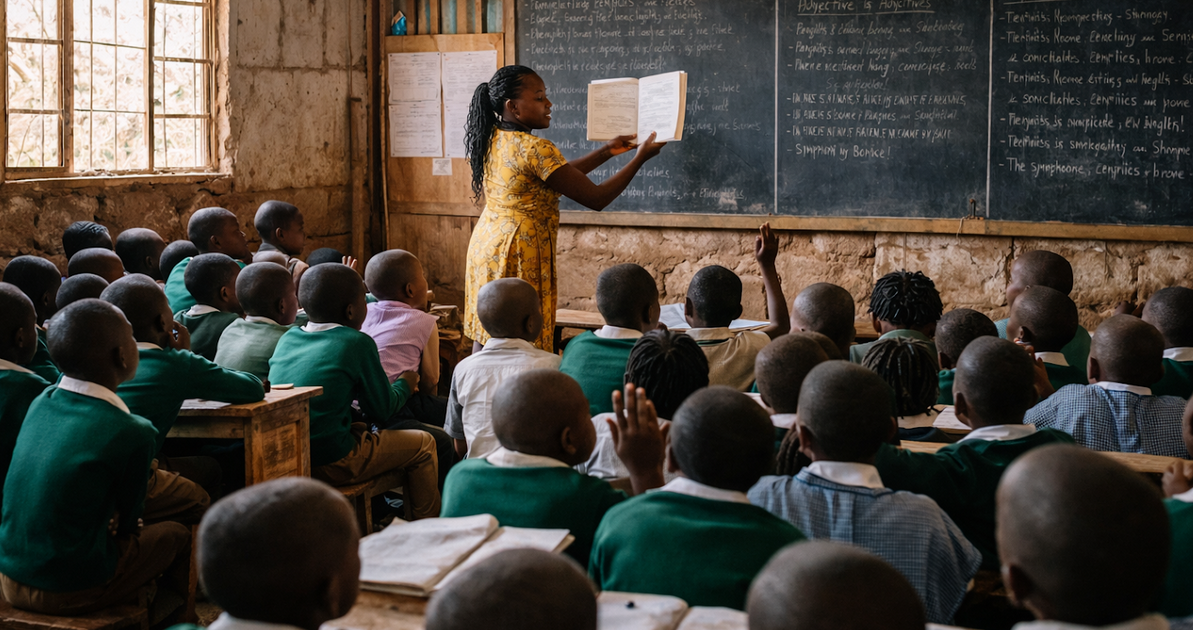
APBET schools are low-cost, community-based institutions operating mainly in informal settlements and underserved areas, filling gaps where public schools are either overstretched or inaccessible.
They cater largely to children from vulnerable households, offering education from early childhood to junior secondary level at minimal or flexible fees.
But behind their critical role lies a deepening crisis that stakeholders warn could reverse gains in access to education for the country’s poorest children.
John Ochieng, the APBET chairman in Kisumu County and proprietor of St. Williams Learning Centre in Otonglo, paints a grim picture of an overstretched system struggling without government support.
“At my school alone, we have about 510 learners, from Early Childhood Development to Junior Secondary School. Multiply that across the county, and you begin to understand the scale of the problem,” he said.
Kisumu, he said, has more than 250 APBET schools serving tens of thousands of learners, many from informal settlements such as Manyatta, Obunga and Nyalenda. Nationally, the number exceeds two million.
Despite this, the schools remain largely outside government policy and funding frameworks.
He warned that the government’s push for 100 per cent transition was being dealt a significant blow, as thousands of learners from APBET institutions drop out each year due to lack of support.
Concerns are also mounting over the quality of education, with overcrowded classrooms, limited learning materials and undertrained teachers affecting outcomes.
One of the most pressing challenges, he said, was the lack of Competency-Based Curriculum (CBC) materials.
“In most cases, a teacher is using a single copy of a book. Learners do not have books on their desks. We rely on digital copies where possible, but even that is not reliable,” he said.
Textbooks, costing between Sh600 and Sh1,000, he said, remain beyond the reach of most parents, many of whom struggle to meet basic needs.
He added that the shortage of trained teachers has further compounded the situation.
Before the Covid-19 pandemic, some APBET schools, he said, benefited from limited government support through teacher deployment.
“That support has since been withdrawn. We no longer have government teachers. We depend on NGOs, but they cannot cover all schools,” Ochieng said.
At St. Williams, for instance, only one teacher is supported by an external organisation, Pacemaker International. Across the county, most schools rely on underpaid or volunteer teachers.
The absence of structured government-led capacity building has also left teachers ill-equipped to implement the CBC effectively.
“Teacher training used to be supported. Now it is not happening. Our teachers are struggling,” he said.
Although donor support helped rebuild some facilities after the Covid-19 pandemic, recovery has been slow, with several schools—particularly in areas like Manyatta—shutting down due to financial strain.
A key sticking point, he said, remains the registration and recognition of APBET schools.
A 2018 mapping and registration exercise by the Ministry of Education led to the gazettement of some institutions in Kisumu.
However, the process has stalled nationally, locking many schools out of Free Primary Education (FPE) funding.
The exercise, initiated to streamline the sector and eliminate unregulated briefcase schools, required institutions to undergo mapping, assessment and registration before qualifying for support.
But implementation has been uneven, with regions such as Nairobi, Mombasa and Nakuru yet to complete the process.
“Only about 31 schools here are registered, and even those are not receiving any support,” said Ochieng.
According to Ochieng, the Ministry has indicated that funding and full recognition will only follow once all regions comply with the policy framework—leaving already assessed schools in limbo.
“The ministry says they are waiting for compliance across all regions. But in the meantime, learners are suffering,” he said.
Transition to senior secondary school, he said, remains particularly affected, with many learners dropping out after Grade 9 due to lack of fees, uniforms and placement opportunities.
“In some areas, children simply stop going to school. They have no options,” he said.
Ochieng argued that APBET schools fill a critical gap in Kenya’s education system and should be formally recognised and integrated into the national framework.
“The government must accept that APBET schools are playing a major role. They should support us with learning materials, allow registration, and provide infrastructure and teachers where possible,” he said.
He warned that failure to act could have long-term consequences.
“We are talking about thousands of children. If we do not support them now, we risk losing an entire generation,” he said.
For learners like Laura Adhiambo, the system worked—barely. For many others, the window is closing fast.
By Chris Mahandara