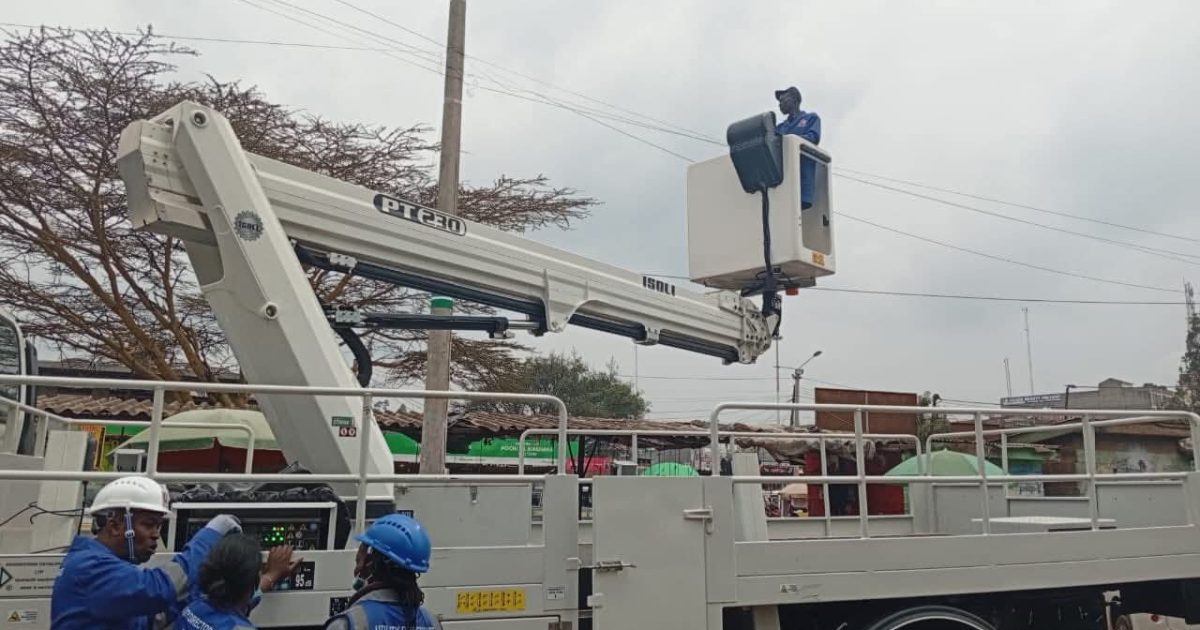
Kiambu county has unveiled one of Kenya’s highest-capacity manlifts, a 23-metre platform designed to fast-track the installation of thousands of solar-powered street lights under the county’s flagship renewable energy programme.
The launch also marked the completion of Phase Two of the Sh1 billion initiative, aimed at reducing electricity costs, enhancing security, and extending business hours across all 12 sub-counties.
The new manlift is expected to cut installation time by half, enabling crews to mount up to 40 streetlights per day.
“This is not just about lights. It is about safer streets, thriving businesses, and lower electricity bills for taxpayers. Kiambu is setting the pace for renewable energy adoption in counties. More than 4,200 solar streetlights have already been installed since the project began in 2023, with another 5,800 expected before June 2026,” said governor Kimani wa Matangi.
“Once complete, the programme will illuminate over 80 percent of Kiambu’s public roads, a scale unmatched by most counties, where renewable lighting programmes remain small or donor-dependent,” said the governor.
Some residents and analysts, however, urged patience and accountability.
“I welcome the programme, but why is it taking so long to reach our estate? Some areas are still in darkness,” said Mary Wambui, a shopkeeper in Juja.
Civil society groups have also called for transparency, noting the project’s billion-shilling cost.
“Without clear funding disclosures, questions of accountability will linger,” said a representative from Energy Governance Kenya, an NGO monitoring county energy projects, who attended the launch.
The initiative is funded through the county development budget, with technical support from local contractors and projected annual savings from the programme.
Kenya has pledged to transition to 100 percent clean energy by 2030 under Vision 2030, and experts say Kiambu’s approach could serve as a model for other counties, particularly if it demonstrates durability and cost-effectiveness.
Comparable programmes in Rwanda and South Africa have reduced public lighting costs by up to 60 percent, while enhancing community safety.
Phase Three, targeting remote villages and feeder roads, is expected to begin early next year, with completion projected by June 2026.
County officials have committed to publishing quarterly progress reports to enhance transparency.
By Njoroge Gladys