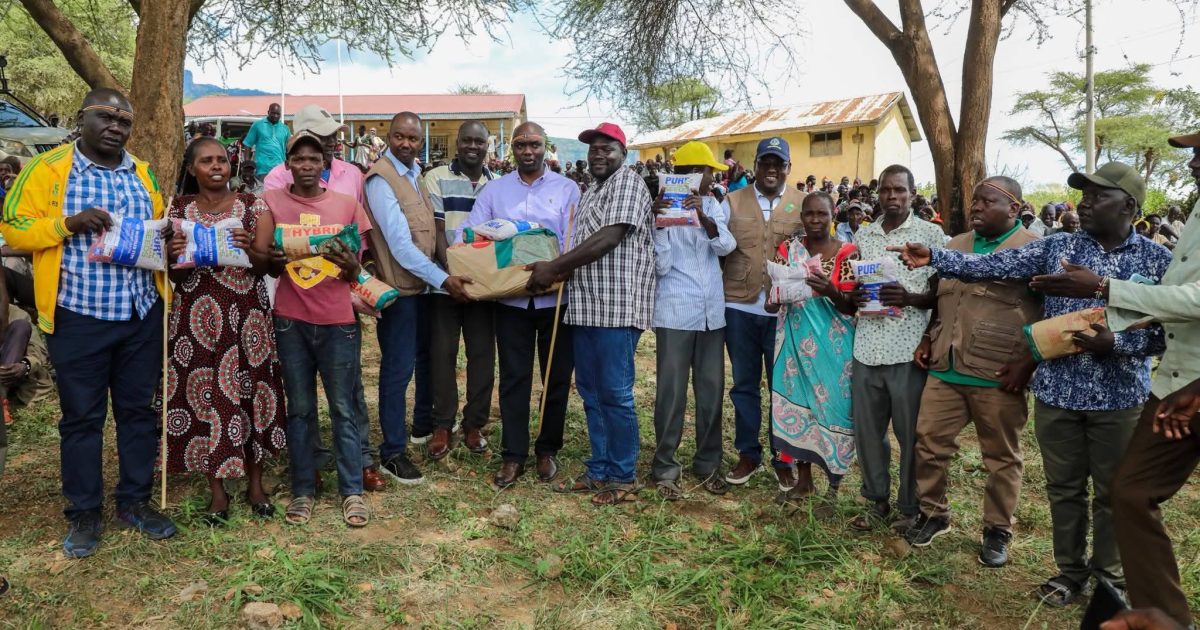
More than 13 tonnes of certified, climate resilient seed varieties have been distributed to farmers in Kerio Valley in a targeted intervention by the Elgeyo Marakwet County government, aimed at enhancing agricultural productivity and adaptive capacity in arid and semi-arid zones.
The distribution comprised 6.5 tonnes of drought tolerant Nyota bean seeds, 4.32 tonnes of fast maturing dryland DH04 maize seeds, and 2.5 tonnes of sorghum seeds, all selected for their high yield potential, early maturity, and resilience to moisture stress.
Beneficiaries were drawn from Endo, Arror, Lower Sambirir, Lower Emsoo, and Lower Tambach areas, all characterized by erratic rainfall patterns and recurrent dry spells.
Governor Wisley Rotich, who led the exercise alongside technical officers from the Department of Agriculture, emphasised the strategic importance of input support in optimizing farm level productivity under climate variability.
“Kerio Valley holds immense potential in agricultural production. Through sustained input provision and the promotion of climate smart agriculture, we are enhancing the capacity of our farmers to achieve optimal yields despite prevailing environmental constraints,” said Rotich.
The Governor indicated that the distributed inputs are projected to facilitate cultivation across approximately 1,400 acres under rain fed conditions. “We plan to put about 1,400 acres under crop production. Specifically, 6.5 tonnes of Nyota beans will cover 324 acres, 4.32 tonnes of maize will plant approximately 430 acres, and 2.5 tonnes of sorghum seeds will be utilized across about 630 acres,” he stated.
He further noted that the intervention is anchored in the county’s Pesa Mfukoni economic empowerment framework, which seeks to enhance household income through market oriented agricultural production.
“Through our Pesa Mfukoni program, structured aggregation and commercialization of the anticipated harvest is expected to increase household incomes while strengthening food and nutrition security significantly,” he added.
Rotich expressed optimism about the intervention’s impact, stating: “This year, we are telling a different story from the great Kerio Valley, a story anchored on productivity, resilience, and shared prosperity.”
County Executive Committee Member for Agriculture Edwin Kibor underscored the technical rationale behind the selection of the seed varieties, noting that the intervention aligns with climate smart agriculture principles.
“We have deliberately procured certified, drought tolerant and early maturing crop varieties that are suitable for the agro-ecological conditions of Kerio Valley. These seeds will ensure higher germination rates, improved yields, and reduced risk of crop failure due to moisture stress,” said Kibor.
He further reiterated the importance of adherence to agronomic best practices, adding, “We are also providing extension support to farmers to ensure proper land preparation, timely planting, and effective crop management for maximum productivity.”
Area Agriculture Chief Officer Edwin Komen reiterated the importance of extension services and continuous farmer engagement to guarantee optimal outcomes.
“Our extension officers will be on the ground to guide farmers on appropriate spacing, pest and disease control, and post-harvest handling. This is aimed at ensuring that the distributed inputs translate into tangible productivity gains and improved household incomes,” said Komen.
He added, “We are also encouraging farmers to adopt diversification and sustainable land management practices to enhance resilience in the face of climate variability.”
On his part, Public Service County Executive Edwin Seronei highlighted the county’s integrated approach in supporting farming communities through institutional coordination. “This programme demonstrates the county government’s commitment to strengthening service delivery at the grassroots level. By integrating agricultural support with other public service functions, we are ensuring that farmers receive timely inputs and technical assistance,” Seronei stated.
The seed distribution exercise which is part of a broader county strategy to scale up adoption of drought resilient crop varieties, improve cropping intensity, and enhance resilience of smallholder farming systems in the Kerio Valley ecosystem will continue in Soy North and Soy South wards.
by Rennish Okong’o