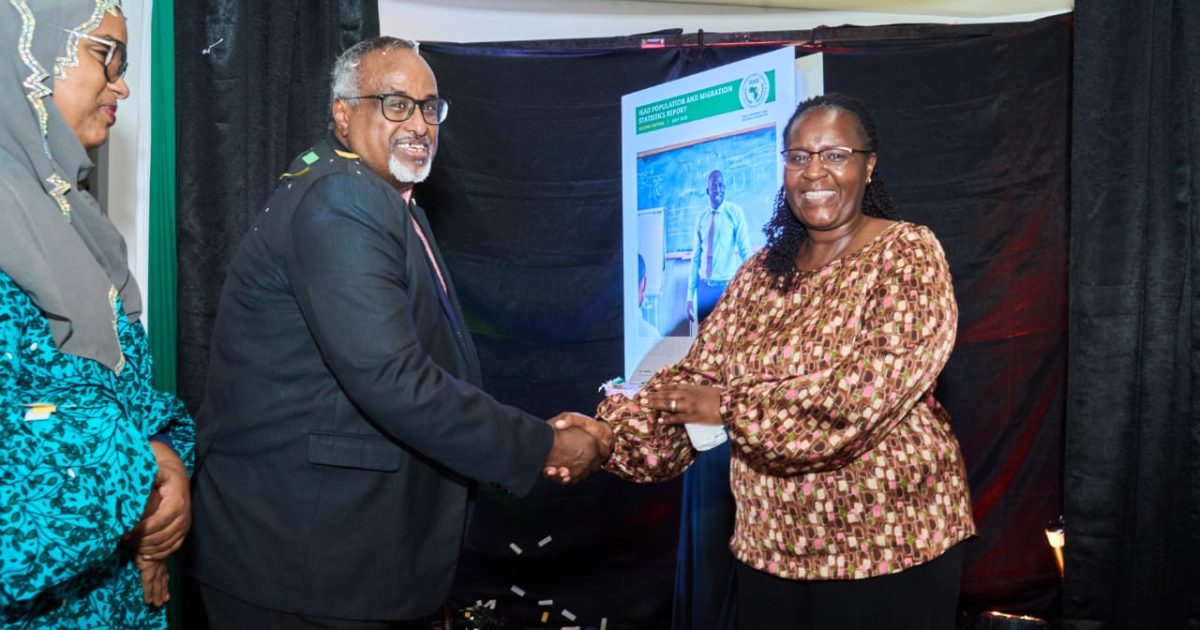
The Intergovernmental Authority on Development (IGAD), in collaboration with GIZ and Statistics Sweden, has launched the second edition of the IGAD Population and Migration Statistics report to strengthen evidence-based migration and displacement governance.
The report seeks to generate, harmonise, and utilise reliable data to inform regional and national migration policies
The report provides comprehensive statistics and analysis of migration and displacement trends in the IGAD region, which includes Djibouti, Eritrea, Ethiopia, Kenya, Somalia, South Sudan, Sudan and Uganda from 2010 to 2022.
It highlights the region’s critical role in global migration dynamics and the importance of data-driven policies to address migration and displacement challenges.
Key findings reveal that the IGAD region’s population grew from 207.5 million in 2010 to 283.5 million in 2022, with men (141.8 million) and women (141.7 million) almost equally represented.
International migrants rose by 65.9 per cent over the past decade, reaching 6.8 million in 2022 with forced displacement remaining a pressing issue, as the region hosts 4.3 million refugees, one in every six globally.
The number of working-age migrants increased significantly from 2.7 million in 2013 to 4.3 million in 2022, representing a 56.8 per cent increase. This trend was observed across both sexes. Labour migration within the region also expanded.
Among these, the majority originated from South Sudan, Somalia, and Sudan. Women and children constituted a large share of the refugee and asylum-seeking populations. For instance, in 2022, 51 per cent of refugees and 49 per cent of asylum seekers were female.
The report shows that the region is prone to mixed migration flows that are mainly destined for: Europe through Sudan, Libya, and Egypt; the Kingdom of Saudi Arabia (KSA) and other Gulf countries through Djibouti, Northern Somalia, and Yemen; and South Africa through Kenya, Tanzania, Zambia, and Malawi.
The report also highlights the economic significance for Member States of remittances, which reached US$12.3 billion in the IGAD region in 2022, up from US$3.3 billion in 2010. Kenya at US$4.02 billion, Ethiopia (US$2.54 billion), and Somalia (US$1.74 billion) were the top remittance-receiving countries.
Speaking during the launch in Mombasa, IGAD Deputy Executive Secretary Mohamed Ware said it was through the availability of accurate, reliable, and timely data that nations could develop evidence-based policies and national development plans to achieve the prospects of a resilient, peaceful, prosperous, and integrated region where citizens enjoy a high quality of life.
He noted that migration, driven by political instability, economic disparities, environmental shocks, and deep historical and cultural ties, remained one of the most defining features of the IGAD region.
“Our Member States are simultaneously countries of origin, transit, and destination. The result is a highly dynamic migration landscape, comprising labour migrants, refugees, internally displaced persons, returnees, and stateless populations,” he stated.
The Deputy Executive Secretary further stressed that accurate and harmonised data is not a luxury but a necessity.
“Without it, our policies risk being reactive rather than proactive. With it, we can anticipate challenges, safeguard rights, and design durable solutions that uphold the dignity of displaced populations,” he said.
He added that well-governed migration, underpinned by sound evidence, is a driver of sustainable development, social stability, and regional integration while on the other hand, poorly governed migration risks heightening vulnerability, marginalisation, and exploitation.
The Kenya National Bureau of Statistics (KNBS) Acting Director for Population and Social Statistics Rosemary Bowen noted that for the region, migration is not just a challenge but also an opportunity.
“It is a driver of economic growth, cultural exchange and regional integration. However, it also presents significant governance challenges, particularly in ensuring safe, orderly and regular migration while addressing irregular migration and its associated risks,” she said.
By Sadik Hassan