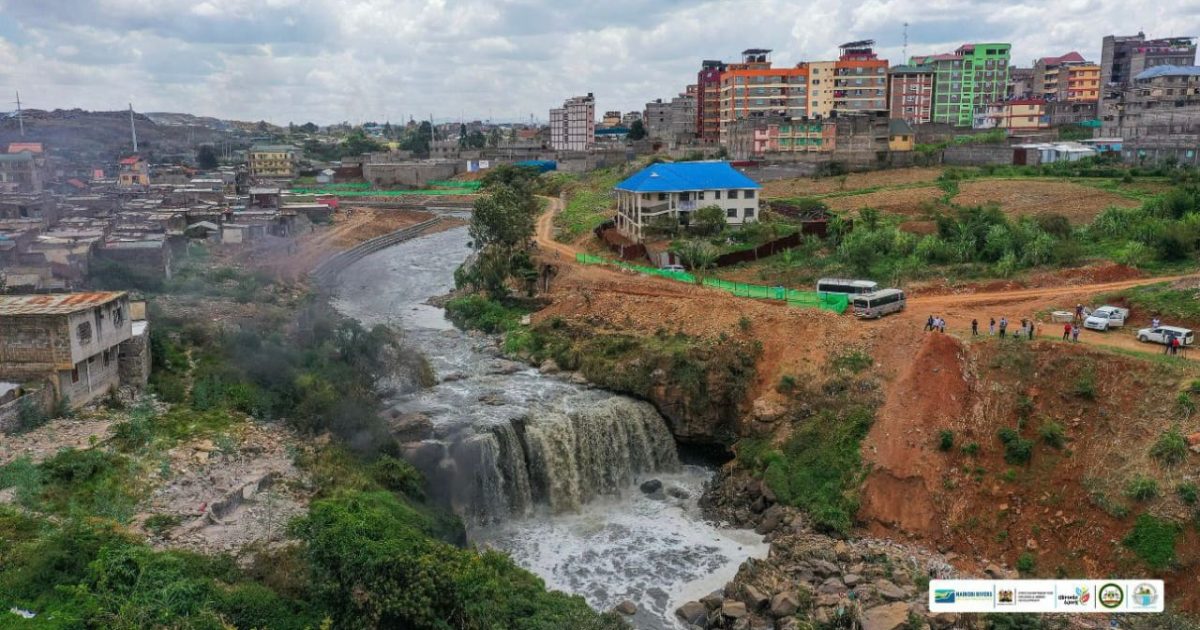
The Nairobi county government has reaffirmed its commitment to the ongoing Nairobi Rivers Regeneration Programme, a multi-agency initiative aimed at restoring the city’s main waterways into clean, accessible and economically productive corridors.
Speaking during an inspection of the Kamukunji regeneration site, the County Executive for Green Nairobi, Maureen Njeri, announced that the project represents a significant step in restoring riparian lands affected by pollution and encroachment.
“This project represents a long-awaited opportunity for Nairobi to transform its environmental narrative through the regeneration of its rivers,” she said
Njeri noted that the county government, through the Green Nairobi Department, is collaborating closely with the Nairobi Rivers Commission to provide technical guidance, secure access to land spaces along the river corridors and oversee waste management and supervision of ongoing works.
Furthermore, she explained that the city’s three major rivers Nairobi, Mathare, and Ngong have suffered heavy pollution over the years due to rapid urbanization, inadequate sewer infrastructure and illegal dumping.
The regeneration plan involves the construction of a modern trunk sewer line, the first major upgrade since the 1970s to improve wastewater management.
“We are putting up a huge trunk sewer that will run along the river, replacing dilapidated networks that have outlived their usefulness,” she said.
At Kamukunji, the site of the historic Saba Saba rallies, the project will transform the area into a recreational park equipped with playgrounds, sports grounds and landscaped gardens.

Additionally, Njeri that the county will replicate such green spaces along the river corridor to give communities cleaner, safer environments.
“We want residents of Nairobi to participate in activities such as walking, working, and recreation along the river while also enjoying the clean water that can be utilized for various purposes,” she said.
The programme, which aligns with Governor Johnson Sakaja’s urban renewal agenda, will also involve enforcement actions against industries discharging effluent into rivers and heightened community awareness on proper waste disposal.
“Waste management is a significant issue due to residents often neglecting their responsibilities, and it is crucial for everyone to understand the proper disposal of their waste,” Njeri remarked, adding that the county is bringing in new waste collection trucks and contractors to clear heaps that have accumulated along riverbanks and road reserves.
She confirmed that the Dandora dumpsite will eventually be decommissioned, once new waste collection, transportation, and treatment systems are fully in place.
“The dumpsite has been discussed for years, but we are now at the tail end of developing a practical strategy to ensure that less waste reaches Dandora and pollutes the river downstream,” she said.
Moreover, Nairobi Rivers Regeneration Project Manager Lt Col Kahigu Njoroge described the regeneration as a bold step by the government to reclaim the city’s environmental spine.
“This is not just a clean-up; it is reclaiming Nairobi’s environmental backbone and turning the rivers from the city’s backyard into its new frontage,” he said.
Lt Col Njoroge outlined five major components of the Sh45 billion government-funded project as flood control, sewer network upgrade, solid-waste management, non-motorized transport corridors, and urban landscaping.
He said engineering works are already underway in sections between Dandora and Kamukunji, with completion targeted for January 2027.
Thus, the upgraded river will feature expanded channels, pedestrian bridges, and non-motorized pathways stretching from Dandora Falls to Naivasha Road, allowing residents to walk or cycle safely along the river.
“The sewer lines being installed will serve Nairobi’s population up to 2065. Gabion interceptors are being built to trap solid waste before it enters the river,” he explained.
He added that the project also involves reclaiming wetlands and catchment areas such as Ondiri Springs, while greening efforts will turn neglected spaces into community parks.
“We are working with all relevant agencies from the Kenya Forest Service and Kenya Urban Roads Authority to the National Environment Management Authority and the county government to ensure success through a whole-of-government approach,” he said.
The regeneration drive is also creating thousands of jobs for local youth, particularly in labor-intensive tasks such as gabion construction and landscaping.
“We are deliberately employing young people living near the project areas to give them income and ownership of the work,” Lt Col Njoroge said.
At the community level, Josephat Karomi, Chairperson of the Kamukunji Environment Conservation Champions CBO, said the initiative has transformed lives by engaging idle youth in meaningful work and reducing crime rates.
“Many young people who were involved in crime and drug abuse now earn a living from this project,” he said.
Karomi added that the community helped design the Kamukunji Park master plan, which will host a modern football pitch, multipurpose grounds, and sanitation facilities.
The park will also feature the Freedom Horn, an art installation symbolizing Kenya’s democratic struggle, complete with a Freedom Museum, amphitheatre and maze celebrating the values of voice, struggle, and change.
“This park has deep historical meaning as the birthplace of Kenya’s multi-party democracy and its revival restores pride and identity to our community,” he said.
With regeneration works now gaining pace, both national and county leaders say the Nairobi Rivers Programme will redefine urban living by reconnecting residents to clean water, public spaces, and sustainable livelihoods.
By Naif Rashid