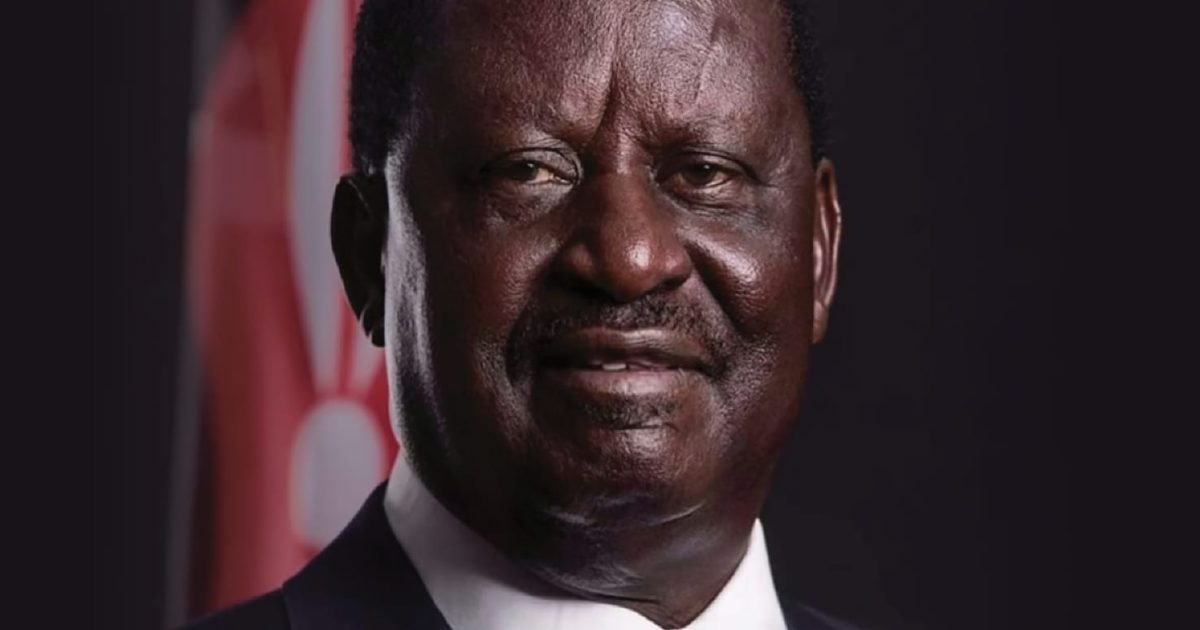
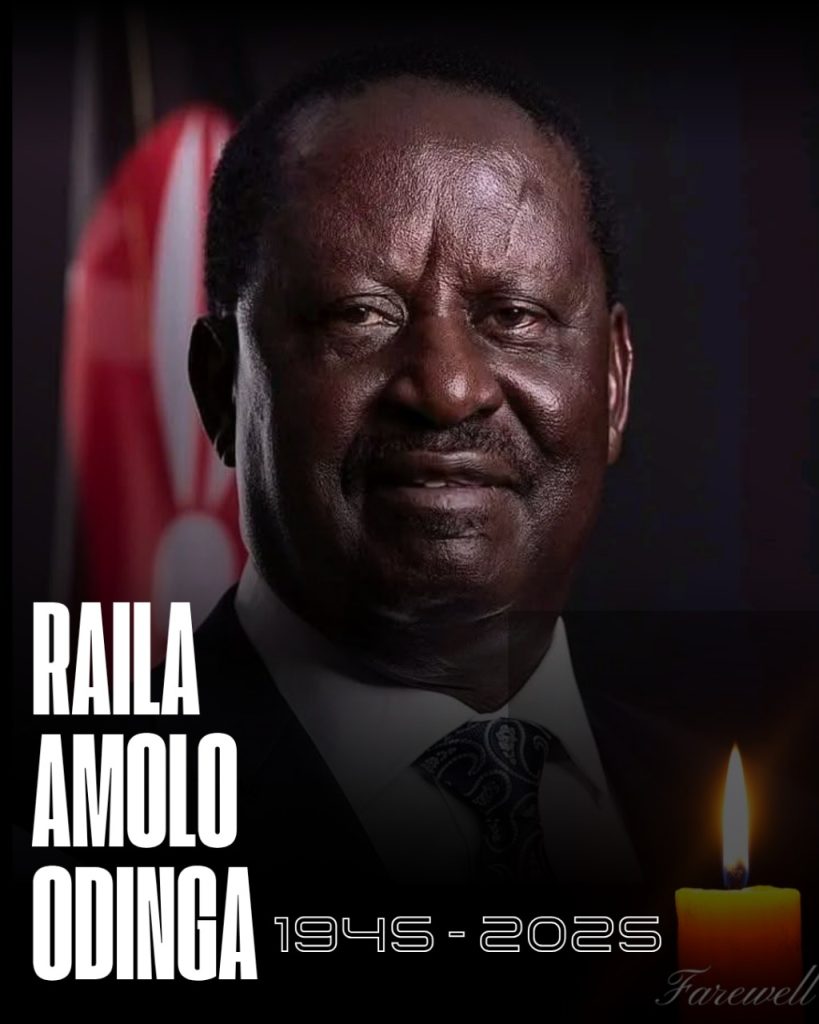
Raila Amolo Odinga; Kenya’s political enigma takes last bow
The death of Raila Amolo Odinga has brought the curtains down on the political career of a man known for many decades as a champion of democracy and master of the political chessboard.
Kenyans and world leaders have come together to mourn the passing on of the former Prime Minister and a man who strode Kenya’s political arena like a colossus.
Odinga, who died on Wednesday October 15, 2025 while undergoing treatment at a hospital in India, was aged 80. His death has ignited a nationwide wave of mourning for a man widely regarded as Kenya’s most influential political leader and reformist.
Fondly known by the moniker ‘Baba’, meaning father, Raila has for more than four decades remained the enigma of Kenyan politics, the man who possessed enormous power yet was not formally in power and a master of political handshakes.
Odinga’s political career began in earnest in the early 1980s and in the 90s, he began his intense fight against what he considered authoritarianism during the reign of the late President Daniel Arap Moi.
His activism landed him in lengthy detentions without trial, including a stint in detention for six years after the attempted 1982 coup. He was accused of involvement in the plot though the charge was later dropped.
Raila was detained again a number of times for his pro-democracy agitation, forcing him
to flee in exile in Norway in 1991. Raila played a pivotal role in the movement christened the ‘second liberation’ that
agitated for repeal of Section 2A of the Constitution in 1991, paving way for Kenya to revert to a multi-party democracy. Odinga’ political career is punctuated by perennial loss in his five-time bid to capture the
Presidency.
In 1997, he ran on a National Development Party (NDP) ticket and finished third after the
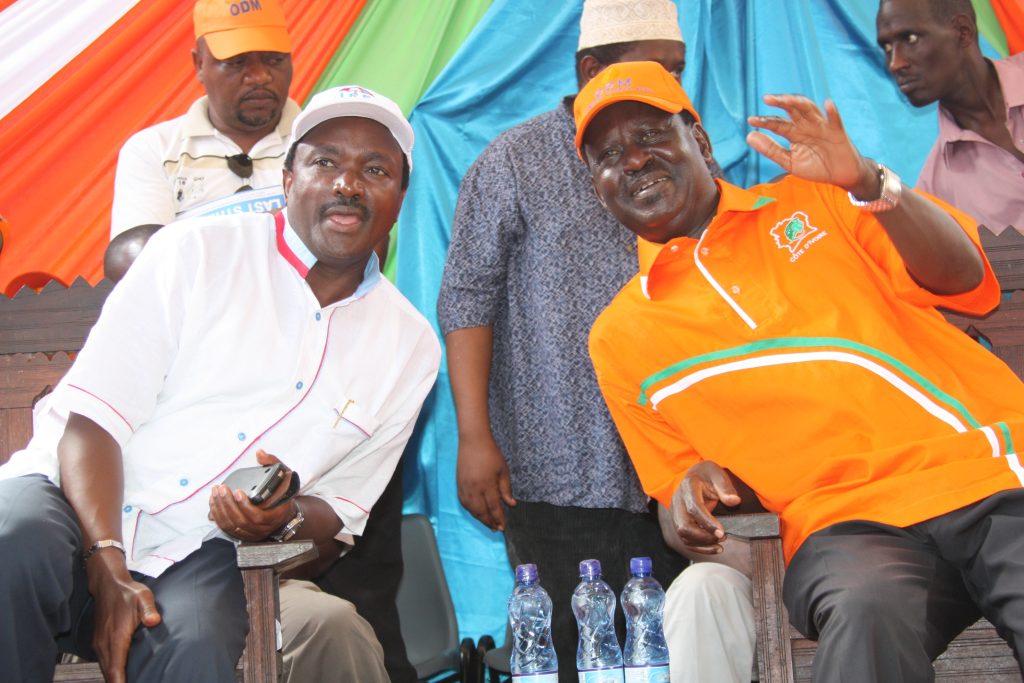
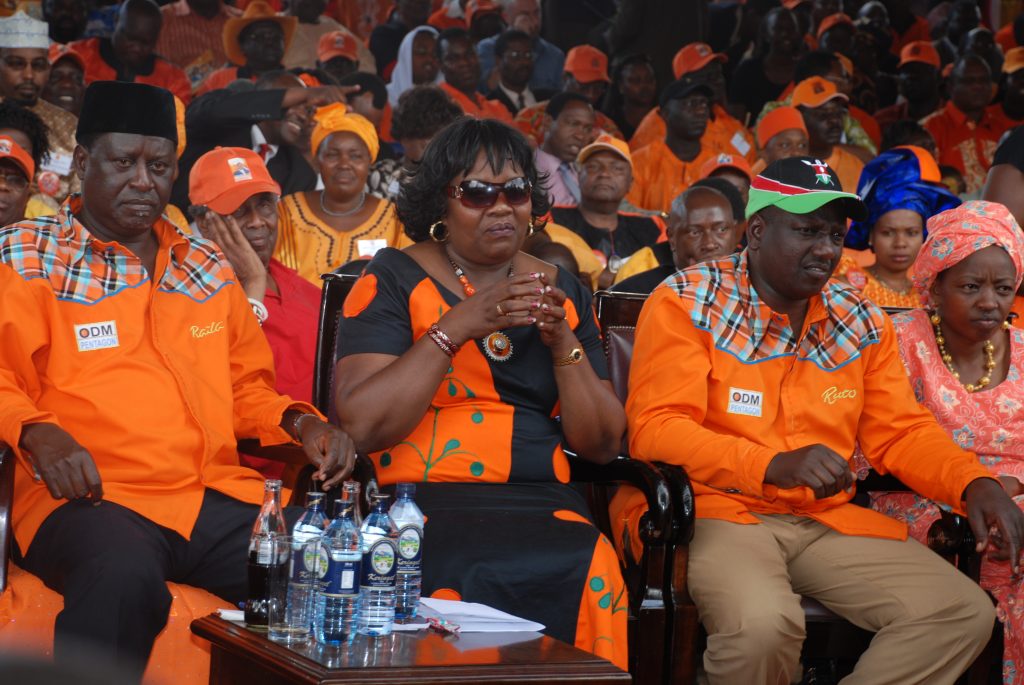
late Daniel Arap Moi and the late Mwai Kibaki. In 2007, Odinga contested the presidency on an Orange Democratic Movement (ODM) Party ticket in a hotly contested poll where incumbent Mwai Kibaki was declared winner, but the
disputed results led to post-election violence.
A power-sharing deal was negotiated with the then President Mwai Kibaki following which Odinga was appointed Prime Minister (2008-2013).
In 2013 running under the Coalition for Reforms and Democracy (CORD) ticket, Raila was the runner-up, losing to Uhuru Kenyatta but contested the results in the Supreme Court where the court upheld Uhuru’s victory. Come 2017, Raila running under the National Super Alliance (NASA) coalition again emerged runners-up and petitioned the outcome which the Supreme Court nullified, but he boycotted the repeat election.
In 2022, he ran on Azimio la Umoja-One Kenya coalition and again he emerged runner- up. He contested the results in the Supreme Court but the Court upheld President William Ruto’s win. Despite not clinching the Presidency, Raila has held key government roles, serving as Prime Minister under the Late President Mwai Kibaki under a power-sharing deal following the 2007-2008 post-election violence.
The arrangement was brokered through the National Accord and Reconciliation Act, which ended the crisis after lengthy negotiations by the late renowned diplomat and former UN Secretary-General, the late Koffi Annan.
During his tenure in Government, Raila is credited for pushing for the implantation of performance contracting in government ministries that has immensely improved accountability and service delivery. Odinga is widely credited as one of the key architects and father of the 2010 Constitution.
He was a champion of devolution; decentralized system of governance that led to the creation of 47 county governments. To him, this was the only way of addressing historical injustices, marginalization and
skewed resource distribution.
In his eulogy, President William Ruto has described Raila Odinga as a giant of democracy, a fearless freedom fighter and a tireless warrior of good governance. He said Odinga championed reforms that gave birth to the rights and freedoms we hold dear with his voice speaking for the oppressed, whose conviction inspired generations and his
vision shaped the course of our history.
“Raila Amolo Odinga is truly a once in-a-generation leader, a man whose ideals transcend politics and whose legacy will shape the destiny of Kenya for generations to come. A giant who towered for decades over the democracy landscape,” he added.
Raila Odinga was born on January 7, 1945 at Maseno, Nyanza region to Jaramogi Oginga Odinga’s, Kenya’s first Vice-President and Mama Mary Ajuma Odinga. Odinga began his formal education in Nyanza Mission schools, attending Kisumu Union Primary School and later Maranda Primary School, then Maranda High School in Bondo, a
leading institution known for producing intellectuals.
In 1962, at the age of 17 years, the young Odinga left secondary school to purse studies in East Germany, enrolling at the Herder Institute in Leipzig to study German language and culture. He later attended the Technical University of Magdeburg, earning a Master of Science degree in Mechanical Engineering in 1970.
He also completed short courses at the British Standards Institution, the National Bureau of Standards in Washington DC, the University of Denver, focusing on quality control and standardization.
Upon his return to Kenya, he served as an Assistant Lecturer in the University of Nairobi’s Department of Mechanical Engineering from 1970 to 1974.
He later joined the Kenya Bureau of Standards, rising to the position of Deputy Director, where he oversaw standardization and compliance.
Raila Odinga entered active politics in 1992 after serving six years in detention; from 1982-1988 for allegedly participating in the 1982 attempted coup.
He joined the Forum for the Restoration of Democracy (FORD), winning the Lang’ata Parliamentary seat in 1992 and securing re-election in 1997.
He was, on February 15 2025 presented by the country as candidate for African Union Commission (AUC) Chairmanship but he lost to Djibouti’s Mahamoud Ali Youssouf who won with 33 votes against 22 votes that Raila garnered. After the defeat, Raila on March 7, 2025 at the Kenyatta International Convention Centre, signed a 10-point Memorandum of Understanding (MOU) with President William Ruto.
The pact between ODM and UDA aimed to implement the National Dialogue Committee report on youth unemployment, electoral reforms, devolution, judicial independence, and national cohesion.
Worth noting is that Odinga’s family has played a central role in Kenya’s independence movement. Raila’s father Jaramogi Odinga Oginga resigned as Vice-President in 1966 over differences with Kenya’s first President Mzee Jomo Kenyatta.
Odinga married Ida in 1971 and together they have four children but their eldest son, Fidel passed on in 2015.
Late former Vice-President Michael Wamalwa Kijana famously remarked about the dichotomous political personality of Raila Odinga saying he elicited such strong opposing reactions that create two political phenomena; ‘Railamania’ and ‘Railaphobia’. Wamalwa explained that people who feared Raila suffered from a disease called ‘Railaphobia’, while his devoted followers suffered from ‘Railamania’.
Odinga’s name will remain etched in the mind of Kenyans for many years to come. His decades long participation in politics spanning detention, coalition building and constitutional reform, have established him as an institution, a consequential and most influential figure in Kenya’s modern political history.
Odinga has been able to galvanize significant support across the country since he was running on a platform of anti-corruption, reforms, inclusive governance and equitable development. Odinga’s enduring legacy has positioned him as a political mobilizer, a democratic icon and as the father of modern Kenya democracy.
Jowi, Jowi, Jowi, Raila Amollo Odinga, “Agwambo”!.
Kakamega, Thursday, October 16, 2025 KNA by George Kaiga