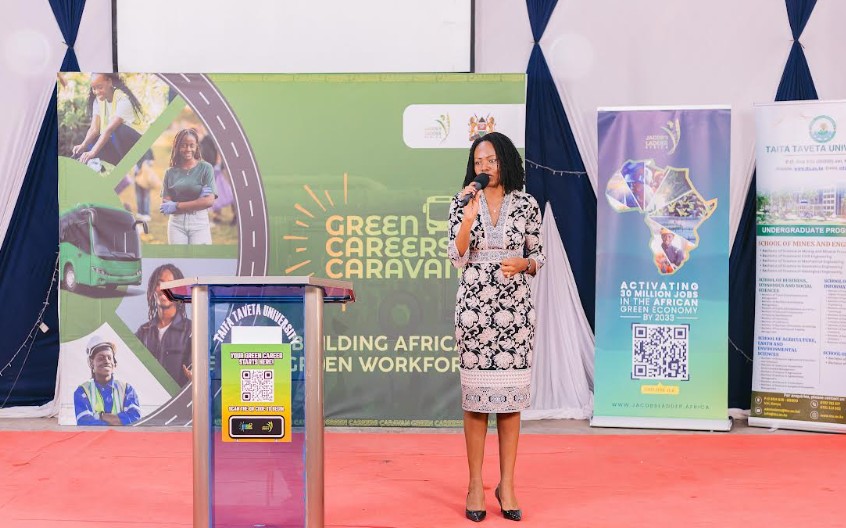
Fifteen public universities have partnered with Jacob’s Ladder to launch an ambitious five-year initiative to prepare Kenyan youth for the green economy, making its second stop at Taita Taveta University this week as part of a nationwide campaign to address the country’s deepening youth unemployment crisis.
The Green Careers Caravan, launched through the Vice-Chancellors’ Committee and the State Department of Higher Education and Research, aims to directly engage over 150,000 young people across 42 public universities by 2030.
The initiative comes at a critical time when nearly 12 percent of the youthful workforce and more than 31 percent of the 10 million youth in the labour force are either unemployed or underemployed.
Speaking at the event, Sellah Bogonko, Co-Founder and CEO of Jacob’s Ladder Africa, emphasised the urgency of converting Africa’s demographic potential into tangible outcomes.
“We are witnessing a historic convergence of Africa’s demographic dividend and the global green transition. But potential alone is a passive promise. Only when our young people are fully aware of opportunities, equipped with relevant skills, empowered through access and networks, guided by strong ethics, and driven by an entrepreneurial mindset within systems that work for them, will they become the active builders, innovators, and leaders who turn Africa’s promise into the world’s greatest story of transformation,” Bogonko said.
The transition to a green economy offers significant hope across Africa, with the shift potentially generating 3.3 million jobs by 2030 in renewable energy, e-mobility, construction, manufacturing, and sustainable agriculture.
The caravan is designed to help students understand and access these emerging opportunities through inspiration sessions, innovation pitches, and debates on critical environmental challenges.
Professor Christine Onyango, Acting Vice Chancellor of Taita Taveta University, highlighted the institution’s pioneering role in integrating environmental sustainability with economic opportunity. The university, known as the home of ideas with a niche in mining and engineering, has established the Center of Excellence for Mining Environment and Natural Resource Management under a German-Kenya project funded by DAAD.
“Mining engineering happens in the environment, and when we think about green, we think about the environment,” Professor Onyango explained.
She stated how the university has developed programmes to address environmental destruction caused by mining, including a Master of Science in Engineering Environmental Reengineering focused on rehabilitating land damaged by artisanal miners.
The university has also created innovative sustainability programmes, including SUMEWA, an initiative that uses solar energy to recycle mining water and make it safe for human consumption, and a biogas system that converts kitchen waste into cooking fuel.
These practical applications of circular economy principles are complemented by academic programmes such as an MBA in Natural Resource Management and climate-smart agriculture initiatives.
Noting the university’s comprehensive approach to environmental restoration and sustainable resource management, Professor Onyango emphasised that Taita Taveta’s approach extends beyond reforestation stating that, “Planting trees is one thing, but taking back the soil so that you can support plant growth and other activities of human nature is important.”
Shedrack Mutungi, County Executive Committee Member for the Department of Youth Affairs, Sports, Gender and Social Services, pledged the county government’s full support for the initiative.
He revealed that the county has passed the Poverty Alleviation and Empowerment Act, which will allocate 5 percent of the county’s total budget every financial year to youth empowerment programmes, including green economy initiatives.
“The current government is committed to ensuring that the youths are able to get job opportunities and investment opportunities within the county,” Mutungi said, urging students to remain patient and entrepreneurial while avoiding get-rich-quick schemes.
The Green Careers Caravan, which began at Kisii University, will extend to thirteen more universities during the first half of 2026 before scaling to all 42 public universities across Kenya over the next five years.
The programme then plans to expand to one new African region each year, delivering more than 150 university activations continent-wide.
By Arnold Linga Masila