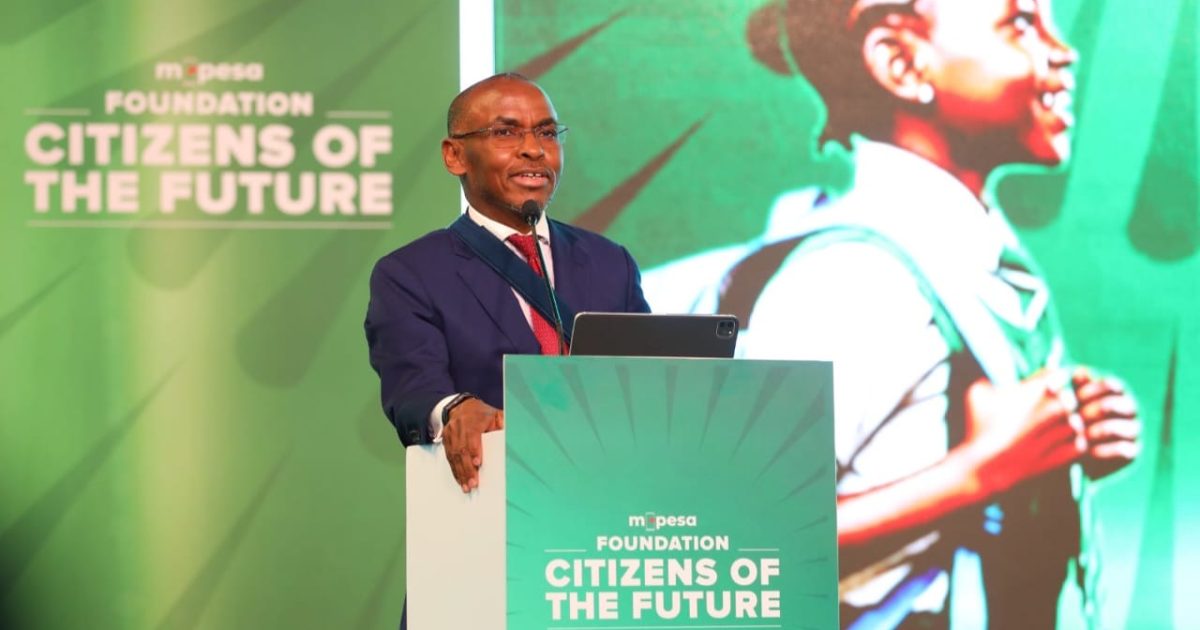
The Ministry of Education has called for deeper collaboration between government, industry, and technology players to strengthen Kenya’s education system and adequately prepare learners for a fast-evolving digital economy.
Speaking on Thursday during the launch of Safaricom’s Citizens of the Future initiative in Nairobi, Technical and Vocational Education and Training (TVET) Principal Secretary Esther Muoria, said Kenya must shift from a theory-based education model to one anchored on practical, technology-driven learning that aligns with industry needs.
Dr Muoria said a genuine paradigm shift was necessary if the country was to produce a generation ready to thrive in a digital future, urging both public and private sectors to join hands in bridging the current skills gap.
“We cannot afford to prepare learners for a digital future when they lack the facilities to equip them for it,” she said.
“It is time we take an active walk to the industries not just to lecture but to train with a clear purpose to fill specific skills gaps identified by employers,” she added.
She noted that while industries remain key partners in skills development, many face limitations in time, equipment, and personnel, which affect their engagement in training initiatives.
“Industry is often too busy producing, and even when we succeed in engaging them, the requisite equipment and manpower to train adequately are not always forthcoming. However, as educators, we must still put our best foot forward because we are the ones responsible for shaping citizens of the future,” Muoria said.
The PS lauded Safaricom and its philanthropic arms, the Safaricom Foundation and the M-Pesa Foundation, for stepping up to complement government efforts in modernising learning and aligning it with Kenya’s digital transformation agenda.
She described the Citizens of the Future initiative as a timely response to the need for more practical and industry-linked learning.
Principal Secretary for Basic Education, Prof Julius Bitok, commended Safaricom for its continued partnership with the government in supporting education reforms and enhancing access to digital learning opportunities.
He said the government was making significant investments to improve education standards but required private sector partnerships to amplify impact.
“The decisions we make today determine whether Kenya advances or stagnates,” said Prof Bitok.
“Singapore moved from a GDP per capita of 300 dollars to 90,000 dollars within six decades because they invested in education. Kenya must do the same if we are to achieve Vision 2030,” he added.
Prof Bitok revealed that the government had allocated Sh710 billion to the education sector this year, part of which would go toward employing 100,000 new teachers, constructing 23,000 classrooms and 1,000 laboratories, and rolling out two million digital learning devices across the country.
He commended Safaricom’s inclusive approach, noting its efforts to provide assistive learning tools such as Braille kits, mobility aids, and speech-to-text systems for learners with disabilities.
“This initiative is not just about modernising schools; it’s about transforming lives and ensuring every child has the opportunity to learn and thrive,” he said.
He added that the Citizens of the Future programme aligns with the government’s Competency-Based Curriculum (CBC), which emphasises creativity, innovation, and problem-solving.
“We must prepare learners for a future where adaptability and digital literacy are essential. Safaricom’s investment is helping turn that vision into reality,” he said.
Safaricom Chief Executive Officer Peter Ndegwa described the programme as a milestone in Kenya’s education transformation journey and a reflection of the company’s long-standing commitment to inclusive growth and community empowerment.
He said over the next five years, Safaricom would invest billions of shillings to improve education outcomes in at least 500 schools across all 47 counties.
“We will provide infrastructure upgrades, digital upskilling for teachers and learners, and scholarships for 10,000 students in TVET institutions,” said Ndegwa.
He explained that the initiative, implemented jointly by Safaricom Foundation and M-Pesa Foundation, would ensure equitable access to modern learning tools, digital connectivity, and career opportunities.
“No child should have to struggle just to learn. This initiative is about creating equal opportunities for every learner, regardless of where they come from or the challenges they face,” he said.
Ndegwa added that the programme would be supported by partners such as UNICEF, the World Bank, and other education stakeholders to expand digital access for over 30,000 learners through ICT infrastructure and training.
“Technology will be the engine that drives this programme. We want to nurture future leaders who are adaptable, innovative, and ready to shape Kenya’s future beyond the classroom,” he said.
He further announced that Kenyans would be able to nominate schools for inclusion in the initiative through an online and SMS-based platform, with nominations running from October 30 to November 30.
“We want communities to be at the heart of this process. The best ideas often come from the people who experience the challenges first-hand. This is a bold step toward a more inclusive, empowered, and educated Kenya,” Ndegwa said.
M-Pesa Foundation Trustee and former Safaricom CEO Michael Joseph said the Citizens of the Future initiative builds on the company’s 25-year legacy of transforming lives through innovation and social investment.
“From the start of Safaricom in 2000, our abiding objective has been to change people’s lives for the better,” he said.
“The M-Pesa Foundation and M-Pesa Academy have already transformed thousands of students from humble backgrounds into global achievers. Now, with Citizens of the Future, we are expanding that impact to hundreds more schools,” he said.
He said bridging the gap between classroom learning and the skills required in the job market was vital for Kenya’s competitiveness in the global economy.
“Education is evolving rapidly, and we must ensure our young people are not left behind. This initiative will empower them with both digital and life skills to compete globally,” Joseph said.
M-Pesa Foundation Chairman Nicholas Nganga hailed the partnership as a continuation of the foundation’s 15-year legacy of empowering learners from disadvantaged backgrounds.
“Education is where opportunities begin; our work with Safaricom and government partners reaffirms our shared vision of empowering Kenya’s next generation through quality, inclusive education,” he said.
He noted that through its various programmes, the M-Pesa Foundation had already supported over 3,000 schools and impacted more than 3 million learners nationwide.
“With Citizens of the Future, we will enhance this impact even further by promoting digital literacy, upgrading learning environments, and strengthening teacher training programmes,” he said.
Nganga emphasised that education remains the most effective tool for breaking the cycle of poverty and driving sustainable national development. “When we invest in our children’s education, we are investing in Kenya’s future,” he said.
The Citizens of the Future initiative is expected to enhance access to modern learning facilities, promote inclusivity, and strengthen digital literacy in schools across the country. Through this collaboration between the government, Safaricom, and its foundations, Kenya takes a major step toward creating an innovative, equitable, and future-ready education system that empowers every learner to thrive in a digital world.
By Naif Rashid and Darlene Kuria