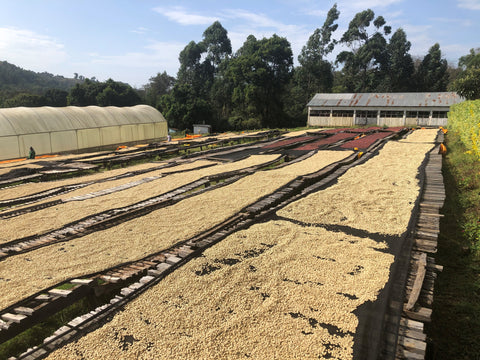
What was once a landscape of scattered smallholder farms struggling to access markets and fair prices is now home to a thriving network of farmers’ cooperative societies. Today, about sixty active cooperatives operate across Tindiret Sub County, reshaping the fortunes of thousands of rural households.
Area Member of Parliament Julius Melly made these observations yesterday while visiting Kapng’endui Farmers’ Cooperative Society, one of the most vibrant groups in the region.
Speaking during an interaction with members at the cooperative’s collection centre, Melly lauded the farmers for embracing teamwork and building sustainable business models through cooperative ventures.
He noted that the societies have become powerful instruments of change, helping small farmers pool resources, market their produce collectively, and secure better deals from buyers.
According to Melly, the rise in the number of cooperatives has given farmers a sense of ownership and strength that was previously out of reach. “When farmers join cooperatives, they stop seeing themselves as isolated producers and begin to act as businesspeople with leverage,” he said.
He added that the larger the membership base, the stronger the collective voice when it comes to setting prices and accessing essential farm inputs.
The MP observed that many farmers affiliated with well-managed cooperatives have already experienced tangible improvements in their incomes. Through these societies, they can buy inputs at subsidized rates, sell produce in bulk to eliminate middlemen, and access credit or training that was once unavailable.
However, the legislator emphasized that growth in numbers alone is not enough. “What counts is governance, transparency, and accountability,” he said. “A cooperative can only deliver if its leadership is trusted and its operations are efficient.”
Across Tindiret, evidence of this progress can be seen in a range of commodities. Cooperative societies dealing in dairy, bananas, maize, and horticultural crops have reported higher yields and better returns.
In Kapkoros village, for instance, banana growers organized under a cooperative have seen their earnings rise steadily, allowing them to invest in livestock, improve their homes, and educate their children. The cooperative structure has also reduced transport and marketing costs by enabling farmers to share logistics and storage facilities.
The legislator believes these achievements are changing the very mindset of rural farmers. “We are beginning to see households that were purely subsistence becoming small agribusinesses,” he explained. “They are now planning, reinvesting, and thinking about their farms as enterprises rather than survival plots.”
He added that this shift is vital not only for boosting household incomes but also for building resilience against the shocks of fluctuating markets and unpredictable weather.
Despite these encouraging developments, the MP acknowledged that challenges remain. Some cooperatives still face issues of poor management, delayed payments, or lack of transparency, which can erode farmer confidence. Market access and value addition are also limited for certain societies that continue to sell raw produce rather than processed goods.
Infrastructure gaps, such as inadequate storage, cooling, and transport facilities, further prevent cooperatives from realising their full potential. Climate change and erratic weather also complicate farming, though Melly said the cooperative framework offers a platform for collective adaptation and innovation.
Looking ahead, the legislator outlined several priorities for sustaining and expanding the cooperative movement. These include strengthening governance through leadership training, improving value-chain integration so that cooperatives can move into processing and packaging, and investing in infrastructure to reduce post-harvest losses.
He also emphasized the importance of involving more youth and women in cooperative leadership to ensure inclusivity and sustainability.
by Sammy Mwibanda