The government is considering placing the stalled Sh19.9 billion Koru–Soin multipurpose dam under the newly created Infrastructure Development Fund to unlock its financing once and for all, Deputy Chief of Staff and Head of the Government Delivery Unit (GDU) Eliud Owalo has said.
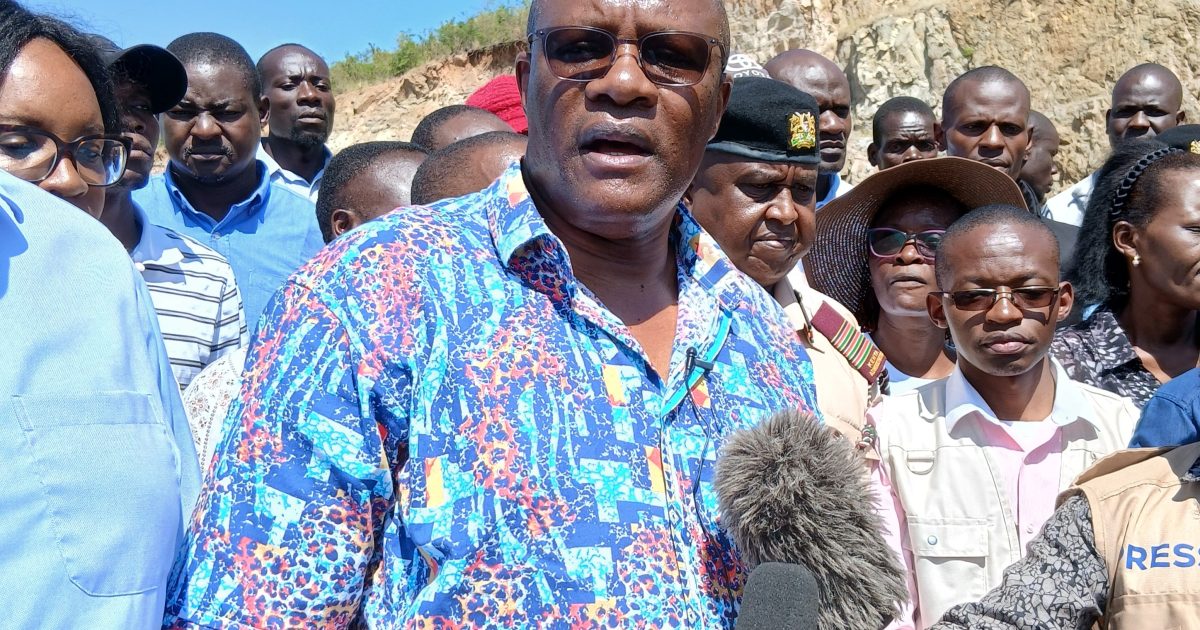
Speaking during an inspection tour of the site in Kisumu County accompanied by national and county officials, implementing agencies and local leaders, Owalo said the State wants to move the project from years of delays to a clear and irreversible completion path by securing a substantial capital injection through an infrastructure bond.
“This project cannot continue depending on the annual fiscal space, which can only manage about Sh1 billion. At that pace, we would need nearly 20 years to complete it. We are recommending that Koru–Soin be listed for consideration under the infrastructure development fund so that we pump in monumental financing at once and sort it out once and for all,” he said.
Owalo said the tour was meant to verify the true status of the dam, long delayed despite earlier groundbreaking, and to jointly confront the challenges that caused works to stall.
So far, he said, the State made an initial Sh500 million down payment when the contractor was mobilised in 2022, and preliminary works were launched.
However, the contractor is currently owed Sh890 million in certified but unsettled bills, leading to a halt in operations.
“The contractor has certificates totaling Sh890 million. Work has stalled. The purpose of our visit here today is to explore how the contractor can get back to the site as we explore tapping into the Infrastructure Development Fund,” he said.
He confirmed that the State Department for Water has already requested Sh900 million from the National Treasury as an immediate intervention measure.
Half of the funds will go to the contractor to partially clear pending certificates, while the remaining half will be channeled to land compensation.
A total of Sh2.2 billion, he said, was required to complete payments for affected landowners in Kisumu and Kericho counties.
“We will be sorting out two problems at the same time. Compensation will continue as work resumes,” he said.
The dam, once completed, is expected to deliver three major benefits: eliminating perennial flooding in the Nyando basin by storing water from upstream; supplying 72,000 cubic metres of water daily to residents of Kisumu and Kericho; and supporting irrigation on 11,000 hectares of farmland. It will also generate 2.5 MW of electricity that can be fed into the national grid.
Owalo also directed county commissioners for Kisumu and Kericho to immediately convene an expanded stakeholder forum involving affected landowners, county governments, National Land Commission (NLC), local leaders, the National Water Harvesting and Storage Authority, and agencies such as Kenya Electricity Generation Company (KenGen), Kenya Power and Kenya Rural Roads Authority (KeRRA).
The forum, he said, will harmonise compensation issues, access roads and future phases of construction.
He insisted that Koru-Soin remain a priority project for the Kenya Kwanza administration and that the proposed infrastructure bond present the most sustainable path to reviving it.
“We want this project pursued to a logical conclusion within the tenure of this government,” he said.
But even as the government works to mobilise financing, Owalo raised concern over systemic problems slowing infrastructure projects across the country.
He faulted contractors for taking up more projects than they can execute, often using multiple proxy companies to win several tenders only to spread themselves too thin and stall works.
He also called out political interference, saying some politicians were influencing procurement processes and shielding non-performing contractors, undermining delivery.
“Politicians are not engineers. They should leave construction to qualified young people. If you are paid and fail to deliver, we will recommend that you be blacklisted,” he said.
Owalo added that the delivery unit would continue verifying all government projects to ensure reports submitted to Nairobi match what is on the ground and to enforce corrective action where necessary.
After the dam visit, the team also inspected the Mamboleo–Miwani–Chemelil road, the Kabonyo–Kanyagwal fisheries project, affordable housing sites in Kisumu and the Kisian Economic Stimulus Programme (ESP) market.
by Chris Mahandara