Thousands of maize farmers in Vihiga County are set to benefit from a new agricultural training programme by BAYER Africa aimed at increasing maize yields through improved planting practices and the use of high-performing seed varieties.
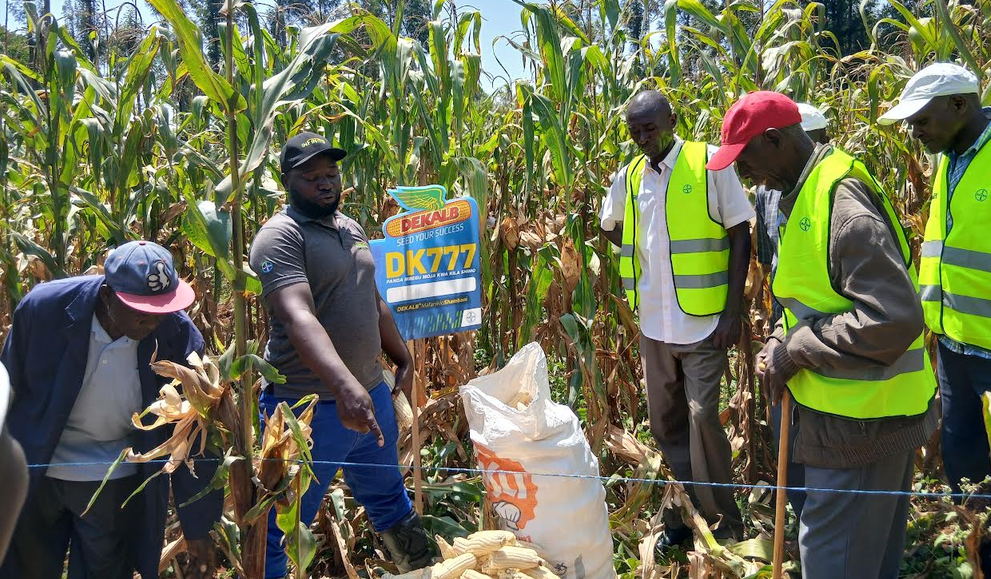
The programme, which targets about 20,000 farmers in Vihiga and neighbouring counties, is promoting the “one seed per hole” planting method alongside the use of hybrid maize varieties such as DK777.
Speaking during a farmer training session in Sabatia Sub-county, BAYER Africa Client Economist Cosmas Kiprop said the initiative seeks to help farmers maximize production while reducing the cost of seed and improving resilience against climate variability, pests and crop diseases.
Kiprop said demonstration farms have been established in Sabatia, Hamisi and Emuhaya to provide practical training on proper planting techniques, spacing, fertilizer application, weed management and harvesting.
“We first assess the size of a farmer’s land and the crops grown in the previous season before advising on the appropriate amount of seed and fertilizer required,” he said.
He added that BAYER Africa is collaborating with local agro-dealers to ensure timely availability of certified seed and fertilizer, while county agriculture officers are participating in the programme to provide continued technical support to farmers.
Kiprop noted that many farmers traditionally plant two or three seeds in one hole as insurance against poor germination, a practice he said leads to unnecessary seed wastage and reduced crop performance.
“Plants growing in the same hole compete for nutrients, moisture and sunlight, making them weaker and more susceptible to diseases,” he explained.
According to him, planting one seed per hole allows each plant adequate access to nutrients, improves air circulation within the crop and reduces disease incidence, while significantly lowering the amount of seed required.
He said farmers need only about four kilograms of seed per acre when using the recommended planting method, compared to up to 16 kilograms under the traditional practice.
Farmers who adopted the technique during the previous season also reported easier and faster weeding due to better crop spacing.
To address declining maize productivity in the county, Kiprop said BAYER Africa is promoting maize varieties suited to different agro-ecological zones. He noted that DK777 performs well in the mid-altitude areas of Vihiga because of its uniform growth, high grain quality and tolerance to common diseases and periods of low rainfall.
The organisation recommends DK777 and DK9709 for high-altitude areas, DK777 for the county’s mid-altitude zones and DK831 for lower, drier regions.
Kiprop said demonstration farms in Sabatia recorded yields of up to 18 bags of maize per acre compared to the county average of about nine bags, adding that farmers who match seed varieties with their ecological zones can increase production by between 30 and 50 per cent.
He further advised farmers to harvest maize only when it is mature and to dry it thoroughly before storage to minimise post-harvest losses.
“Choosing the right seed for the right environment is key to achieving higher yields and better returns,” he said.
BAYER Africa has encouraged farmers to participate in field days being held across the county to learn modern farming practices and consult local agro-dealers on suitable seed and fertilizer before planting.
The organisation said it will assess crop performance in August and conduct additional training on proper maize storage in September as part of efforts to reduce post-harvest losses and improve household food security.
By Convivian Khasoha and Victor Zeddy