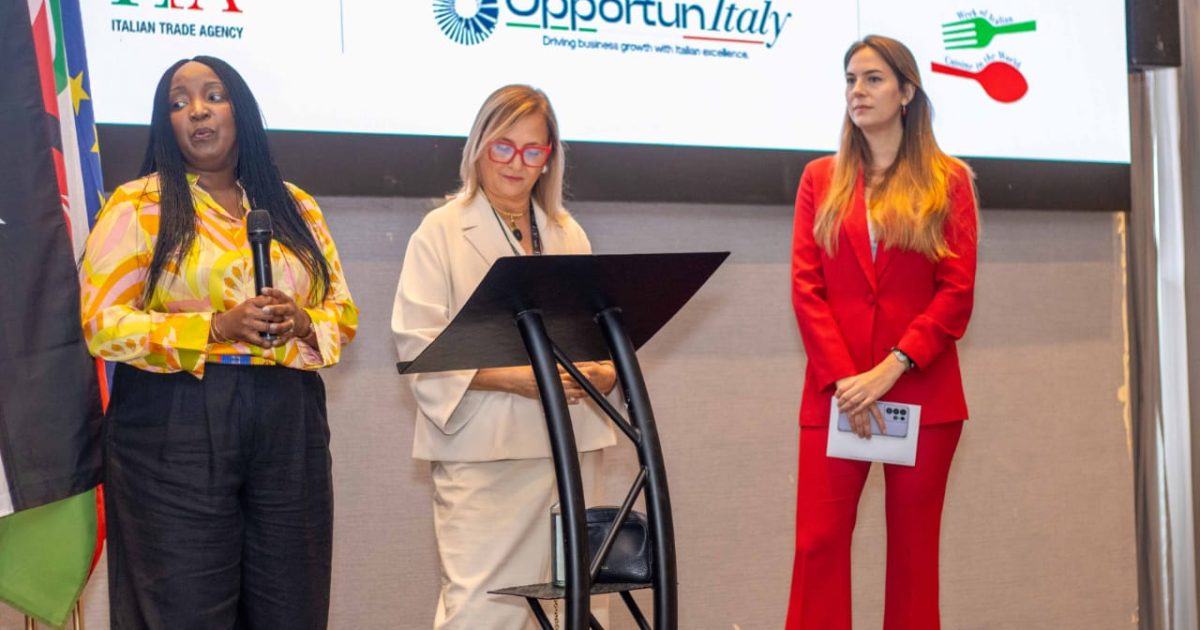
Italian wine and food producers are seeking to deepen trade and investment partnerships with Kenya through increased market access, technology transfer, and knowledge exchange.
The push was highlighted during the second edition of Borsa Vini Kenya 2026, held in Nairobi, bringing together Italian wine and food producers, Kenyan business professionals and other stakeholders to explore opportunities for commercial cooperation.
The event, organised by the Italian Trade Agency (ITA) in collaboration with the Embassy of Italy in Nairobi, brought together approximately 25 Italian companies representing 10 regions, showcasing the country’s diverse wine and food products.
Speaking during the event, Italian Trade Commissioner Alessandra Rainaldi maintained that Kenya remained an important partner for Italy, with significant opportunities to strengthen cooperation in trade, investment, and technology.
Rainaldi stated that the Italian Trade Agency supports small and medium-sized Italian enterprises seeking to export or invest internationally, while promoting Italian products, innovation and technology in global markets.
Additionally, she noted that the partnership between Kenya and Italy could extend beyond the exchange of products to include mutually beneficial investments, and the development of local industries.
“Kenya is a reliable partner for Italy, and we see many opportunities to expand our cooperation, particularly in areas such as agro-industry, leather, startups and innovation,” the Commissioner highlighted.
Further, Rainaldi emphasised the importance of establishing partnerships that allow both countries to benefit from each other’s strengths, particularly through technology transfer, skills development, and value addition.
She observed that while Kenya has valuable natural resources and agricultural potential, Italy has developed expertise in manufacturing and transforming raw materials into finished products.
Consequently, the Trade Commissioner said such cooperation could help Kenyan enterprises improve production processes, strengthen their technical capacity, and access new markets.
She particularly cited the Labinova programme, which has supported capacity building in Kenya’s horticultural sector since 2010 through training, management support and exposure to Italian technology and equipment.
Rainaldi added that the renewed cooperation between the two governments provided an opportunity to strengthen business relations over the coming years.
Notably, she pointed out that the Borsa Vini platform was designed to connect Italian producers with Kenyan buyers and wine professionals while promoting the quality and diversity of Italian products.
Meanwhile, the participating companies represented different Italian wine-producing regions, including Veneto, known for Prosecco, as well as Piemonte, central Italy and Sicily.
The programme also featured a wine masterclass led by Kenyan sommelier Victoria Mulu-Munywoki, giving participants an opportunity to learn about the characteristics and diversity of Italian wines.
On her part, Trade and Economic Officer at the Embassy of Italy in Nairobi, Giulia Orlandi, announced that the event was part of the 11th edition of the Week of Italian Cuisine in the World, which runs from November 8 to 14.
Orlandi, who represented the Embassy during the event, explained that the initiative combines economic engagement with cultural and culinary activities aimed at strengthening relations between Italy and other countries.
She noted that Borsa Vini provided an opportunity for Italian companies to interact directly with Kenyan professionals and consumers while showcasing the country’s food and wine traditions.
“The event has an economic character, but it also has a cultural and culinary dimension. It is an opportunity to bring together Italian producers and Kenyan professionals while promoting our culinary heritage,” she reiterated.
On the other hand, Orlandi disclosed that the Embassy worked closely with the Italian Trade Agency to support business engagement, with the two institutions playing complementary roles in strengthening commercial relations.
She explained that while the Trade Agency focuses on technical support and facilitating business connections, the Embassy works at the diplomatic level to promote opportunities and strengthen engagement with relevant authorities.
“We have an integrated approach. The Italian Trade Agency deals with the technical aspects, while the Embassy supports companies through political and institutional engagement. We work closely together to provide comprehensive support,” she elaborated.
Orlandi added that the Embassy also helps Kenyan businesses understand the Italian market and identify opportunities for engagement with Italian suppliers and enterprises.
Similarly, she mentioned that the event’s culinary programme further strengthened the cultural exchange between the two countries with Michelin-starred Italian chef Italo Bassi among the participants, offering food tastings and show cooking demonstrations to introduce guests to Italian cuisine and ingredients.
Orlandi therefore affirmed that the chef’s participation created opportunities for knowledge sharing and interaction between Italian and Kenyan culinary professionals.
Ultimately, she described the experience as a fusion of talents between the two countries, adding that the programme also included special dinners with a charitable purpose.
Meanwhile, the Week of Italian Cuisine in the World seeks to promote Italian culinary traditions, food products, and the cultural values associated with Italian cuisine.
Through Borsa Vini Kenya, organisers hope to strengthen business connections, increase awareness of Italian products, and create lasting relationships between producers and buyers in Kenya and the wider region.
The event reflects the broader commitment by Italy and Kenya to expand cooperation through trade, investment, innovation, and cultural exchange.
By Celine Mwende and Stephen Musau