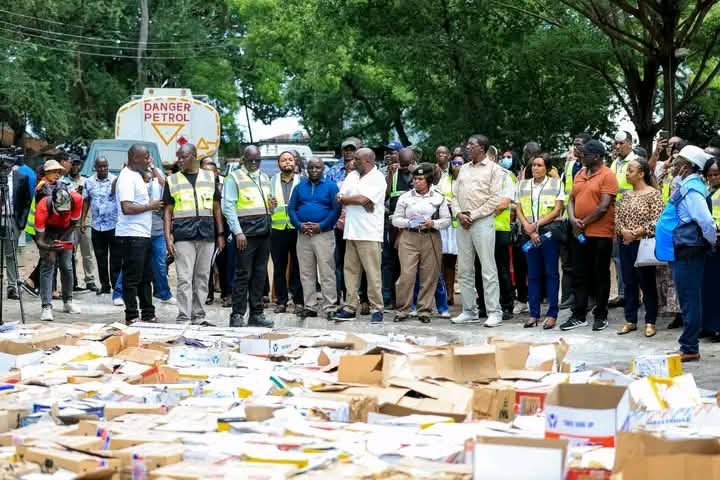
The government has intensified the war on counterfeit and illicit trade after the Anti-Counterfeit Authority (ACA) in Mombasa destroyed goods worth Sh104 million, in a renewed crackdown aimed at protecting consumers from potentially harmful products, safeguard legitimate businesses and close loopholes exploited by counterfeit goods traders.
Some of the counterfeit goods destroyed in the exercise were alcoholic drinks worth 14 million.
The destruction exercise, conducted at Saimbort Ships Contractors Limited, comes ahead of the Third International Symposium on Intellectual Property Protection and Enforcement (ISIPPE-3), scheduled to take place in Mombasa from November 18 to 19, 2026.
Stakeholders at the symposium will be exploring strategies for strengthening the fight against counterfeiting and safeguarding public health and consumer safety.
The Mombasa exercise is the second major destruction undertaken by the Authority, following an earlier exercise in April this year at Athi River, where counterfeit goods valued at approximately Sh200 million were destroyed.
Speaking during the exercise, ACA Executive Director Robi Kinga said the seized alcoholic drinks had been intercepted within the Kenyan market, adding that the Authority remained committed to protecting consumers and future generations.
“We are here today to fulfil one of our statutory and constitutional mandates of fighting counterfeit goods within the Kenyan market,” said Kinga.
He urged brand owners to continuously engage the Authority and other relevant agencies by sharing information, intelligence and data to help strengthen enforcement against counterfeit products across the country.
“We are calling upon you to come to us with anything that you feel is hampering your business and brands. Bring that information to the ACA,” he said.
Kinga further revealed that the Authority was working on regulations to introduce a track-and-trace system for alcoholic beverages, which would enable the verification of products from the point of production to the consumer.
“As we mentioned a few months ago, we are working on a track-and-trace system. The regulations will be taken to Parliament and subjected to public participation to ensure that we protect our consumers,” he said.
He added that the Authority will continue destroying counterfeit goods seized from the market, calling on consumers, government agencies and the media to support the fight against counterfeiting.
“This war requires the support of all the players,” he said.
Representing the Ministry of Investment, Trade and Industry, the Industrialisation Secretary, Prof. Erastus Gatebe said the government remained committed to supporting enforcement agencies in promoting legitimate businesses and protecting investments made by manufacturers and traders.
“We are here to support the exercise, we can only protect the investment,” said Prof. Gatebe.
He noted that counterfeit and illicit trade had contributed to the collapse and struggles of legitimate businesses, with traders finding it increasingly difficult to compete in a market flooded with illegal products.
Prof. Gatebe identified the alcoholic beverages sector as one of the most affected by counterfeiting, accounting for 40 per cent of counterfeit products.
He said this had prompted multi-agency teams and law enforcement officers to intensify their operations to protect consumers and safeguard legitimate businesses.
“The agencies, together with the law enforcement teams, are doing a good job, but they still have a lot of work to do to ensure that Kenyan consumers are protected,” he said.
Prof. Gatebe also disclosed that the Ministry was developing a system to identify and authenticate products circulating in the Kenyan market.
He said the government would work with the Directorate of e-Citizen to establish a system that would enable legitimate products to have unique registered identifiers, making it easier for consumers and enforcement agencies to distinguish genuine products from counterfeits.
“Any legitimate product will have a unique trademark registered across the system. This is where the Anti-Counterfeit Authority will be involved so that we do not have counterfeit products circulating in the market,” he said.
Meanwhile, the CEO of the Kenya Association of Manufacturers, Tobias Alando, commended the Authority and other government agencies for their continued efforts to combat counterfeit and illicit alcohol trade.
He said the illicit alcohol trade, estimated at 40 per cent, posed serious risks to public health while contributing to revenue losses for the government.
Alando said businesses operate in a competitive environment where all players should have equal opportunities, adding that destroying counterfeit goods sent a strong message to those involved in illegal trade.
He urged members of the public to report information on counterfeit and illegal products to the relevant authorities to support enforcement efforts.
“We want to encourage our citizens that if you have any information on illegal and counterfeit products, share it with us,” he said.
By Mary Mtawa