The gentle rustle of bamboo groves across Kenya’s highlands and lowlands hides a secret many are just beginning to rediscover: this woody grass is more than just a plant. It is an untapped treasure with the power to restore degraded landscapes, create jobs, and transform livelihoods.
For centuries, communities living near bamboo forests relied on it for everyday needs. On the slopes of Mt Elgon, for instance, families harvested bamboo shoots for food, fenced their farms with the slender culms, and used it as firewood. Yet by the 1980s, concerns about overexploitation led to restrictions, forcing the nation to rethink how to balance conservation with utilisation.
In the quest to unveil the tremendous life-changing impact of bamboo in the Kenyan arena, KNA exclusively sought insights from the Kenya Forestry Research Institute (KEFRI) through its principal research scientist, Dr Nelly Oduor, who explained that bamboo is not merely a common grass but a distinctive woody grass with extraordinary ecological and economic significance.
According to Oduor, ecologically, bamboo regenerates at an impressive rate, rehabilitates degraded landscapes, stabilises fragile soils and conserves vital water catchment areas, while economically, it provides a sustainable substitute for timber, energy and industrial raw materials, thereby positioning itself as a resource that not only safeguards the environment but also drives wealth creation, job opportunities and community development across the country.
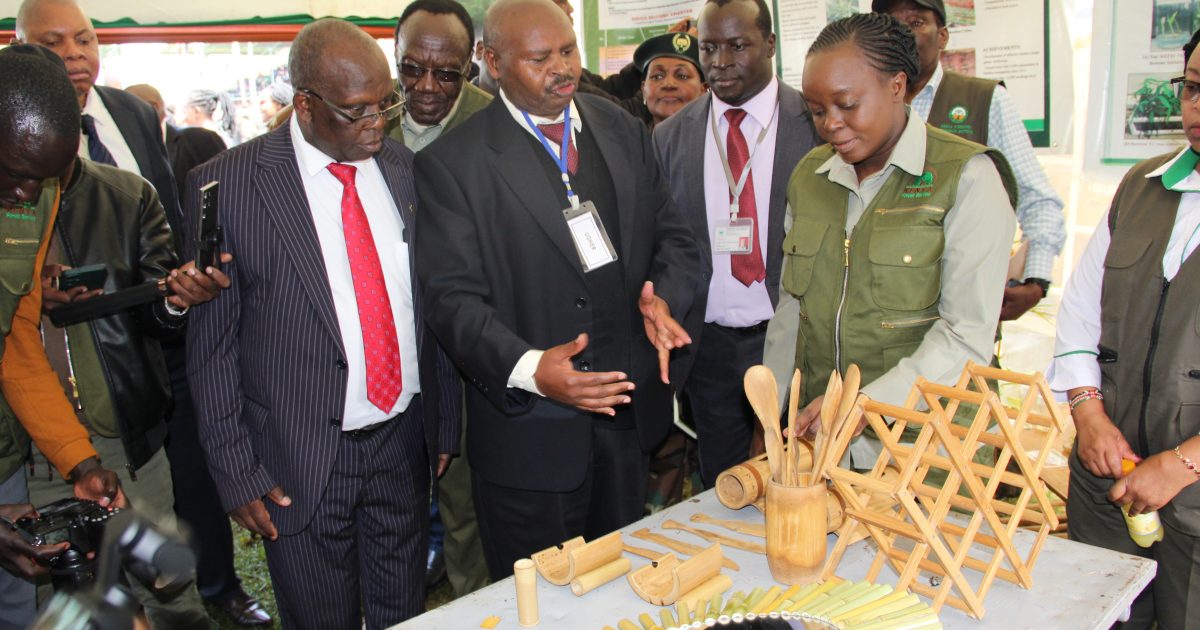
Oduor takes us through some of the ornamental bamboo-made materials: seats, tables and mirror frames elegantly crafted to blend traditional artistry with modern design; flower vases and picture holders that bring a natural touch into living spaces; lampstands and wall hangings that radiate warmth and creativity; as well as intricately woven baskets and mats that reflect both beauty and functionality, all demonstrating the versatility of bamboo in transforming simple sticks into stylish household treasures that carry both cultural identity and economic value.
“The value of bamboo lies not only in its versatility but also in its ability to answer some of Kenya’s most pressing challenges. From food to medicine, construction to cosmetics, and even beverages and fodder for livestock, more than 10,000 products worldwide are linked to bamboo,” Oduor revealed.
She emphasised the immense ecological significance of bamboo, noting that it stabilises soils, restores fragile riverbanks and rehabilitates degraded landscapes, while also revealing that under the government’s ambitious 15-billion-tree planting initiative, bamboo has been allocated 205 million seedlings to be established on 150,000 hectares distributed between individual farms and public land, thereby underscoring its central role in environmental conservation and sustainable land management in Kenya.
To deepen understanding of this remarkable shift, particularly in the construction sector, KNA also sought insights from the Kenya Forest College, which played a central role in showcasing practical demonstrations of how bamboo can transform lives, and at the World Bamboo Day exhibition, which displayed model bamboo houses that stood tall in their elegance and portability, serving as powerful symbols of innovation and proof that the plant can provide sustainable and affordable solutions to modern housing challenges in Kenya.
The college’s outreach coordinator, Iddah Wawiye, underscored that unlike conventional timber houses, the bamboo structure requires no foundation and can be dismantled and moved with ease, making it a flexible, affordable and environmentally friendly option for modern housing solutions.
“Most of the houses we see are made from timber, but bamboo houses provide a better alternative. They are warm, beautiful, and portable. To protect them, bamboo only needs preservatives against insect infestation,” Iddah Wawiye added.
She said that Kenya Forest College is also championing bamboo as a green substitute for polythene seedling bags and developing floating bamboo gardens.
“These gardens could revolutionise farming in flood-prone areas like Budalangi by keeping crops safe from rising waters,” she explained.
Beyond such innovations, bamboo has now been elevated to national economic planning. During the celebrations in Kericho, Cabinet Secretary for Environment, Climate Change and Forestry, Dr Deborah Barasa, described the launch of the Kenya National Bamboo Development Strategy and Action Plan (2025–2035) as a turning point.
“With this strategy, we now have a clear roadmap to expand bamboo to 150,000 hectares, establish 20 county incubation centres, and create at least 750,000 green jobs in the first two years of planting,” CS Barasa asserted.
As the sun set on the World Bamboo Day celebrations, the message resonated strongly across policy makers, farmers and innovators alike that Kenya’s future lies in embracing this humble grass not as a plant of the past but as a resource of the future. From rural homesteads to urban balconies, bamboo is being reimagined as the cornerstone of climate resilience, economic empowerment and sustainable living.
By Hillary Kemei