Cabinet Secretary for Environment, Climate Change and Forestry, Dr Deborah Barasa, has disclosed that over 900 million trees have so far been planted nationwide through collaboration between the government and environmental stakeholders in line with the Presidential Directive to grow 15 billion trees by 2032.
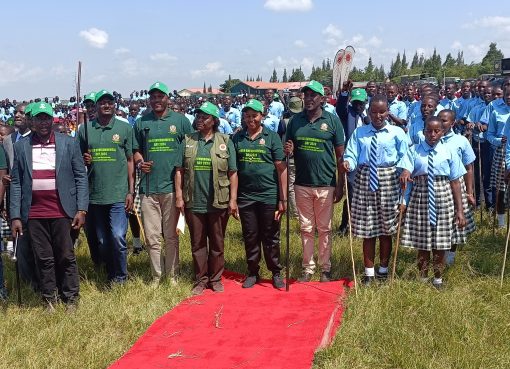
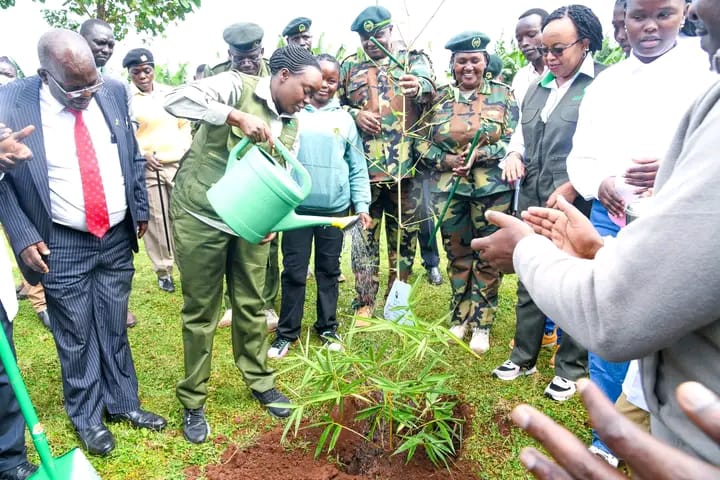
Dr Barasa made the remarks when she presided over the World Bamboo Day 2025 celebrations at the University of Kabianga in Kericho County, which involved a bamboo tree planting exercise where a total of 30,000 bamboo tree seedlings were planted at the university grounds and its environs.
The CS said, “For many years Kenya’s bamboo potential was recognised but underutilised. We knew that our indigenous highland bamboo (oldenia alpina) covered over 133,000 hectares in Aberdare, Mt Kenya, Mau Complex, Mt Elgon, and Cherangany. We also introduced more than 40 exotic species through the Kenya Forestry Research Institute (KEFRI), of which at least 12 now thrive in different ecological zones.”
Dr Barasa, who also launched the Kenya National Bamboo Development Strategy 2025-2035, said commendable progress has been made in the bamboo sector, including policy recognition, as bamboo was gazetted as a scheduled cash crop in 2020, providing a legal foundation for commercialisation.
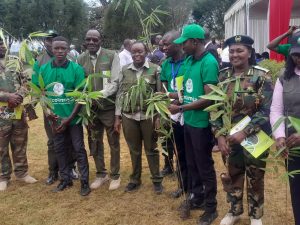
She also pointed out that companies such as Pot Enterprises and African Plantation Capital have established plantations, while community groups like Eco Green Kenya are expanding cultivation.
The CS further observed that artisans and SMEs are producing bamboo furniture crafts and joinery products with KEFRI supporting training and technology transfer.
“KEFRI has successfully validated exotic species while nurseries across the country are scaling up seedling production,” Dr Barasa noted.
The Environment CS also highlighted that Kenya benefitted from INBAR and the Dutch-Sino East Africa Bamboo Development Programme linking farmers and institutions to international expertise and markets.
Dr Barasa said in achieving Vision 2030, the Bottom-Up Economic Transformation Agenda (BETA), and the presidential directive on 30 percent tree cover by 2032, most bamboo will contribute directly to the 15 billion trees growing programme.
The World Bamboo Day, whose theme was ‘Bamboo for people, planet and climate solutions’, the Kenya National Bamboo Development Strategy intends to expand bamboo to cover 150,000 hectares across forests, riparian zones, and farms, while establishing a national centre of excellence and 20 county incubation centres for technology and innovation.
The Environment CS said bamboo was creating 750,000 green jobs in the first two years of planting through the national landscape and ecosystem restoration strategy.
Dr Barasa pointed out that the venture was mobilising Sh15 billion to drive commercialisation, value chains, and carbon credit opportunities.
“Positioning bamboo as a timber substitute, an alternative source for pulp and paper, furniture construction materials, textiles, energy and food,” the CS added.
The CS who addressed the environment stakeholders drawn from the University of Kabianga, KEFRI, the Kenya Forest Service, and Private Forest Partners in Kericho said, “With this strategy, by embracing the bamboo strategy, livelihoods will be unlocked, degraded lands will be restored,climate solutions will be created, and Kenya will be established as a regional leader in the bamboo value chain.”
Meanwhile, Kenya Forestry Research Institute (KEFRI) Director, Dr Jane Njuguna, said in Kenya KEFRI was nurturing a strong bamboo sector with approximately 140,000 hectares of bamboo trees, out of which 130,000 hectares were growing naturally and 10,000 hectares were on farms.
Despite this, she said, the current bamboo activities are predominantly at cottage level, with notable efforts from Green Pots Enterprises and Eco-Pole leading some industrial-level processing.
According to Dr Njuguna, the sector supports around 5000 households through cottage-level industries and bamboo nurseries, which are providing essential livelihoods and fostering local economic growth.
She said ongoing research is crucial for advancing the bamboo sector, with the current efforts focusing on nursery management and tissue culture, plantation management and harvesting regimes, treatment of harvested culms and processing, capacity building, technology transfer and developing standards and raising awareness through trade fairs and other initiatives.
In her closing remarks, the CS challenges the National and County Governments to play their part in providing an enabling environment, effective extension service, forestry research and allocation of funds to the sector.
Meaningful participation from stakeholders will continue to be sought through regular consultation and discussions as we strive together to attain the most efficient, sustainable and equitable use of our bamboo resources.
Among the guests present at the function were University of Kabianga Vice Chancellor Prof. Eric Koech, Secretary, Forest Development, State Department for Forestry Mr George Tarus, Acting County Commissioner Kericho Dr Kibe Maguta, and others.
By Dominic Cheres and Kibe Mburu