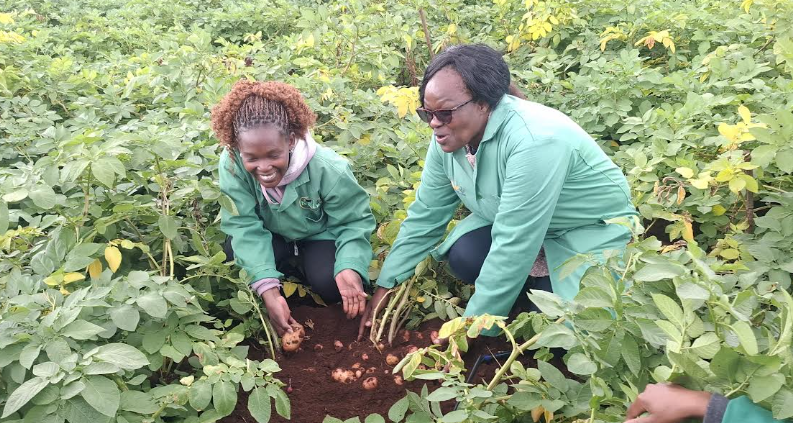
The Kenya Agricultural Livestock Research Organisation (KALRO) is in advanced stages of producing and testing a blight-resistant Genetically Modified (GM) potato variety.
The potato late blight disease is a major problem for potato farmers in Kenya and can cause significant yield losses of up to 30 percent if no adequate control measures are put in place
KALRO, in partnership with the International Potato Centre (CIP), has been testing the ‘Shangi’ potato variety, which has shown high resistance without the need for fungicides.
The technology has so far undergone testing in three different potato-growing locations in the country, namely Muguga in Kiambu, Njambini in Nyandarua, and Molo in Nakuru County.
Speaking Thursday during a guided media study tour to the GMO potato Confined Field Trial (CFT) site at KALRO Muguga, Dr Moses Nyongesa, a research scientist at KALRO, gave insights into the science behind GMO potatoes and their potential impact.
He said farmers have been controlling the blight disease by relying on fungicides, which are costly and have a health and environmental implication if not used appropriately.
“We have now a biotechnology potato variety that is under development at quite advanced stages; it has gone through the proof of concept and is promising, as farmers will now be able to reduce the cost of production, eliminating completely what they would have incurred if they had used fungicides.
The technology, he explained, was started 3 years ago, and starting from the laboratories and in the greenhouses to show that the Shangi variety actually is resistant to blight, they also tested it under Confined Field Trials (CFT), which have been concluded, and submitted the results to the National Biosafety Authority (NBA), a government regulatory agency.
“We are waiting for approval by the National Biosafety Authority (NBA), who will also engage the public participation before approval that will see us proceed to the next phase of National Performance Trials (NPT),” he said

Dr Nyongesa said once they get the approval, they will conduct the NPT trials in six different locations in major potato-growing areas, coming closer to where the farmers will interact with this potato variety.
The tests, he confirmed, are conducted by the Kenya Plant Health Inspectorate Service (KEPHIS), and once the data from these NPTs is assembled together and assessed, then the recommendation for variety release will be made based on those reports, followed then by commercialisation.
Dr Nyongesa was optimistic, saying in case the NPTs commence in October, it will take six months, so looking at mid next year for all the reports to support the recommendation for release even as other authorities, including the Cabinet Secretary responsible for Agriculture, make a formal declaration that the variety has been released for cultivation in the country.
The current production of potatoes in the country stands at 3 million metric tons, and we are hopeful that this new variety promises to increase the yield by an additional 30 percent, he said.
Dr Miriam Mbiu, plant pathologist from KALRO, explained that as they progressed the trials into the field for two seasons in three agroecological location working on Blight resistance, they adjacently carried out the nutritional composition analysis where they wanted to see if the varieties differ with the non-transformed varieties.
“What we have found out is that these varieties are not different from the others. In terms of proteins, carbohydrates, and the phenolic compounds, we were able to test about 13 of that nutritional composition in terms of the agronomic data that includes the vegetative and also the tubers, and we saw they are not different from each other.
She noted that the only difference between the new potato variety and the non-transformed one already in the market is only the gene that confers and allows it to have resistance against potato blight; otherwise, the taste is the same.
“Currently we are bulking our seed for the NPTs following the same protocol that is also done on the conventionally bred varieties. After NPTs, we are going also to conduct just one trial to check the distinctiveness and uniformity and stability of the candidates that we will have submitted for the NPTs,” D. Mbiu said
Dr Paul Chege, a plant scientist currently working at ISAAA Africa Centre said the Genetically Modified (GM) crops have been adopted in about 29 countries globally
Kenya is among the countries producing GM crops, with BT cotton being with the farmers and virus-resistant cassava that is almost reaching the end of research through KALRO.
In Africa, Ethiopia, Nigeria, and South Africa are growing BT maize; Ghana and Nigeria have BT cowpea, and South Africa is also producing the soybean.
Dr Chege said that looking at a biotech potato that is resistant to late blight disease, which has been affecting a staple crop and causing devastating yields to farmers, could not come at a better time, he said.
“Researchers are talking about more than 16 percent loss due to this disease, and these losses come as a result of the farmers spraying fungicides against the disease with about 13 spray rounds per season, which is a lot.
Now that we know this technology works, the farmers will not have to spray all that much fungicide, which at the end of the day is harmful to human health. it will also alleviate farmers from a lot of backbreaking labour and, at the same time, increase yields of potatoes that would have been lost to the disease,” he added
Dr Chege noted that one of the major reasons for technology not reaching farmers is mostly misinformation, and thus the reason interaction between scientists and journalists is very important so that the public gets the information on what is GMO and what is not.
Many countries, he added, have embraced the Shangi variety in the country, and we commercialise it on the continent and globally, and therefore this potato research is one of the pioneer research projects of unique crops in Africa.
According to the GM database globally, over 43 countries consume and import GM crops. The crops are planted in over 209 million hectares, and between 1996 and 2024, there has been a rise in the adoption of GM globally by 21 percent.
In Kenya, potatoes are the second most important food crop after maize, with a large number of small-scale farmers involved and a significant contribution to the national economy, generating an estimated USD 500 million annually.
The industry employs millions and has a substantial market value but also faces challenges related to yields and disease like late blight.
By Wangari Ndirangu