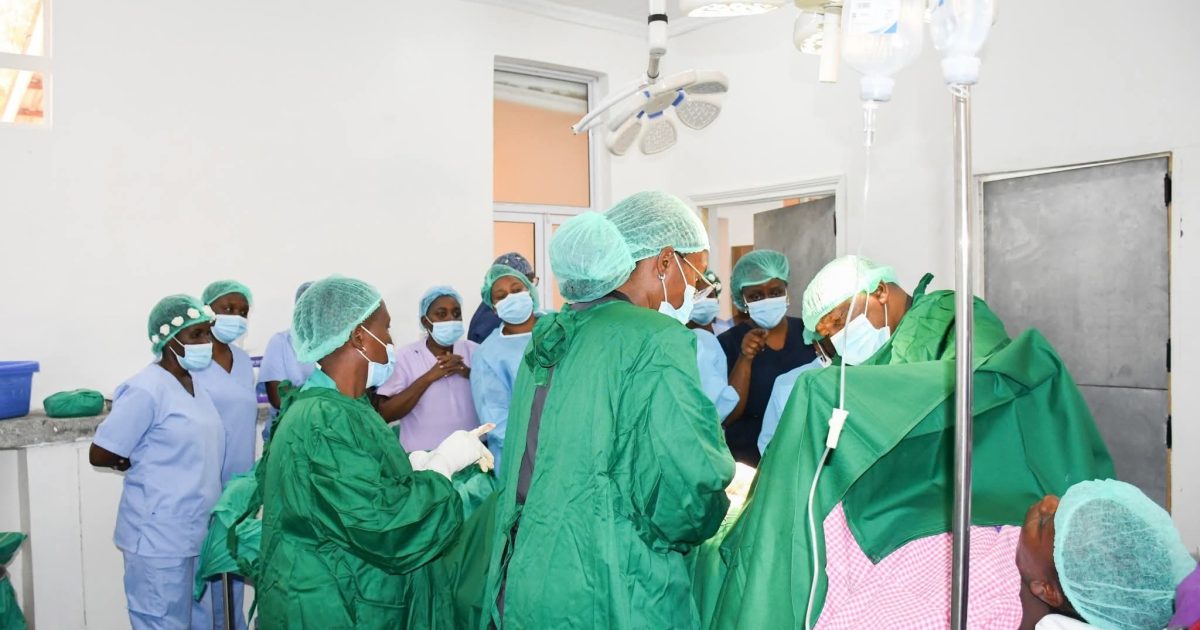
After a forty-year wait, more than 60,000 residents relying on Bondeni maternity hospital in Nakuru county can now breathe a sigh of relief, after a Sh.15 million theatre became operational this week.
Governor Susan Kihika said the theatre, initially built in 1985, remained unused for decades due to a lack of personnel and critical apparatus such as power backup systems, suction and sterilizer machines, defibrillators and anaesthesia equipment.
The governor said the revival of the theatre was part of the county’s broader initiative to allocate resources to projects that had stalled for many years and regretted that expectant mothers had previously been travelling for over 3 kilometres to the Nakuru County Teaching and Referral Hospital (NCTRH) for Caesarean sections, a journey she said sometimes ended up in tragic deaths of the unborn infants.
Kihika explained that the hospital had undergone a major facelift at a cost of over Sh20 million, with major strides being the establishment of new units, including a laboratory, pharmacy, laundry, kitchen and a procurement department, which were not there before the upgrade.
She assured the residents that critical emergency services will now be handled at the new facility, adding that the opening of the new theatre had been accompanied by renovations and equipment procurement, allowing for life-saving surgical procedures to be performed locally.
“The theatre room has been fitted with ultra-modern equipment and the residents will now be served without being referred unless they have a distinct case that needs a specialist,” Kihika assured.
The governor reiterated that the administration’s main agenda was to ensure that residents in the county get quality health care, adding that her government would continue maintaining its focus on developing the local hospitals, thus making the health sector a top priority from NCTRH to dispensaries at the grassroots.
“The farthest one should go for medical services should not exceed 10 kilometres because we are going to make sure it is a walking distance within the next two years,” the governor added.
A 28-year-old woman delivered successfully at the facility on the first day through a caesarean section operation performed by a team of medics led by the County’s senior medical specialist and obstetrician-gynaecologist, Dr. John Murima.
Dr. Murima, who is also the Chief Officer for medical services, said the facility would ease pressure and congestion at NTRH, where most patients are referred.
He noted that the newly operational theatre provides a local solution for surgical needs, potentially saving lives in the County community.
Dr. Murima stated that by providing a safe and sterile environment for necessary surgical interventions, the theatre will directly reduce the incidence of maternal and neonatal deaths, which are significant public health concerns in Kenya.
“A well-functioning operating theatre leads to better surgical outcomes by reducing the risk of complications and enhancing the overall quality of care provided to mothers and newborns,” the Chief Officer indicated.
The presence of a functional surgical theatre, Dr. Murima observed, will allow the maternity hospital to offer comprehensive care, extending beyond routine childbirth to handle complex obstetric cases that require surgical intervention.
Bondeni maternity, now a level four hospital, is one of the oldest health care facilities in Nakuru, having been built in 1952 to take care of African women living in South of the Railway line.
Though for many years it was associated with the poor as it is situated at the heart of the largest and oldest Bondeni slum in Nakuru, the hospital enjoys an enviable history as a facility, where many distinguished people, among them a former Cabinet Secretary, prominent lawyers, politicians, doctors, engineers, architects and educationists were born.
The hospital, which was exclusively a maternity hospital, did not admit first-time mothers, as it could not handle any complications because it had nurses as attendants, has now changed into a modern health care facility with state-of-the-art equipment.
Currently, the hospital is recording between 170 and 200 deliveries a month.
For years, it was managed by the defunct Municipal Council of Nakuru until 2014 at the advent of devolution, when it was upgraded to level four in 2015 and allocated its own budget.
By Esther Mwangi