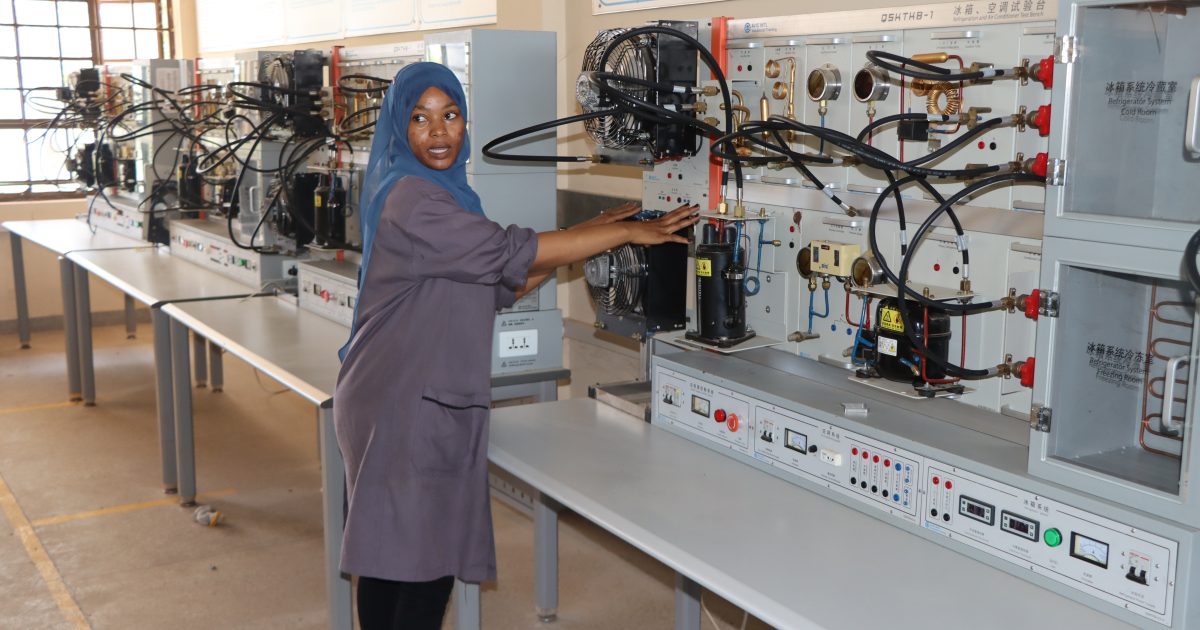
When 26-year-old Latifa Mohammed walks into a workshop in her blue overalls, the room shifts. Clients stare first out of doubt, then out of respect.
Students follow her with quiet confidence. At Likoni Technical and Vocational College in Mombasa, she has become a symbol of a slow but steady shift as more women enter technical training.
Mohammed, the third-born in a family of nine, says her interest in Refrigeration and Air Conditioning (RAC) began long before she joined college. She liked observing cooling systems in homes and offices and wanted to understand how they worked.
She chose the field because the Coast region, especially Mombasa, has hot and humid weather, thus high demand for refrigeration services. She also saw a gap, because many women in the region preferred fields like cosmetology, garment making and food production.
Her decision was not easy; friends and relatives asked whether the work suited a woman. Some even wondered whether she would get married if she continued with the course. However, she says her father’s support was instrumental. He encouraged her, defended her choices and introduced her to clients.
Mohammed says the early days were tough. She faced a lot of resistance and was forced to prove herself repeatedly. During one repair job, a client questioned her ability. But upon completing the work, he asked in surprise whether she was the same person who had handled the repairs. He later requested her by name for every service call.
Her technical training is extensive. She started with NITA Grade 3, where she learned refrigeration installation, maintenance and troubleshooting. She also handled car air conditioning systems.
In Grade 2, she worked on cold rooms and morgue systems and developed an innovative project that uses a backup contactor to reduce downtime in refrigeration systems. In Grade 1, she trained on duct air conditioning, mostly used in industries and supermarkets.
Likoni TVC has been central to her progress; the institution trained her, secured attachment opportunities and guided her through industry exposure. The support attracted a sponsorship from Toyota Kenya, which funded her studies, accommodation and allowance. Toyota Kenya has also committed to supporting her training as a future instructor.
She says encouragement from trainers and the college Principal kept her from giving up. When she joined RAC, only two women were enrolled. Over the years, more girls have joined the engineering department, though some still faced social pressure to focus on marriage instead of careers. Mohammed says changing this mindset is key to increasing the number of women in technical fields.
Likoni TVC later retained her as a technician. She now manages practical sessions for refrigeration and air conditioning. Her work on social media and her strong performance in class convinced the institution she was the right fit when a trainer transferred. She balances teaching with external repair jobs, though she avoids outside work during school periods.
Mentorship is a major part of her role. She guides both male and female trainees and supports struggling students. She has helped students apply for HELB, bursaries and jobs. She recalls a case where a girl was being pushed into marriage. She stepped in, offered guidance and ensured the girl stayed in school. Some of her trainees now work in industry after her referrals.
Female trainees often tell her they feel inspired when they see her working in overalls. Some fear getting dirty in workshops. She reminds them that the work demands full involvement and discipline. Her message to young women is direct; “Push yourself. Avoid doubt. Skills give independence.”
Her first encounter with Toyota Kenya came by chance. She enrolled at Likoni TVC under a local MP’s sponsorship after her father retired. She had been studying for a diploma in business studies at the Thika Institute of Business Studies, but financial pressure forced her to shift.
She started again under NITA. Toyota Kenya later noticed her performance and sponsored her through all grades. She says the support changed her path. Without it she believes she would have been married off by now.
Her practical experience is broad. She worked with Jua kali technicians where she learned to match compressors with correct gas sizes and filter driers. She completed a four-month attachment at Coast General Teaching and Referral Hospital where she handled cold rooms in ICU, renal and mortuary units. She also partnered with a male colleague for field jobs. He contributed tools, and they split earnings and tasks equally.
Mohammed plans to advance her education and strengthen her skills over the next five years. She wants to create structured mentoring programmes and increase the number of women in engineering courses across the Coast. She also hopes to build national linkages for technical training.
Her next innovation aims to automate her redundancy system by adding Programmable Logic Controller (PLC) controls so that solar power and auxiliary contactors switch on automatically without manual intervention. She also plans a smart air conditioning project that utilises sensors and microcontrollers for remote monitoring of temperature, humidity, and power usage.
The broader significance of Mohammed’s story lies in its challenge to entrenched stereotypes about gender and technical education. In a region where cultural norms have historically limited women’s participation in certain fields, her success demonstrates that change is possible when institutions, families, and individuals are willing to embrace it.
As Kenya seeks to expand its technical workforce to meet the demands of industrialisation and the growth of Special Economic Zones such as Dongo Kundu, the inclusion of women in fields like refrigeration, electrical installation, and plumbing is not just a matter of equity but of economic necessity.
Mohammed’s journey from trainee to technician to mentor illustrates the transformative potential of TVET when it is accessible, inclusive, and responsive to both individual aspirations and market needs. Her blue overalls have become a symbol of possibility for young women along the coast, proof that barriers could be broken and new paths forged.
By Sitati Reagan