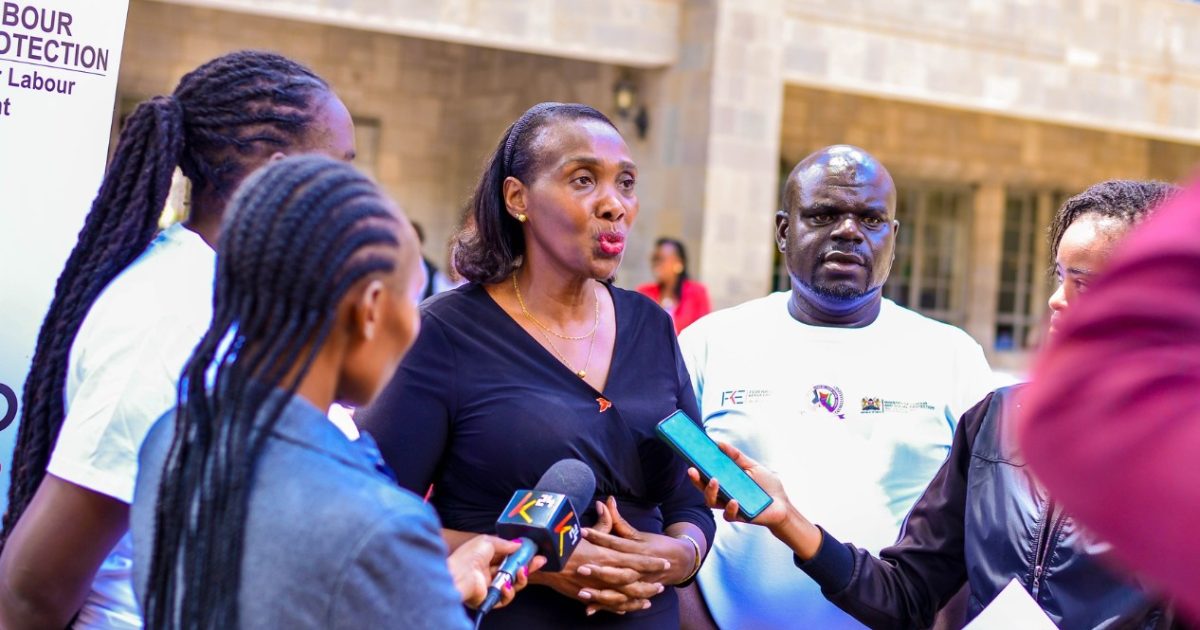
The Executive Director of the Centre for Domestic Training and Development (CDTD-K), Ms Edith Murogo, has called for urgent and sustained reforms to improve the working conditions of domestic and care workers, describing them as among the most vulnerable yet indispensable contributors to Kenya’s economy.
Ms. Murogo made the remarks during a press briefing held at All Saints Cathedral Hall in Nairobi at the conclusion of the national consultation process on International Labour Organization (ILO) Conventions 189 and 190.
Ms. Murogo said the process marked a significant milestone in a countrywide journey that engaged stakeholders across multiple counties in dialogue aimed at strengthening labour protections for domestic and care workers.
She underscored the importance of Kenya’s ongoing consideration of the ratification of two key ILO instruments, Convention 189 on domestic workers and Convention 190 on violence and harassment in the world of work.
Convention 189 seeks to guarantee domestic workers fair wages, reasonable working hours, clear employment terms, social protection, and freedom from abuse, while affirming dignity and equal treatment.
On the one hand, Convention 190 establishes global standards to prevent and address violence and harassment in the workplace across all sectors.
Ms Murogo said the ratification of the two conventions presents Kenya with a historic opportunity to formally recognise domestic and care work as real work while strengthening protections, dignity, and social justice for workers.
“Domestic and care work is the backbone of our society. It is time we match this reality with policy, protection, and investment,” she said.
She expressed gratitude to the government of Kenya, development partners, civil society organisations (CSOs), employers, workers, and all participants who contributed to what she described as a “powerful national conversation grounded in lived realities”.
The consultations were held across the country, including Nakuru, Mombasa, Kisumu, Kakamega, Kiambu, Meru, Garissa, and, finally, Nairobi, forming part of a structured process aimed at strengthening labour protections for domestic and care workers.
“What we have witnessed is not just consultation but a powerful national conversation grounded in lived realities,” she said.
Ms Murogo noted that a consistent message had emerged throughout the consultations: that domestic and care workers, predominantly women, remain among the most vulnerable yet indispensable workers in the economy.
She highlighted challenges including informality, low wages, excessively long working hours, exposure to violence and harassment, and limited access to social protection.
“Yet they sustain households and enable our economy to function. This is not just a labour issue. It is a matter of dignity, justice and human rights,” she emphasised.
Ms Murogo commended the process as a strong model of social dialogue, bringing together workers and key stakeholders, including the Ministry of Labour and Social Protection, the Centre for Domestic Training and Development (CDTD), the International Labour Organization (ILO), the Central Organisation of Trade Unions (COTU), the Federation of Kenya Employers (FKE), AICS, and Youth Alive! Kenya, and other civil society organisations advocating for labour rights.
She noted that the engagement demonstrated the value of inclusive participation in shaping policy, adding that organisations such as Oxfam in Kenya and other partners played a key role in supporting community mobilisation and participation.
She also appreciated domestic and care workers and employers for their contributions and inputs during the consultation process, which she said were central to the process.
Ms Murogo stressed that while the ratification of the conventions would be a major milestone, the true measure of success would lie in implementation.
With the stakeholder consultation process complete, the next phase will see the proposals submitted to the Cabinet for approval before being forwarded to Parliament for deliberation.
She called on the Government and partners to strengthen labour systems, improve access to justice and reporting mechanisms, enhance awareness among workers and employers, and invest in capacity building for all stakeholders.
The Centre for Domestic Training and Development (CDTD) is a dynamic women’s rights movement dedicated to reshaping perceptions around domestic and care work, eradicating child labour, combating forced labour and human trafficking, and ending all forms of violence against girls and women.
CDTD is also championing the protection and empowerment of survivors and upholding their dignity and agency so they can recover and thrive.
She further emphasised the need to ensure that no worker, whether in formal or informal employment, is left behind and called for strengthening essential services supporting vulnerable workers.
She concluded by expressing optimism that the process represented the climax of a shared journey built on commitment, sacrifice, and collective effort.
By Ian Chepkuto