Kenya marked the International Day of Persons with Disabilities (IDPD), with government officials, development partners, and representatives of persons with disabilities underscoring the need for inclusive policies, accessibility, and full participation in social and economic development.
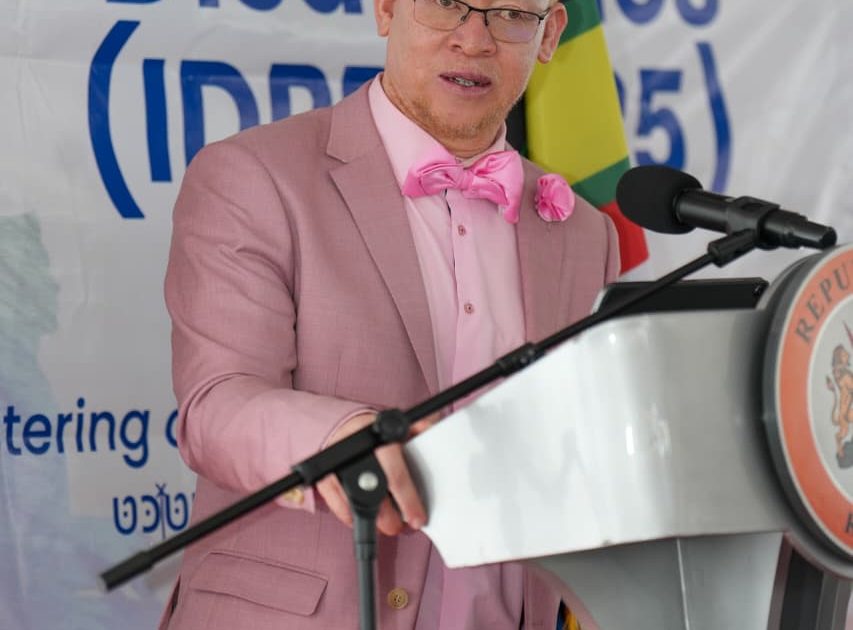
Speaking at the Kenya Society for the Blind in Nairobi, Government Spokesperson Dr. Isaac Mwaura, highlighted the government’s ongoing efforts to integrate persons with disabilities (PWDs) in national development while delivering his weekly government briefing.
He noted that this year’s theme, ‘Supporting Disability-Inclusive Societies for Advancing Social Progress’, reflects Kenya’s constitutional commitment that every citizen should contribute to development without discrimination.
Additionally, Dr. Mwaura announced that the government continues to operationalise the Persons with Disabilities Act 2025, domesticated from the UN Convention on the Rights of Persons with Disabilities.
He maintained that the law strengthens provisions on inclusive education, accessible infrastructure, reasonable accommodation, participation, and institutional accountability in both national and county governments.
“The government prioritises disability inclusion as a cross-cutting agenda under the Constitution and the Bottom-Up Economic Transformation Strategy,” he reiterated.
In addition, Dr. Mwaura highlighted that the strategy ensures PWDs are not left behind in accessing resources, social protection, and economic opportunities, particularly through micro, small, and medium enterprises (MSMEs).
Further, the Govt. Spokesperson revealed that over 50,000 households benefit from government cash transfers under the UNHCR programme targeting persons with severe disabilities, including those with autism, Down syndrome, cerebral palsy, and intellectual disabilities.
“The government has also raised the age for youth disability beneficiaries from 29 to 35 years to ensure inclusivity for late-starters,” he added.
Notably, Dr. Mwaura reported progress in education and healthcare for PWDs, citing improved learning resources, teacher support, and ICT-based tools at institutions such as Sika Primary School for the Blind and Sika High School for the Blind.
He added that more specialised teachers are being trained, and community-based rehabilitation programmes now provide assistive devices and mobility aids at primary healthcare facilities.
On governance and representation, Dr. Mwaura observed that persons with disabilities are increasingly occupying leadership positions citing commissioners at the National Gender and Equality Commission (NGEC) and Public Service Commission, as well as MPs, Senators, and Judges who are PWDs.
The Govt. Spokesperson insisted that such representation strengthens inclusion and enhances equitable access to decision-making structures.
“Persons with disabilities must be enabled to participate fully in society. Inclusion reduces the burden of care and allows individuals to contribute meaningfully to national development,” stated Dr. Mwaura.
Importantly, he called for deliberate action from all sectors to remove barriers to education, employment, healthcare, and civic engagement.
Rehema Jaldesa, National Gender and Equality Commission (NGEC) Chairperson called for stronger enforcement of disability rights.
She urged the government, county administrations, and private sector actors to fully operationalise the Persons with Disabilities Act 2025, ensuring that resources, accessibility standards, and affirmative measures are effectively implemented.
“The Commission calls for multisectoral action to foster a disability-inclusive society and advance social prosperity,” rallied Jaldesa in a speech read on her behalf by Dr. Purity Ngina, CEO of NGEC.
Equally, the Chairperson outlined that opportunities exist to mainstream disability inclusion across policies, budgets, and planning in education, health, housing, transport, digital platforms, and social protection.
She also urged development partners and civil society organisations to strengthen disability-inclusive programming and support the participation of persons with disabilities in governance and community development.
Speaking at the event, Mathias Kamp, Country Director of Konrad Adenauer Stiftung (KAS), emphasised the importance of inclusive governance and democratic engagement, noting that minority groups, including persons with disabilities, must have a voice in decision-making.
Kamp highlighted KAS initiatives aimed at promoting inclusion through accessible events, scholarships, and fellowships for PWDs.
“Inclusion is not charity; it is the right of every person to participate in society. Democracy is meaningful only when it protects the rights of minorities, including persons with disabilities,” Kamp asserted.
He confirmed that KAS will continue partnering with the Office of the Government Spokesperson to advance inclusive communication and accessibility in all governmental and civic engagements.
Brigid Songok, nominated MCA representing PWDs in Nandi County and Chair of the UDA Disability Caucus, addressed the gathering, calling for attitudinal change alongside policy implementation.
Songok urged society to view PWDs as leaders, innovators, and contributors rather than objects of charity.
She also stressed the importance of accessible infrastructure, assistive devices, and meaningful participation of PWDs in governance and development.
“True social progress will only be achieved when every person, regardless of ability, has the freedom, support, and opportunity to live a full and dignified life. Inclusion must be structural, not symbolic,” she demanded.
Songok also acknowledged partnerships with educational institutions such as the Kenya School of Social Work, which provide assistive devices and training to PWDs in county-level programmes.
Meanwhile, Dr. Mwaura reiterated the government’s commitment to strengthening the Interagency Coordination Advisory Committee, which brings together ministries, departments, agencies, constitutional commissions, and PWD organisations to harmonise efforts across sectors.
He said inclusive participation in decision-making ensures that PWDs contribute to the formulation and implementation of policies affecting them.
Similarly, Dr. Mwaura also highlighted government initiatives to improve social protection and economic empowerment for PWDs, including training county disability champions, establishing inclusive development frameworks, and providing funding for disability units and programmes.
The Govt. Spokesperson observed that these measures promote participation, reduce dependency, and enhance the visibility of PWDs across public and private sectors.
On the other hand, he highlighted progress in political representation, noting that recent elections resulted in increased PWD representation in Parliament, Senate, and local governance.
He cited examples of MPs, senators, and civil society leaders with disabilities who have championed inclusion and rights for their communities.
Ultimately, Dr. Mwaura called for a sustained national effort to integrate PWDs in all spheres of society, reaffirming that collaboration between government, civil society, political parties, and development partners is key to building a truly inclusive republic.
The event reaffirmed Kenya’s commitment to constitutional principles of equality and non-discrimination, underscoring that national development is achievable only when no citizen is left behind.
by Naif Rashid